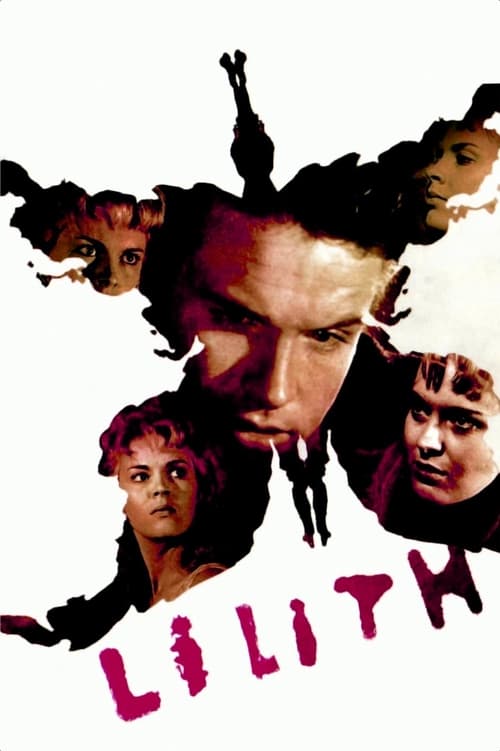
Oh if only Warren Beatty had been a stronger actor, and was able to bring some nuance to the part of Vincent - the war vet who takes a job at a sanitarium and gets too involved with a female patient. If he was able to convey the idea of a man going from point A to point B during the course of the film – and gradually falling to ruin after betraying his core principals - this movie might have had more of a punch. The director, Robert Rossen, felt that “Vincent's progression from "normality" into psychosis was unconvincing because Beatty's acting implied psychosis from the start.” I agree, and because of this, the damage he causes at the end doesn’t have the impact it should. His downward spiral isn’t as shocking. So watch the film for Jean Seberg, who gives the performance of her career. She delivers a convincing unworldliness to the role of Lilith. The things she says and the way she says them, carry a strange alien lyricism. But just about the time you think she might simply be an eccentric spirit, odd but okay, she does something disturbing (as in her inappropriate behavior towards young boys)Jean was proud of her work in the picture, and said that she didn’t want to portray madness that was full of screams and yells and wild faces. She’s quoted in the book "The Films of Jean Seberg" as saying, “Madness is like a camera that goes in and out of focus - Now sharp, now fuzzy.” She continued, “Here were all these lost, brilliant, sensitive, kind people, and suddenly they’d just go out of focus. There was this irrational violence just below the surface, and it was frightening – the way a high strung horse is frightening when you know he can’t control himself.” Seberg brought all that to bear in her acting.That also sums up the movie in a nutshell for me, it flitters in and out of focus.
"Do you think they can cure this fire? Do you know what they have to cure? She wants to leave the mark of her desire on every living creature in the world."Hired as an occupational therapist in training at an upscale psychiatric hospital by Dr. Bea Brice (Kim Hunter), aimless young veteran Vincent Bruce (Warren Beatty) gradually loses his grip on reality after becoming moonstruck over ethereal nymphomaniac patient Lilith Arthur (Jean Seberg). Peter Fonda features more often than I'd prefer as Lilith's suicidal, nebbishy lapdog Stephen Evshevsky. Jessica Walter and Gene Hackman also pop up in an extraneous cameo as a dysfunctional married couple.Based on a 1961 novel by J.R. Salamanca, Lilith is the final feature to be directed by former blacklist victim Robert Rossen (who also wrote and produced the film), missing with both audiences and critics for the most part. To be fair I'd say it does more than simply answer the momentous hypothetical, "What if Michelangelo Antonioni had directed The Cobweb instead of Vicente Minnelli?", but not a lot more. As with the last film I watched, most of its allure lies in the airy black-and-white cinematography—this time courtesy of German legend Eugen Schüfftan. Despite the sub-Freudian idiocy of Lilith's diegesis, the location-based production (set in Maryland though filmed primarily on Long Island) is often successful in evincing an unearthly aura. A game Seberg plays the mad siren role for all it's worth (not much—not her fault), which only highlights the palpable indifference on Beatty's part. Beatty had originally signed on to another Rossen project set in Cape Canaveral, which ultimately failed to materialize. After much dithering, Beatty reluctantly took the role of Vincent because he was $10,000 in debt and looked up to Rossen as an accomplished filmmaker. The early rapport between star and director allegedly vanished shortly after shooting began. In fact, according to Beatty's biographer Peter Biskind, the flighty star was roundly disliked by cast and crew alike. In a letter to a friend, Seberg's appraisal was unsparing, "Warren Beatty's behavior is just unbelievable. He's out to destroy everyone, including himself." Fonda reputedly tried to convince revelers at the wrap party to throw Beatty into the swimming pool. Rossen's judgment was harshest of all—not surprising, given that he clearly had the most to lose. Tense standoffs between the two were a daily hurdle, and assistant cameraman Tabor Sands even claims that the terminally-ill Rossen (who was briefly a professional boxer in his younger days) once slapped Beatty in the face on a crowded set; by the time of Rossen's premature death in 1966 he had obviously not cooled on the matter, "If I die, it'll be Warren Beatty that killed me." Some stray notes:-THERE'S NOTHING WRONG WITH CURING SICK PEOPLE…OR IS THERE?-SHE'S LIKE ALL OF THEM; IT DESTROYS THEM TO BE LOVED-DO YOU FEEL CLEANER NOW? DO YOU THINK I INFECTED YOU?-ENTERTAINING ECCENTRIC SPINSTERS, PUSHING WITLESS GIRLS ABOUT-I SHOW MY LOVE FOR ALL OF YOU, AND YOU DESPISE ME-HOW CARELESS JOY CAN MAKE US, AND YET HOW WONDERFUL
Lilith tells a dark story, one interested in blurring the boundary between “sane” and “insane”, in a film that suggests there’s maybe not too much daylight between each. The troubled, increasingly unhealthy relationship here between Jean Seberg’s mental patient and Warren Beatty’s trainee has intensity that plays almost as a dark fairytale, all that heavy imagery and moody cinematography different to what sorts of things even the people involved were making at the time. I’m most familiar with director Robert Rossen’s style from The Hustler, and this shares a focused look at what makes people tick, only pushed a lot further here. There’s a kind of Gothic sensibility to this one, something that matches the fractured headspace of nearly every character in this story one way or another. It’s a film where everything is heightened, which Seberg’s beguiling fragile magnetism matches. She leads to some of the most compelling, and disturbing moments of the whole film, Lilith a broken force of nature drawing in the people around her so they can never quite go back to how they were before. I think that more abstract approach also hinders this; it’s meant to be darker, more offbeat take on a romance story, but each character feels more like a concept than a fully rounded person. While partly the point, it flattens out a lot of what this is trying to do, going for depth but winding up in more self-conscious dirge territory that wears thin by the end. There is something quite intriguing about the shadow world explored here, Beatty a man drawn into a connection with a patient who doesn’t realise what he’s getting into. There’s a power shift always going on, and it’s effective at always leaving you off-kilter, but I think this one feels shallower than it should, not enough under its box of tricks. While compellingly not quite like any other film, the trade-off is that it almost tunes you out after a while, the artsiness both a draw and a drawback. As the incidents stack up and the “what’s real and what’s not” feel increases, something vague and overly morbid weighs the runtime down, boldly trying something different but a bit monotonous in practise really. It’s a film that wants to go into troubled minds, but without fully exploring these people, a lot of this one ends up feeling done for the sake of it, the foundations not quite there to properly dig in. Really impactful moments are surrounded by a story that never quite convinces, bigger shock moments that don’t quite stack into a full movie in its own right.