

this whole movie feels like when you tell a joke and no one hears it but then someone repeats it louder and everyone laughs
Simon ist ein Durchschnittstyp, aber er selbst findet das okay. Er geht jeden Tag mehr oder weniger pünktlich zu seiner Arbeit, die schon seit Jahren mit keinen echten Überraschungen aufwarten konnte - bis der neue Kollege James eintrifft, der charakterlich so gar nicht zu Simon passt, im Gegensatz zu der Tatsache, dass er Simon äußerlich bis aufs Haar gleicht. Simon ist zuerst fassungslos, dass niemand zu sehen scheint, wie sehr sich James und er gleichen, ärgert sich bald jedoch noch viel mehr darüber, wie viel beliebter James bei den anderen Mitarbeitern ist. Außerdem scheint die liebreizende Kollegin Hannah ein Auge auf James geworfen zu haben, wo doch Simon ihr seit Jahren hinterher schmachtet. Doch der anfängliche Schock verfliegt mit der Zeit und er und sein Doppelgänger werden Freunde... vorerst!
The Double läuft in 1 Kino in New York City - nächste Vorstellung Dienstag, 13. Oktober um 21:40 im Metrograph.
Nächste Vorstellungen: Dienstag, 13. Oktober.
Vollständiger Spielplan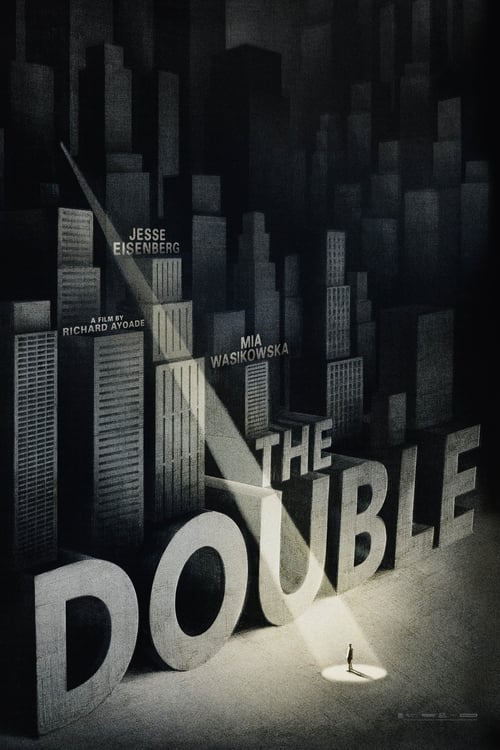
Spielzeiten zu The Double, jeden Morgen aktualisiert
Wähle dein Kino und bekomm einen Hinweis, bevor der Film aus dem Programm fällt.
this whole movie feels like when you tell a joke and no one hears it but then someone repeats it louder and everyone laughs

i feel like jesse eisenberg did this movie because he was jealous that armie hammer got cloned in the social network (2010) and he didn’t

"I like to think I'm pretty unique."I have a theory. You know what that means? It's time for Silly Psychoanalysis with Screening Notes! Everybody get your Silly Theory Hats on! I'm going to be analyzing what I see as the film's psychological core. If you're looking for a more traditional (and spoiler-free) review, try my previous entry for the film. On this second viewing I bumped up my rating by half a star and the film snuck into my top 10 for 2013. I still have a few minor problems with it (some of the jokes still fall flat for me and the characters occasionally lapse into clichés), but overall I think it's an exceptional little movie. It's evocative, intriguing, and most of all funny. Let's get on with the theory then.Today I'm going to look at similarities between the beginning and ending of the film, with particular focus on how Simon changes over the broad course of the narrative. There will also be spoilers for Fight Club.At the beginning of the film, Simon is shy and withdrawn and seems to have no direct access to his own enjoyment or pleasure. He is never allowed to be emotionally satisfied. Even his sentimental reveries, highlighted by the film's soundtrack, are interrupted or cut short. Simon knows this about himself, and phrases his frustration thus:"I don't know how to be myself. It's like I'm permanently outside myself. Like, like you could push your hands straight through me if you wanted to. And I can see the type of man I want to be versus the type of man I actually am and I know that I'm doing it but I'm incapable of what needs to be done. I'm like Pinocchio, a wooden boy. Not a real boy. And it kills me."Simon is incapable of being the man he wants to be, despite his recognition of the failure. His agency is somehow short-circuited. He knows how he wants to change himself, but is held back from doing so, as if his mind has been separated from his body.James, on the other hand, is the exact opposite of Simon. He succeeds in all the ways Simon fails. But if James embodies the man Simon wants to be (or at least a caricatured version thereof), then he also embodies the deadlock preventing Simon from becoming him. Through his interactions with James, Simon's exasperation reaches its peak and he decides to kill James. Simon and James share each other's injuries, so Simon hand-cuffs James to his bed and jumps off his balcony. The fall is enough to be fatal if not properly looked after, and while Simon is taken to the hospital, James is left to die. Before jumping, however, Simon goes to Hannah and tells her "I don't want to be a boy held up by string," a reference to his previous speech and an indication that he is finally taking control of his life.So how did he manage to do this? How does he overcome his emotional deadlock? The answer lies in the particularity of the way Simon decides to kill James.Simon doesn't just kill James, he kills him by (almost) killing himself. There is a direct parallel between the way Simon kills James and the way The Narrator kills Tyler Durden (his hallucinatory double) in Fight Club. The Narrator shoots himself in such a way that is not quite fatal, but the suicidal appearance of his act is enough to eliminate Tyler Durden as a psychological manifestation. But more important than killing Tyler, this act also represents The Narrator's transition into being the person he wants to be. He is not only killing his (imaginary) double, he is eliminating the psychological deadlock which held him back from self-actualization. In the same way, when Simon jumps from his balcony, he is not only killing James, but is also killing the part of himself which holds him back from being the man he wants to be.In Lacan and Contemporary Film, Slavoj Zizek explains this phenomenon:"When we are subjected to a power mechanism, this subjection is always and by definition sustained by some libidinal investment: the subjection itself generates a surplus-enjoyment of its own. This subjection is embodied in a network of 'material' bodily practices, and, for this reason, we cannot get rid of our subjection through a merely intellectual reflection. Our liberation has to be staged in some kind of bodily performance, and, furthermore, this performances has to be of an apparently 'masochistic' nature; it has to stage the painful process of hitting back at oneself."Simon is incapable of changing himself merely through "intellectual reflection"—he knows what he's doing but feels he has no power to change it—because he has some "libidinal investment" in the power structure which subjects him. He likes looking at Hannah from afar, he likes looking up to Mr. Papadopoulos, perhaps he even likes having something to blame for his failures and insecurities. In a strange way, it is his own fault that he can't change. He feels powerless because of his own enjoyment in being subjected, and for this reason his final act of defiance must be directed at himself. In order to destroy the part of himself that James embodies, he must attack himself, not James. In order to change himself, his violence must be directed inward.2013 | Multiple Watches in 2014Previous review
Ein isolierter und schüchterner Büroangestellter verliert den Verstand, als ein charismatischer, identischer neuer Mitarbeiter an seinem Arbeitsplatz auftaucht und sein Leben systematisch übernimmt.
The Double wurde 2013 von dem britischen Filmemacher und Komiker Richard Ayoade inszeniert, nach seinem Debütfilm Submarine.
Ja, der Film ist lose an die gleichnamige Novelle von Fjodor Dostojewski aus dem Jahr 1846 angelehnt.