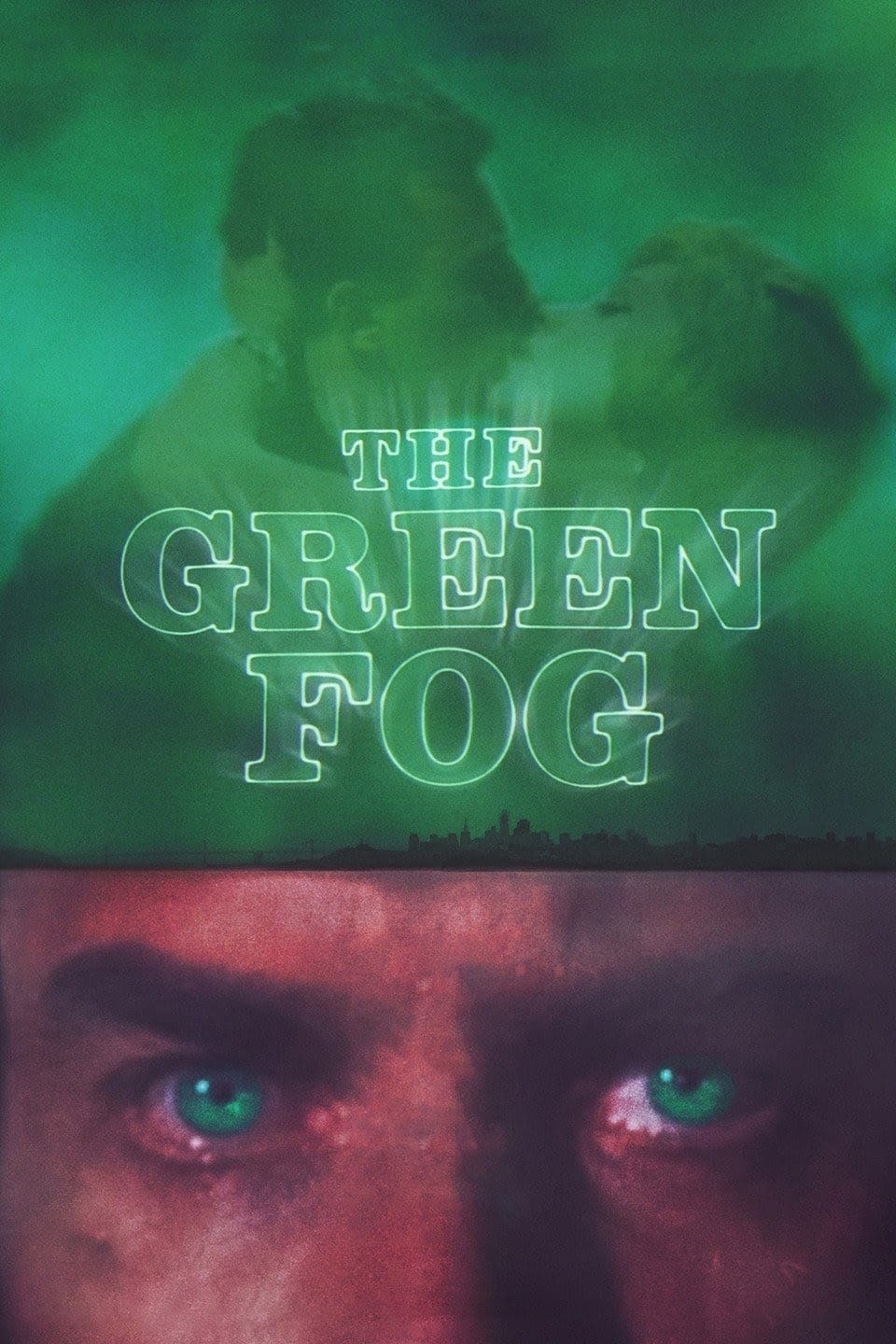
In 1998, Gus Van Sant released a shot for shot remake of Hitchcock’s Psycho. It was an interesting academic exercise, and somewhat only interesting because it was so terrible. The idea that you can copy something almost exactly (bar some silly additions - and the realities of modern casting (oh, and colour)), yet still not capture its soul, its essence or its form, is a tantalising fact that reveals the true nature of cinema.Filmmaking is more than a science, it is an art. There is something alchemical about cinema.However, in 2017, the combined genius of Maddin, Johnson and Johnson did something far more interesting - something that’s almost the antithesis of what Van Sant did. This film, or this project, is a remake of Hitchcock’s Vertigo made out of footage from other films and television shows. It is fascinating.The film was financed as a celebration of San Francisco. Using archive footage of the city was the only brief for these eccentric filmmakers. This opens up the door to boundless creativity though, and led them to Hitchcock’s celebrated classic. Therefore, to explore the city, Vertigo, being one of the city’s most famous depictions, becomes a backbone. In remaking Vertigo we explore some astonishing ideas. The wealth of footage, from only SF based films, gives us an idea of how so many films trade in the same material. We see the codes and conventions of genre echo in front of us as we experience cinema as a shared language. The frames of films become letters, malleable to any grammatical construction, and their combinations become words and sentences, which shows the flexibility of cinema as well as its rigidity. Why do we come back to the same ideas and moments time and time again? Why can disparate scenes feel so cleanly and logically linked? The politics of cinema are also laid bare. The echoing situations and conflicts show how cinema likes to deal with detain situations. Some of this is how we so often deal with verticality and peril - with visceral thrills. Rooftop chases are made of so many sequences, whereas more prosaic or emotional sequences often hang on specific films longer - or feel more jarring when they cut. This isn’t an issue, this is actually fascinating. We realise that cinema echoes itself in some areas but doesn’t when it is perhaps more human. Is this good or bad? Well, it’s certainly worth considering.The really interesting political element is how it factors in the male gaze. Vertigo is famous for some for confronting the male gaze, and infamous for others for just conforming to it. Even Maddin, when talking about this project, spoke about how any subversion in Vertigo was done through conformance. Here, he doesn’t so much take Vertigo to task but puts film on trial. The ending sequence is a vertiginous spiral of quick cutting scenes of male dominance and echoing gender dynamics. We cut from film to film and see the same hierarchies, the same expressions, the same gendered roles. It is a shocking culmination and a smart revelation of how regressive elements in films are small threads in a much more troubling tapestry. And how this makes it worse.But then, this film is also fun. Really fun. It is a playful and eclectic exploration of cinema and TV where you can play spot the film (you get a full list at the end - it’s a wide range) and giggle with delight at the creativity. This is such an intelligent work but it is also roguish and charming. Its academic nature is rigid but is in concert with an accessible and surface level fun that makes it even more special.This is a brilliant experiment, a clever thesis and a real open ended exploration. It shows how cinema plays on the same scale yet produces so may results. Yes you can make Vertigo out of other films. But you also can’t make Vertigo out of other films. And these joint statements being equally true is the brilliance here. And it even carries into the music: a new score that flirts with the original, evoking it, yet is completely novel at the same time. Because that’s cinema. It is shared logic. It is repetition. It is the same combinations in the same way again and again and again.But filmmaking is more than a science, it is an art. There is something alchemical about cinema.
[7]First things first: this work is a commission by the San Francisco Film Society, celebrating their film festival's 60th anniversary. Jacob Garchik was also commissioned to compose an original score which was played live at the premiere by the world-famous Kronos Quartet. (It is a recording of their performance that accompanies The Green Fog out into the larger world.) So this is a bit different than Maddin's usual métier.It's also very different from The Forbidden Room, Maddin's first directorial co-credit with brothers Evan and Galen Johnson. The Johnsons are primarily editors and image-manipulators, said to be largely responsible for the faux-chemical warps and distortions that helped make Forbidden Room such a palpable labyrinth of interconnected narrative space. By contrast, The Green Fog mostly presents its source images as they were found, with the exception of an occasional encroachment of literal green fog.Having said all that, I hope my point is clear. At this stage in his career, Maddin has mastered a particular form of filmmaking, and has garnered significant approbation for it. But instead of simply generating more of the same, his newest work finds him taking on new collaborators, trying radically new things, and broadening his formal repertoire. In every way, The Green Fog is the work of a bold, forward-thinking artist, and it's a great pleasure to see Maddin and the Johnsons going out on numerous conceptual limbs here.The film is a found footage montage, something that Maddin has never to my knowledge done before. Using clips from various films and TV shows set in San Francisco, the Johnsons and Maddin have made a mostly wordless, abstract tone-poem version of Vertigo, the greatest San Francisco film of them all. Through the condensation and abrupt gestures of montage, The Green Fog actually covers the entirety of Vertigo in just over an hour.The film's prologue is probably its most successful section, primarily because in it, Vertigo is evoked rather than retold. We get images of shipyards, wandering detectives, and lonely, bereft woman, all gently melded into a broad ideational field. After this, the narrative of Vertigo quite literally kicks in, with rooftop chases, dangling cops, and various Scotty stand-ins confined to chairs.Granted, no one speaks. (In one of the film's odder affectations, lengthy scenes of conversations are often allowed to play out, only with the speech edited out.) But often there is a sense of frustration at just how easily a film as singular as Vertigo can be remade using other films, some of them not very good. It speaks to a reciprocity of genre, I suppose, how Hitchcock employed certain common tropes and embellished on them, while TV shows like "Streets of San Francisco" or "McMillan and Wife" simply imbibed Hitchcock as a basic style.Nevertheless, The Green Fog is more than just a Vertigo-based version of Marclay's Clock. Maddin and the Johnsons continually highlight the trope of specularity that haunts Scotty, and by extension Hitchcock's whole enterprise, by breaking their own film open to comment on our watching of it. Certain key moments, for example, are transformed into police surveillance sessions, with cops pausing, rewinding, and fast forwarding the video, or actual film in some cases. The Green Fog demands that we see ourselves seeing.And it also reminds us that our temporal distance from Vertigo and the instantaneity with which we can access virtually all of film history, puts us in an awkward but powerful position. For the Muir Woods sequence, Maddin and the Johnsons put two clips side by side: the "I come from here" scene from Marker's La Jetée and NSYNC's video for "This I Promise You." It would seem to be a case of the sublime meeting the ridiculous. But if Justin Timberlake were in that control room, he'd point just to the side of that video monitor, saying "I come from here." And in fact, we all do.
64/100Really wonder whether I'd ever have tumbled to what this film is doing absent any foreknowledge of its conceit. (If you're told only that it's riffing on a classic, figuring out which classic is child's play. But if you didn't even know that? I like to believe that it would have dawned on me eventually, but perhaps I flatter myself.) Rewatched Vertigo immediately beforehand, and I'd recommend that you do the same if it's been a while; there are some very specific references that I'd certainly otherwise have missed. Ultimately, though, I was less interested in the film's rough scene-for-scene collage (which often feels a bit Chuck Workman-y: "Here are a bunch of shots from throughout cinema history of characters looking at paintings") than in some of the generalized avant-garde touches, e.g. editing the dialogue out of conversations while retaining all of the preludes to speech, like intakes of breath and sudden changes of expression. Makes for an eerie facsimile of communication, which is obviously germane to the project as a whole. Some great jokes, too, from individual substitutions (Madeleine jumping into the bay is represented by some dude stumbling and falling into a swimming pool) to the glorious sequence (FYC, Best Scene) that depicts Scottie's catatonia via multiple static shots of Chuck Norris. Slight, but fun. Be sure to stay for the end credits, which reveal all of the sources, rapid-fire, in what amounts to a moving version of this Twitter feed.