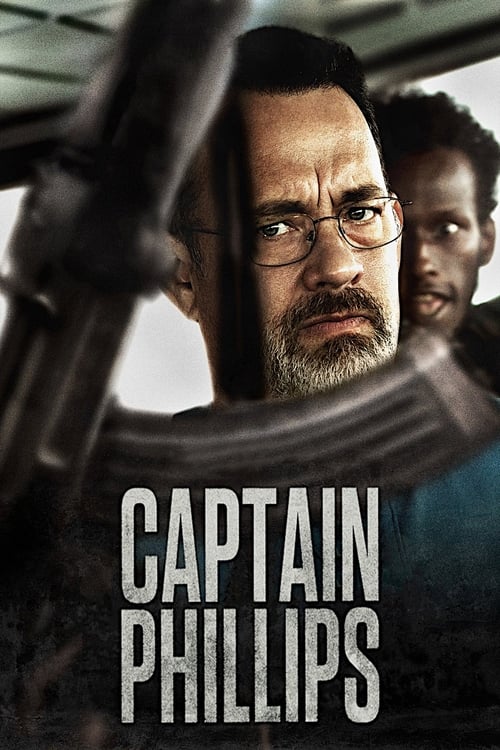
There is a moment early on in Captain Phillips when the American captain and Somali pirate leader look out through their binoculars at the same time and end up staring right at each other. Captain Phillips immediately recoils, looking visibly shaken. But the pirate continues to stare.A while later, when the pirates take over the ship, the pirate leader tells Phillips: look at me. Look at me. I'm the captain now.And that's when you realize that the central focus of the film isn't Tom Hanks, and it isn't a bunch of Americans being all noble and brave. The core of the film, the central energy, is the four young Somali pirates and their desperation, their thirst to prove themselves.That's why Captain Phillips is ultimately so effective. There are no bad guys in this story; there are just humans and global politics, and what happens to men who are mere pawns in the big scheme of things.Captain Phillips is one of the best action films I've ever seen. It builds up tension relentlessly and provides action sequences so pulse-pounding that the sight of animated bad guys smashing buildings to smithereens will be even less effective on me from here onward.Tom Hanks is sidelined for most of the film, but in the final fifteen minutes he shows why he's regarded as one of the greatest living American actors. It's hard not to tear up when he's almost insensible with shock, so disoriented that he has to think a moment to remember his own name.And the Somali pirates are just brilliant. It's hard to believe that they're first-time actors. How can you possibly explain the steely intensity of Barkhad Abdi's gaze, the way he becomes a real human being despite the fact that he's given nearly no backstory? And what about the other three men, who seem just as real, unpredictable and frightening, but always painfully human?Of course, there are some considerable flaws in the film. The opening scenes are clumsy and heavy-handed, making you doubt whether or not this'll be a film worth your time. The shaky-cam also seems oddly amateur and made me feel rather queasy, even though it fits a film like this one. But ultimately, these flaws can be overlooked because the film offers so much more than the average Hollywood action film.The best thing about Captain Phillips, and the thing that differentiates it from other realistic thrillers like Argo and Zero Dark Thirty, is that it avoids the pitfalls and cliches of jingoism and instead chooses to show both sides of the coin. Much of the film is subtitled, but after some point it stops feeling as though it is. Argo didn't even give its Iranians the dignity of being understood by the audience through subtitles.After we watched the film, my father said that Captain Phillips was probably so balanced because the director was British, not American. That may be true, but it also reveals a painful truth about human nature - you learn that there are no bad guys only after you lose.The British ruled the world for centuries, and left so much of it in shambles (I'm Indian; believe me, I know). It's only now that some of them can gain such an egalitarian perspective on people, to realize that they had ruled over humans, not commodities.But the actors in Captain Phillips are American, as is the screenwriter and the studio that produced the film. The audience that made it successful is American too, and it gives me hope that despite the USA's brand of unofficial colonialism, some individual Americans already know that people are people no matter which country they live in.Captain Phillips is about a lot more than an American captain taken hostage by pirates. It makes viewers feel as though they've been through all that trauma themselves. It's so visceral and startlingly authentic that it's almost painful to watch, and it's gripping from start to finish. It's a great cinematic experience, and undoubtedly one of the best films of 2013.
A macro-economic horror story in the guise of an exceptionally harrowing hostage thriller, Paul Greengrass’ “Captain Phillips” dramatizes a 2009 incident in which a small band of Somali pirates hijacked an American cargo ship, a siege that has since become emblematic of the recent rise in similar armed attacks. Anchored by a compellingly candid titular performance by Tom Hanks (his best on-screen work since “Catch Me if You Can”), Greengrass’ latest recreation of recent history’s most vividly violent events is not – as its awkward opening moments might first suggest – just another Hollywood celebration of American bravado at the expense of faceless third-world foreigners. On the contrary, “Captain Phillips” is not only a masterful action movie that breathlessly and believably re-stages a tense standoff at sea, but a resonant portrait of systemized financial imbalance trickling down into the water. While this is arguably Greengrass’ best film, it’s almost certainly his most urgent.The film’s ungainly first scene is less of a personal introduction than it is an economic one, acquainting us with the strikingly ordinary Captain Rich Phillips on a gray spring morning as he prepares to leave his quaint Vermont home for his latest international assignment. The Captain’s wife (the great Catherine Keener, appearing here in a perfunctory cameo that only feels necessary in retrospect) drives him down the interstate in their minivan, depositing her husband at the airport and sending him across the planet with a kiss and a plea to return safely. Billy Ray’s script then transports us to the shores of Somalia, where the naturally gaunt Muse (first-time actor Barkhad Abdi in a brilliantly convincing performance) and a few other gun-toting men from his village volunteer their services as mercenaries for a local warlord. Less than a few minutes of screen time later, Muse and his fellow pirates make their first attempt to plow their ramshackle skiffs through the choppy wake of Captain Phillips’ hulking cargo ship. Their plan, assuming they’re able to climb aboard the corporate vessel, is to hold the blue-collar crew hostage for $10 million. Of course, if the movies have taught us anything about the hostage business, it’s that things seldom go according to plan.The collision between first and third world is set up with a didactic inevitability reminiscent of more conventionally entertaining fare like “Warrior”, but there’s nevertheless a palpable truth to the marked contrast between two men going to work at very different jobs. Neither Muse nor Captain Phillips are revealed in great detail, as both are chiefly defined by circumstance and the available means by which they might take advantage of their strengths and respective educations to earn a living wage. Little is done to wring the viewer’s sympathy for Muse (he doesn’t have a dying younger brother in desperate need of expensive medical care or anything like that), and just as little is done to demonize him. More crucially, Ray’s script doesn’t attempt to forcible redistribute whatever natural favor Western audiences might have for Captain Phillips towards Muse in the third act – central to the film’s power is how Ray mercifully assumes that the audience respects Muse’s basic humanity, the story refusing to repeat the mistakes of “Fruitvale Station” and spend its duration earning an empathy that ought to be self-evident.Shot in Greengrass’ signature hectic and handheld style aboard ships identical to the ones on which the incident actually occurred, “Captain Phillips” becomes a relentlessly anxious experience from the moment the Somali skiffs first blip onto the outer edges of the freighter’s radar. The narrow, labyrinthine corridors of Phillips’ freighter naturally are a perfect compliment for the unmoored intimacy of Greengrass’ style – “United 93” proved that the “Bourne Supremacy” director could subdue his fetish for shaky-cam, but “Captain Phillips” introduces more complex spaces and simultaneous planes of parallel action, and Greengrass is more than up to the task. In much the same way that the introduction of 3D to the “Transformers” franchise forced Michael Bay to make the action in “Dark of the Moon” markedly more coherent than it was in the series‘ previous installments, “Captain Phillips”’ powder keg suspense and its attendant sense of false calm provide the circumstances Greengrass’ required to marry the documentary immediacy of his compositions with a tactically precise sense of organized space.The viewer always knows what they’re seeing and how it relates to the surrounding environment – because we feel endowed with the same visual information as the characters, we feel confident enough to consider what each party’s next move should be, Greengrass’ direction finally achieving the immediacy that many “verité” filmmakers wrongly assume is implicit to their approach. As a result, “Captain Phillips” is a film so tense that it makes “Gravity” feel like a foot massage. If the film’s New York Film Festival premiere was any indication, many viewers will be moved to tears as the centrifugal force of the narrative finally tapers during the end credits, the accumulated weight of the trauma they’ve just witnessed sinking unto their shoulders.Minor spoilers for this true-life story follow.Ultimately, however, “Captain Phillips” transcends the taint of hollow spectacle that so often accompanies docudramas about recent events because Ray and Greengrass both understand that this isn’t a film about how these men will get escape from one situation, it’s a film about how they’ll always be victims of another. While some (otherwise astute) reviews have cited the film as yet another beaming portrait of American exceptionalism, it’s a bit myopic to think that the film equates right with might. In fact, the force and precision of the U.S. Navy (who eventually enter the picture from sea and sky alike, wielding all sorts of overpowered weaponry) embarrass the feeble and panicked Somali squad to such an extent that the film’s climactic moments, terrifyingly stressed as they are, are also morbidly comedic. One of the pirates is a 16-year-old kid who hijacks Captain Phillips’ freighter barefoot because he can’t even afford sandals – the sniper who has the kid in the sight of his night-vision rifle arrived on the scene by parachuting from a stealth fighter. This isn’t David vs. Goliath, this is the Washington Generals vs. the Harlem Globetrotters.America’s armed forces have every conceivable tool required to defuse this kind of situation – they’ve done it before and they’ll do it again. But for all of the billions upon billions of dollars that we spend on our military, we still can’t spend our way out of the deeply ingrained economic disparity that stratifies our planet into different financial worlds, that forces children to become soldiers and men to become pirates. Americans are experts at scooping water out of a sinking ship, if only we knew how to plug the leak. While the food aid on Captain Phillips’ boat would surely have saved a handful of lives had it reached its final destination, the compromise implicit in Muse’s ultimate fate is damning proof that some solutions are just bigger problems in disguise.