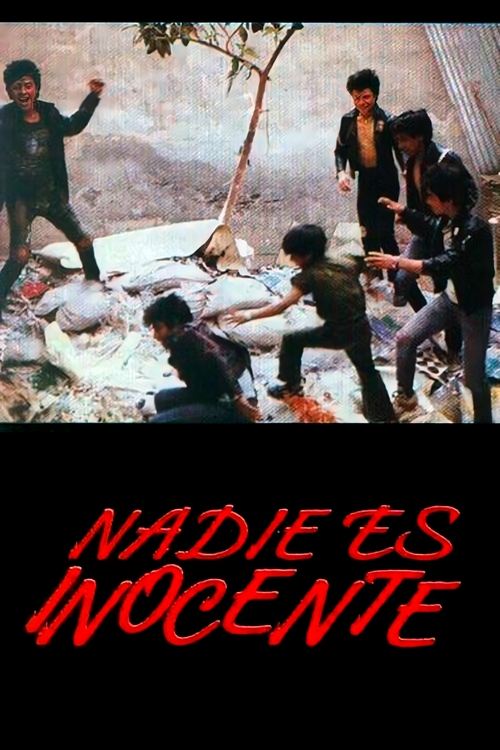
Nobody is Innocent is a terribly sad docu/drama/video art piece running less than an hour, about punks in Mexico City. Starring and assisted creatively by members of the Mierdas Punks — who play themselves — it's a film about belonging, anger, and the lies we tell ourselves and one another to keep going. All the punks have is each other, and they bond through the crucial signifiers of style and rhetoric, at once shaping and revealing their ideology through music, clothes, and obligatory, tribal violence. They pose and they posture and they dream of the day their rejection of the mainstream world around them somehow creates change — of the power of making "the whole society want to vomit." And they get high and try to forget about all of it, escaping through chemicals the uncaring, cruel reality from which even their comrades cannot protect them.⏩ 52 Films by Women: 2024 | 2023 | 2022 | watchlist
Punk: a style and a look in the UK and US — but the bare fact of life in Latin America. Buñuel saw it in 1950, so does Sarah Minter in the 1980s. Luis does Subida al cielo, Sarah makes Descenso al Infierno. No judgment on either of their parts — the lostness, the ringing affirmation that politically we operate by the aesthetics of hunger, overwhelms the soul who craves a connection. But why ask for that? Merely that? That won't stop the Dior clothes gathering in garbage heaps at the edge of town: tomorrow's vintage.The shocking discovery of these films on the Criterion Channel unnerves me. Their existence on such a platform unnerves me.Glauber Rocha, 1965: "Thus, while Latin America laments its general misery, the foreign observer cultivates a taste for that misery, not as a tragic symptom, but merely as a formal element in his field of interest. The Latin American neither communicates his real misery to the 'civilised' man, nor does the 'civilised' man truly comprehend the misery of the Latin American."Kara, de las Mierdas Punk: "Love doesn't exist. I've hardly ever felt it. I felt it once and it was crazy. But it wasn't really love. Love is what you feel for a dog, a cat, an image."Glauber: "Our originality is our hunger and our greatest misery is that this hunger is felt but not intellectually understood. [...] We know — since we made those ugly, sad films, those screaming, desperate films in which reason has not always prevailed — that this hunger will not be assuaged by moderate government reforms and that the cloak of Technicolor cannot hide, but rather only aggravates, its tumors. Therefore, only a culture of hunger can qualititatively surpass its own structures by undermining and destroying them. The most noble cultural manifestation of hunger is violence."
No puedo aguantar tanto nihilismo, me quiero arrancar las pestañas solamente de pensar en que este filme es la punta de la madeja de estambre enredada que nos conduce a más y más inmundicia, da dolor; da tristeza y en esta misma yace la riqueza de este metraje: es un vestigio histórico de aquella vida de Neza que debe erradicarse. No puedo dimensionar a la gente teniendo como identidad una base llena de desgracia y aún más sin cuestionamiento. Si estamos en la mierda es por algo ¿Qué será? ¿Por qué entonces Neza sigue arrastrando con dolor o con nostalgia este momento de su historia? Mi abuelo era de la Aurora, y me cuenta siempre que Neza fue nacida de la pobreza y continuó en ella, revisitar Neza y su pasado parece una condena que no los ha hecho avanzar. Tal vez. No sea yo tan correcta como para entender una filosofía como la de los mierdas punk; pero algo es cierto es que mientras corrían los minutos del filme todo parecía realmente absurdo, todo era destrucción y el arrastre de una ideología dedicada a la presencia del dolor y la miseria (y si, se que podría ser también una forma de resistencia) y es por eso mi problema con esta filosofía, porque enajenó toda una generación permaneciendo estática, nunca se dieron cuenta (y si se dieron cuenta se creyeron el papel y además perpetuaron el fatalismo) de que Neza fue un terreno donde hacer a la gente pobre llegar y separarla de otras zonas con clases sociales distintas; es decir; fueron la segregación más clara del poder y fue tan poderosa aquella filosofía que los dejó atrapados. Y ya ni pensar en las repercusiones físicas y psicológicas de Neza a raíz de esto. Vi por ahí por unos segundos del filme a alguien a hablar de que alguien mató a su esposa, parece que la violencia y cuestiones como el feminicidio tienen sus raíces aquí; una prueba de que para el poder, el hombre también puede ser producto de deshecho.