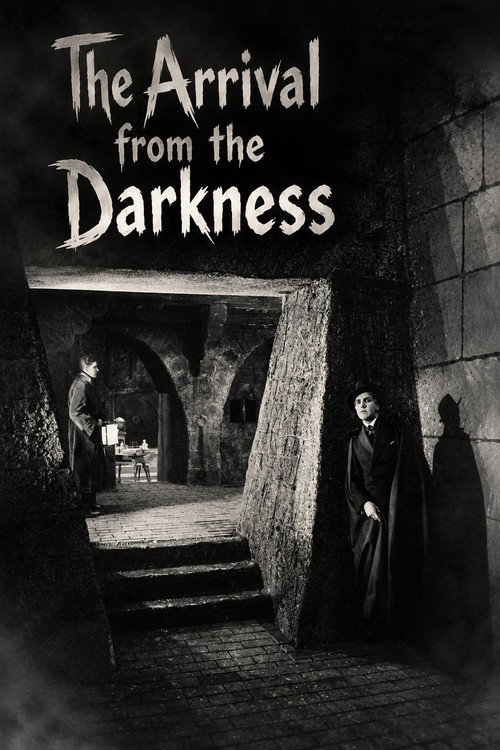
I've heard this is some czechoslovakian copy of Caligari, but turned out... its definitely not. For a moment i thought it might be czechoslovakian Golem, but... this isnt it either. The language of this movie isnt as agressive as most german expressionism movies, its almost romantic and mellow. I would say the whole picture is set in the manner of classic "fantastic stories" of E.T.A. Hoffmann or Goethe. Although the movie have some supernatural horror elements (the lunatic frozen in time for centuries, dark magic, alchemy) it is a horror of the 19th century origins. Definitely not scary, but eerie and with its heart in the right place. If this is your thing, come and get your fix.
In 1921 Karel Hloucha, a pioneer of Czech science ficton literature, wrote a fantasy/horror story, 'Príchozí z temnot' '(Arrival from the Darkness) for Jan S. Kolár. The film was restored and released in the Czech Republic, together with 'Otrávené svetlo' (Poisoned Light) another film from 1921 by Kolár, on a 2-dvd set.The films starts with Richard Bor, who visits his neighbours, Bohdan and his wife Dagmar, who live in a old castle. He has an occult book with him, which he has found in the estate of his grandfather, as a gift for Bohdan, a lover of occultism and mystical books. The castle belongs since centuries to Bohdan's family, but the Bors drove them away at one time and lived there for years. While Bohdan starts studying the book, Dagmar and Bor take a walk. Dagmar is ill at ease when Bor starts bothering her and reminding that she once rejected him and condemned him to solitude. That's when Bohdan comes outside and sees Bor harassing his wife. He storms down and commands Bor to leave his house immediately and warns him that his presents can't be an excuse for flirting with his wife. He will send the book back. Back inside Bohdan and Dagmar inspect the book together and Dagmar tells that she is afraid of it. When she points out that a few pages stick together, Bohdan, after pulling them lose, finds a mysterious old document, with a riddle, that says a mystery is hidden under the black tower, close to their castle. That night Bohdan keeps reading in the book, dozes off and when he wakes up goes to investigate the black tower...For the outside scenes Kolár filmed at three castles, including the famous Gothic 'Karlštejn castle' in Central Bohemia. He mixes close-ups, with mid- and long-shots, with fast cuts. The camera never lingers too long. That's also the merit of the Czech cinematographer Otto Heller, who would become famous for his imaginitive camerawork. This may have only been his 13th film, but his talent is clearly visible. The inside scenes were shot in the studio from the Rex-Film GmbH production company. The Romanian Lupu Pick had bought the company in 1918, to produce the films he was planning to make. In the same year of Kolár's film, he released his own films 'Scherben' and 'Graussige Nächte'. The studio in the Friedrichstrasse in Berlin may have been ideal for Pick's 'Kammersdichtfilme' , but less so for a fantasy film as 'Arrival from the Darkness'. This results in a constant quality discrepancy between studio and outdoor takes. Especially the decor of the mysterious hiding place under the black tower is amateurish.The surprising ending may have been repeated numerous times since, but for 1921 it was still innovative. The acting is more than reasonable. There is certainly no constant staring at the camera with exaggerated expressions of fear, surprise, or other feelings. The camerawork and atmosphere was a pleasant surpise for me. The film has a running time of an hour, so I didn't feel bored, and it in the end the outdoor scenes outweighed the studio ones. I would recommend silent film lovers to give 'Arrival from the Darkness' a try, especially if you are a lover of early fantasy and horror.