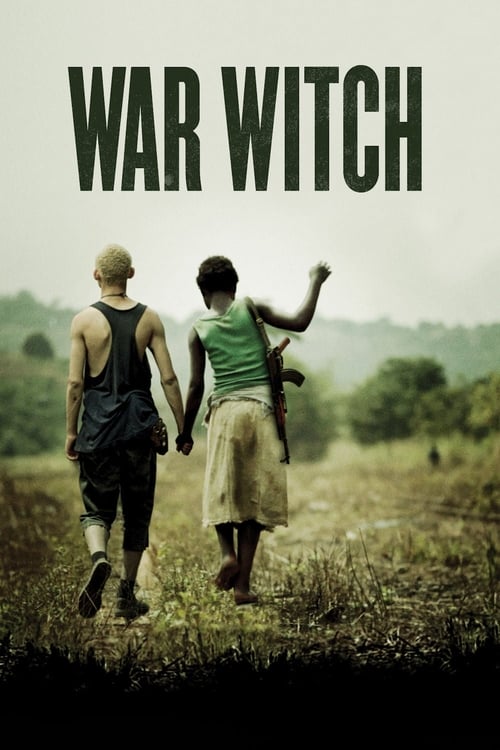
Really good film from Canadian filmmaker Kim Ngyuen. A young girl narrates the story of her life as a child soldier in Sub Saharan Africa to the unborn child in her belly.This has the brutality of 'City of God' and the foundations for 'Beasts of No Nation', which must have taken large inspiration from this film. An Oscar nomination is zero bearing of quality for a film, but normally it means the movie has a blu-ray release at the very least. Not so with 'War Witch' which is quite difficult to track down.There are moments of real beauty mixed in with the bloodshed of civil war in the un-named African country, and while there is plenty of magical realism and 'did that really happen' elements, it doesn't stray too far from the central message of the tragedy of children at war.7.8/10
"I'm a war witch."War Witch is, in a sense, similar to Terrence Malick’s much acclaimed The Thin Red Line. It has a highly poetic look at something which is not poetic in nature and by focusing on the beauty and purity of the environment that surrounds its characters it constantly highlights the paradox between the ruinous acts of violence committed by human beings and the caring and kind spirit of Mother Nature. Kim Nguyen’s film focuses on a 12 year old African girl named Komona who loses her family when the brutal militants attack their village which means from then on she has to handle her life and face miseries and troubles that her fate will bring to her by her own.The reason that makes War Witch a quite unique experience is its story. We often hear stories about the atrocities going on in Middle East but while what goes on in many African nations is not less important than other news stories we rarely hear or see a detailed report about the ongoing civil wars across the continent as if genocide and starvation are parts of everyday life in that part of the world, so this lack of knowledge and awareness about the situation in Africa gives Nguyen a chance to drag the viewers along for the entirety of his film. His film is not a political one, he doesn't even mention the name of the country that the story is happening in. With War Witch he wants to tell a humanistic story about people who find themselves in a dark and hopeless world and soon realize that it is only by sticking to their humanity and imagination that they may survive this mad melancholic world.Nguyen’s picturesque and poetic style make War Witch a very impressive movie, his floating camera (which is like a ghost wandering around in a forlorn yet incredibly beautiful jungle) along with the emotional narration fill the film with sympathy and compassion, we see a girl who quickly grows up and despite her young age experiences all sorts of human emotions from love to regret to guilt to despair. Film’s strongest moments are those which focus on this aspect of Komona’s life, like the scene where she finally returns to her destroyed village or when her husband is desperately trying to catch the white cock. War Witch (aka Rebelle) is a poetic portrait of the harsh life in Africa and on a broader scale a passionate work of art about mankind’s ability to adapt and find little moments of happiness even in the most unfortunate circumstances.
Besides Denys Arcand, it would seem as though Canadian filmmakers tend to achieve the furthest global outreach when their works maintain as great a distance from our local soil as possible. Given the country's history largely built (and maintained to this day) by rich immigrant stories, it makes sense that films like Our Lord and Saviour's Incendies would lay a heavy anchor on the final destination of these foreign-born residents, all the while extending a hand towards the far-reaching paths that led them here. War Witch is a different story, though, for while these other Canadian migrant stories make clear that a change of scenery does little to scrub away the troubles of one's past (and presents new troubles from a not-always-welcoming local population), Kim Nguyen's tragedy of child soldiers in Central Africa never even gets that far; escape—even an imperfect one—for these traumatized children is about as far from reality as one can get.Director Kim Nguyen (who, fun fact, actually got his film degree from the same university as yours truly) paints his grim portrait with a poeticism that runs almost in contrast with its frenetic camerawork. In that respect, given that War Witch was released in 2012, it's almost impossible to avoid comparisons with Benh Zeitlin's Beasts of the Southern Wild, whose own grimy lyricism is applied to a more deftly American locale. Nguyen, by contrast, never veers his poeticism into fantasy, and the recurring otherworldly imagery here is applied as a horrifying, constant reminder of the protagonist's circumstances.This naturalistic presentation of a narrative bolstered by the supernatural beliefs of the characters populating it gives War Witch much of its inherent tragedy; while most African-set films surrounding the labelling of a young girl as a witch present it as a means of dissecting outdated, patriarchal social norms, Nguyen here shows how these magically oriented perspectives within a realistic setting serve as manifestations of trauma and the subsequent attempts to cope with it. With War Witch, Kim Nguyen certainly finds an effective means of waxing poetic without ever appearing exploitative or superficial in his goals, but the bids to fully cohere style and substance are undercut by the freneticism of his presentation spreading to the film's pacing. At just 85 minutes before credits, War Witch jumps in and out of the heart of its chosen battlefield several times; while such a decision succeeds in portraying the futility of escape for Rachel Mwanza's willing lead, this crunched runtime gives the film a more hastened rhythm than Nguyen's presentation and often-unnecessary narration appear to desire. While the balance between realism and supernatural imagery isn't quite matched by a balance between modesty of delivery and ambition of intent, War Witch remains a thought-provoking exercise in highlighting the futility of armed conflict and the slow crippling—but not quite death—of innocence. Ranking the 2012 Oscar submissions for Best International Feature.