
Me at Stalin’s funeral: “I don’t know guys, I’m seeing a lot of RED FLAGS here.” (Repeat until the joke has been widely appreciated.)
Geregisseerd door Sergei Loznitsa
Государственные похороны
Een realistische documentaire met een groot ensemble.
Het enigma van de persoonlijkheidscultus wordt onthuld in het grootse spektakel van Stalins begrafenis. De film is gebaseerd op unieke archiefbeelden, opgenomen in de USSR op 5 en 9 maart 1953, toen het land rouwde en Jozef Stalin begroef.
State Funeral draait in 1 bioscoop in New York City - eerstvolgende voorstelling zaterdag 24 oktober om 19:00 in The Museum of Modern Art.
Volgende voorstellingen: zaterdag 24 oktober.
Volledig programma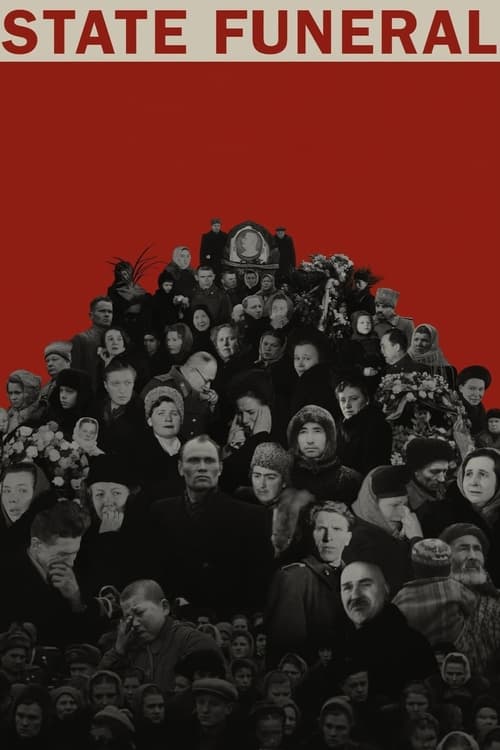
Speeltijden van State Funeral, elke ochtend ververst
Kies je bioscoop en krijg een seintje voordat de film van het doek verdwijnt.
Me at Stalin’s funeral: “I don’t know guys, I’m seeing a lot of RED FLAGS here.” (Repeat until the joke has been widely appreciated.)

I will give a different perspective on this film because just peruse any of the reviews on here and you will see just how affective bourgeois, anti-communist propaganda has been on the masses for the last 50 years, though this film stumbles at the end and reinforces the lies. However, a film like this surfaces a really important contradiction surrounding the standard narrative on Stalin and the USSR which has been propped up by the status quo, (right wing) reactionaries and synthetic left. Liberals on this site run into this specific contradiction: "If it is true that Stalin was some kind of brutal, sadistic killer, then why are we seeing masses of people go out of their way to eulogize him?" Their answer to this is always some kind of Orwellian conspiracy that the USSR made their people support Stalin, and his cult of personality as if it was not a result of his character and principles, but of his repressive brainwashing... See how ridiculous this sounds out loud? You are somehow going to tell me that Stalin and the USSR massacred millions of its own people without resistance, refugee crisis or mass graves? You are going to tell me that the state repression was so strong that people were compelled to go to his funeral? This is absolutely one of the dumbest logical inconsistencies I see on here. I am happy that I grew out of this infantile way of thinking!I caught one user say this, "It's difficult to imagine anything more dour than the entire population of the Soviet Union grieving over their dictator who murdered 42 million of them [...]" Where did they come to this number? Thank the film. Where does the film get this number? No idea, most likely out of thin air similar to all random deaths being attributed to communism as the closing statement implies that this is just basic historical fact (don't laugh!). Here is another nugget, "It's difficult to share the emotions the Russians are showing for the death of an utter bastard but I guess it shows how the regime had control over the people." This user needs to put down 1984 and read some real history! Equally pompous of this writer to include The Death of Stalin as a double feature recommendation (don't laugh!), as if that movie is any accurate. Want to see some big brain horseshoe theory? Check out this snippet from another review:Stalin, who now equates alongside the likes of Hitler and Mao as men whose colossal crimes mark them as bloodthirsty tyrants, was seen very differently by Russians in 1953, as seen at the mammoth funeral commemorating his passing. They instead saw him as a champion of social justice as well as being a war hero despite statistically killing more people than Hitler; during his regime, at least 27 million were murdered and a further 15 million starved to death.Once again, random death count numbers. Seems like the film/people are still reading and using the debunked Black Book of Communism as a source??? The film is literally using Nazi propaganda, maybe the filmmaker is a crypto-fascist if they lazily uphold right wing lies. Ukraine after all has been sort of a key space to breed fascism in eastern Europe.What I take away most from lurking the reviews is a lot of projection. They "hate" Stalin (because the film/state told them to, as we all know they did not actually take into consideration both sides of the cold war) so anything that looks suspicious reaffirms their anti-Stalin biases. What I personally conclude is that Stalin was neither a saint (no one is) nor some evil sadist on the level of Hitler, in fact I am of the camp that Stalin committed no crimes against humanity. He made mistakes, naturally, but he did not go out of his way to eat all the grain during Holodomor or coordinate every death during the Great Purge. Stalin even resisted his own cult of personality that Khrushchev claims he propagated.On a technical level the film itself is immaculate and beautiful, and for the most part it comes off as a respectful montage of this somber time for the soviet people. Except at the end, when it goes full mask off. It is not surprising that the closing summary is the one to spouse the 42 million dead line. Absolutely ridiculous and gives credence to Khrushchev's lies as well. Long live the immortal science of Marxism-Leninism, reject any and all liberal critiques of the party. This film would have been perfect without the garbage at the end.

Sergei Loznitsa’s State Funeral is a monumental cinematic experience that transforms raw archival footage into a sobering meditation on power, propaganda, and the cult of personality. The film, constructed entirely from state-sanctioned recordings of Joseph Stalin’s funeral in 1953, is both a mesmerising historical document and a stark indictment of totalitarianism. The decision to present the footage without voiceover narration or overt commentary is masterful, allowing the images to speak for themselves. The result is deeply unsettling: vast crowds of sombre citizens weeping in synchrony, endless lines of mourners filing past Stalin’s casket, and elaborate rituals orchestrated to immortalise a dictator responsible for unthinkable atrocities. Loznitsa’s approach forces viewers to confront the absurdity and horror of Stalin’s legacy—not through polemic but by exposing the mechanics of his cult’s performative grief.What stands out most is the duality of the spectacle. On the surface, it’s an awe-inspiring demonstration of the Soviet Union’s ability to orchestrate unity. Yet, beneath the façade lies the chilling reality of a regime that demanded unwavering devotion while erasing dissent through violence and repression. The camera’s gaze lingers on individuals—elderly women clutching flowers, workers in factories standing in rigid silence, children waving flags—and one can’t help but wonder how many lives were irreparably scarred by the man being mourned. The film’s pacing, while deliberate, can feel arduous at times, mirroring the oppressive atmosphere of the era it depicts. The grandeur of the scenes often gives way to monotony, which seems intentional, underscoring the hollow theatricality of state propaganda. It’s as if the film asks, “What are these people mourning? And at what cost has this illusion been sustained?” Loznitsa doesn’t romanticise or sanitise. Stalin is presented not as a man but as a grotesque myth made possible by fear, coercion, and indoctrination. State Funeral is a harrowing reminder of how propaganda can warp reality, and how even in death, power can demand fealty. While the film’s lack of narrative framing might alienate some viewers, it’s precisely this restraint that makes State Funeral so haunting. A chilling study of authoritarianism and its victims, it’s a vital work that lingers long after the final frame.
State Funeral is een zorgvuldige documentaire, volledig samengesteld uit zeldzaam, gerestaureerd archiefmateriaal van de massale publieke rouw en staatsrituelen na de dood van Jozef Stalin in maart 1953.
State Funeral werd in 2019 geregisseerd door de Oekraïense filmmaker Sergei Loznitsa, bekend om zijn op archiefmateriaal gebaseerde historische documentaires.
State Funeral ging in première op het Filmfestival van Venetië en kreeg brede kritische bijval op internationale filmfestivals. Volledig schema op Mood.