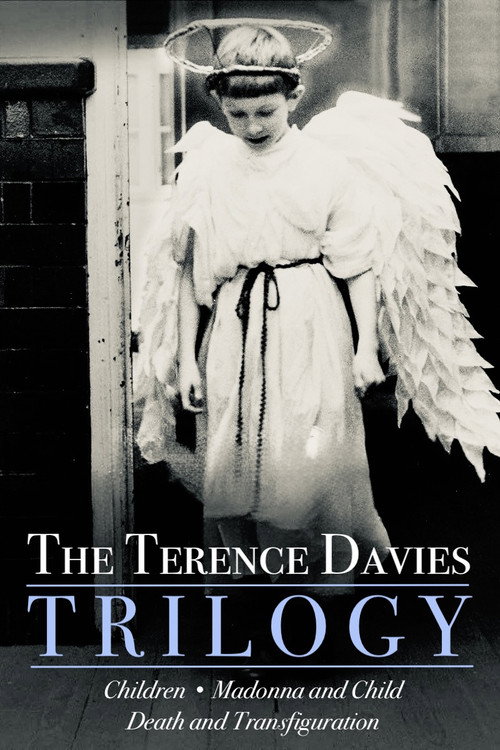
It starts in childhood. They sneer at you, name-call, beat you, threaten you, and tell you it's a sin. Before we even know what we like, they know what we're like. They know we're different. Perhaps they smell it on us. Maybe we're queer, maybe we're trans, maybe we're just a little bit different. It doesn't matter. We're all just a "fag" to them. This is when they start building the closet; this is when they teach us invisibility is armor. A child sits alone in the darkness, listening to his father beat his mother, and he knows he can never be himself. Where others find solace, we find pain. Robert lies to the priest. He hides in the dark; he says his prayers. He cannot confess that which he knows is not truly a sin, but that which he is reminded again and again is a sin. All of this in the shadows, such is the queer world. Faith and maternal love and holidays and work all fail to fulfill, even as they push and pull and demand. Pride month: 30/20
13 Terence Davies films seen (after Distant Voices, Still Lives; The Long Day Closes, Sunset Song, A Quiet Passion, Of Time and the City, The House of Mirth, The Deep Blue Sea, The Neon Bible, Children, Benediction, But Why?, Madonna and Child and Death and Transfiguration) I have now seen everything Terence Davies has made that's here on Letterboxd, bar The Post Office Girl (that's not out yet). It is a sign of how highly I rate his works that the lowest I've given him is a 3/5, and even then that was for a one minute short. Godard, famously dismissive of British cinema, was of the opinion that Distant Voices, Still Lives was one of the few exceptions to his dislike. If I were to hazard a guess why, it's because Davies broke from the hidebound traditions of a literary British cinema and moved towards something more openly modernist. He was as much a child of Sassoon and Eliot as Ealing, and that slippery quality of existence and the past as present is something that features in all his works. This is evident even in the Tucker Trilogy, which I finished with Madonna and Child and Death and Transfiguration. Both shuffle between multiple timeframes and the realms of fantasy with a disarming ease, as if the interchange between life and memory is the most natural thing in the world. Death and Transfiguration is the most audacious of the shorts in the way it interlinks three ages at the moment of Tucker's passing and feels most obviously like a warmup for Distant Voices... and its extended meditation on traumatic childhoods. However, of the three films its Madonna and Child that I found the most affecting, perhaps because that is a Tucker closest to my own age, even if I do lose an elderly relative this year. It's also the most openly funny of Davies's films, with a certain wry quality to the depiction of homosexual activity by cross-cutting it with religious imagery. The shame is palpable, certainly, but it's done with a sardonic quality that I found faintly hilarious. What comes through all of the films is the fervent desire to be loved, to feel a mutual passion with another soul and to be accepted in whatever small manner you can. The howling pain of loneliness is sometimes simply too much to bear, not only because you are left with your thoughts, but because you lose that capacity for sensory joy, and that is one of the most important parts of life for Davies. Tucker's ultimate end, alone in a hospital bed, represents something of a nightmare for Davies but also the death of a potential outcome for the man himself, one perhaps if he'd never taken the choice to become a filmmaker and open himself up to a new world of opportunities and experiences. With these films, Davies took a step into the real world and away from the dusty embrace of a clerk's life. And we all benefitted because of it.Davies in Order:1. The Long Day Closes2. Distant Voices, Still Lives3. The Deep Blue Sea4. Benediction5. Of Time and the City6. A Quiet Passion7. Madonna and Child8. Children9. Death and Transfiguration10. Sunset Song11. The Neon Bible12. The House of Mirth13. But Why?
This is gay Catholic miserablism of the most satisfying kind. And there ain’t no misery like British working class misery cause British working class misery don’t stop. There’s just a whiff of the student film hovering over all of Davies’ first three shorts, which is really no wonder since he literally was in film school when he made the second installment. At a certain point I became convinced that he had read Paul Schrader’s Transcendental Style in Film: Ozu, Bresson, Dreyer early on and decided to use it as how-to guide to directing. You could do a lot worse when you’re picking mentors. The first of the three, Children, is the most Ozu-like. It’s not only the long takes and the generalized lack of intense affect from the actors, but the way that Davies aligns his camera with the stasis of the built environment that reminds me most of Ozu here. At several points, he borrows that signature Ozu trope of using architectural space — interior and/or exterior — to frame a shot, and then he holds the shot for a beat or two after the actors have left the scene. The effect in Ozu is to convey a sense of the stability and persistence of social structures, even as generations of living individuals pass through them in human time. In Ozu, the result is an almost serene feeling of cultural continuity — a reassurance that after the storms of intrafamilial conflict or personal tragedy have passed, the underlying structures which support our sense of “home” will survive intact. In Children, this same technique makes working class existence in Liverpool feel like a permanent prison sentence. Where Japanese architecture is all about delicacy and lightness, the Northern British cityscape is ponderous, dreary, and brutal. In one especially long take, Davies frames the passing streets through a moving bus window, and the sameness of the block after block of brick row houses receding into the distance eventually starts to feel like the endlessly repeating background scroll of a Hanna-Barbera cartoon chase scene. Under Davies’ impassive gaze, the carceral spaces of school, church, and home all start to exhibit a claustrophobic sameness, like a vast gulag in Discipline and Punish: The Movie. Madonna and Child, the second installment of the trilogy, is the most Dreyer-like, especially if we consider Davies’ use of the close-up as a subtle homage to The Passion of Joan of Arc. Terry O’Sullivan, the actor who plays Davies’ proxy in the films, Robert Tucker, has a face almost entirely lacking in buccal fat. His face seems to almost hang off of his cheekbones, like a drenched raincoat slung over a chair. In a few scenes, Davies lights his face in such a way as to accentuate its sunkenness, making it look like a kabuki mask frozen in a grotesque expression of gloom. The religious dimension of these close-ups is made almost comically explicit in a scene where Tucker is on his knees about to give a stranger a blow job. He gazes up at his beneficiary with the same pious countenance of a child about to receive the sacrament; indeed, later in the film, Davies includes a shot of Tucker as a child taking communion, effectively removing all doubt that this connection was intentional. The scene should also remind us of that other working class gay Catholic tribute to Dreyer’s Passion of Joan of Arc: Andy Warhol’s Blow Job, a 35 minute silent film consisting entirely of a close-up on a fellatio-recipient’s face as he passes through various phases of oral ecstasy. The final segment of the trilogy — Death and Transfiguration — is, as the title alone should suggest, the most Bressonian of the three, at least thematically, if not stylistically. While the Catholic mysticism of the concluding segment is far more overt in Davies’ film than it is in most of Bresson’s work, the pervasive ambiguity hovering around these spiritual concerns is remarkably similar. That is to say, whatever “transcendence” that Bresson’s protagonists achieve in his films is, like Tucker’s presumed “transfiguration” in this one, always subject to a measure of uncertainty and existential dread. What Catholicism provides to both filmmakers is an elaborate and rich aesthetics of worldly suffering, and whether or not the end result of their characters’ masochistic ordeals is a form of spiritual redemption or not remains a stubbornly open question. Davies’ trilogy articulates a distinctively queer structure of feeling that I’d want to term “ecstatic loneliness” — a not-entirely volitional withdrawal from the social itself. In this isolated state of imposed martyrdom, some layer of spiritual ecstasy begins to make itself felt. And when this feeling is brought into such close proximity to carnal ecstasy — as it is in Blow Job, John Waters’ Multiple Maniacs, or the climax of the Genet sequence in Todd Haynes’ Poison — it encroaches on the territory of the camp sublime.