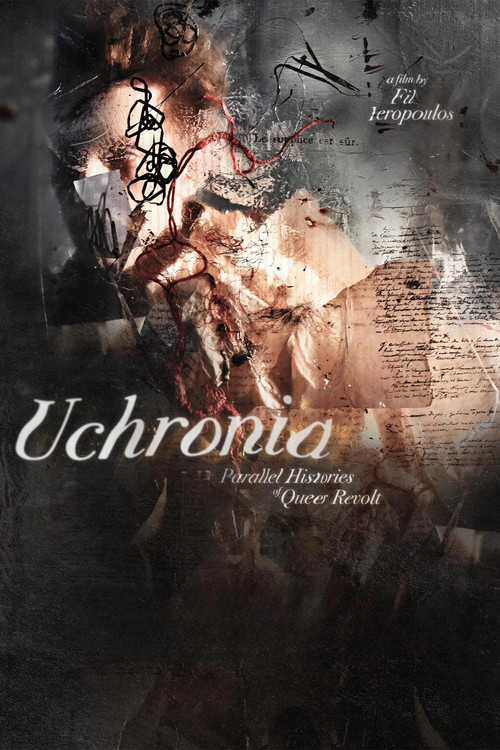
A psychedelic docu-essay, inspired by Arthur Rimbaud’s visionary poem Une Saison en Enfer, in which the poet’s ghost travels through history, encountering revolutionary figures and queer ‘freaks’ such as Emma Goldman, David Wojnarowicz, and Marsha P. Johnson. These encounters form a multilayered collage that interrogates identity, the meaning of revolution, and the role of the artist in shaping radical histories and collective imaginaries.
Andy Warhol says the phrase AI Slop in this movie ❤️A bold, absurd, darkly comic and really interesting love letter to the queer past and present and the importance of queer archive, where it is evident that everyone who worked on this project clearly put their entire hearts and souls into it… whilst simultaneously being a surrealist, riotous, transgressive, radiant. horrific. queer. descent into historical, political, radical and pop-cultural hell (highly complimentary)
me feat. oklou & underscores3.0
– I'm always at a bit of a loss with this kind of film who exactly the target audience is:1) On the one hand, someone with no (academic) experience in the (western) humanities – or someone coming from a plethora of other 'standpoints' – won't just find the film's dialogue "challenging" (to quote the director) but, I feel like, downright incomprehensible. In particular, the high degree of referentiality throughout the entire script immediately marks anyone lacking this educational privilege as an 'outsider', making for what I imagine to be a quite alienating and miserable experience, sitting amidst the bourgeois Berlinale audience laughing at every namedrop and reference.2) On the other hand, anyone fortunate enough to have undergone academic training in the humanities will find most of the ideas put forward in this film very familiar (unless I was too dumb to understand the deeper points being made). In the Q&A, the director Fil Ieropoulos (quite smugly and arrogantly) talked about "going back to the basics", which "we have forgotten about" (except for them of course!), which unintentionally seems to prove that point. Further, the challenges to canonical ideas formulated in the film circle around topics generally in vogue right now in the humanities: archives, 'academic writing-as-genre', etc. – again, ideas anyone fortunate enough to have undergone the academic training necessary to engage with the film will find very familiar. I need to stress that I don't disagree with the film! Or disliked the film! Rather, I want to question how radical, experimental, or boundary pushing the film actually is. To the contrary, I would argue the film felt less like a 'challenge' and more like a pleasant, affirmative pat on the back for intellectual elites. To put it a bit more sexually charged: a circlejerk.– perhaps this comes down to personal preferences but I fail to see the experimental aesthetics the director (quite smugly and arrogantly) proclaimed in the Q&A. In particular, the Jack Smith-esque sequences (ofc with the #authentic 🤤analog🤤film🤤look) and garish, Bertrand Mandico ahh digital cinematography through prisms (at least I believe that's how they achieved the effect) bothered me. A) Because I found them terribly ugly but more importantly b) because these aesthetics have long been assimilated into music videos, advertisements and other hegemonic forms and c) because wildly cross-cutting between them (a technique mastered by action cinema for many many decades) also doesn't equal experimentation in the radical sense the director stressed they achieved, at least for me. Structuring the film in book chapters was original but for a film so obsessed with text, it doesn't further engage with the structural nor aesthetic consequences of making a text-film. Not that I know the answers, but I don't think this is it. – To further comment on the Q&A (@ the 2nd Berlinale screening), I at least appreciated the pushback by producer Spyros Patsouras, pointing out the (smug and arrogant) director's somewhat limiting and eurocentric view of the breadth of contemporary queer (or rather LGBT) cinema. I understand and share Fil Ieropoulos' frustration and (perhaps quite gay) passion for polemic ranting – and even agree with a lot of the points made – but maybe you should be a bit more considerate during a public Q&A, especially at the Forum Expanded. Generally, this singular dogmatism doesn't really suit queer cinema ...
L 🫀5.0
honestly my favourite film i’ve seen from the entire berlinale! just unapologetic queerness in the radical, political sense. it breaks every mold that the current queer and counter culture have cemented for the last decade or even longer. everything said in the q&a resonated with me heavily. we need more provocation!
More like this
Veelgestelde vragen
Waar gaat Uchronia over?+
Uchronia is een psychedelisch docu-essay dat de geest van Arthur Rimbaud volgt terwijl hij door de geschiedenis reist om revolutionaire figuren en queer iconen te ontmoeten.
Wie heeft Uchronia geregisseerd?+
Uchronia is geregisseerd door Fil Ieropoulos en ging in première op het Internationaal Filmfestival van Berlijn in 2026.
Heeft Uchronia prijzen gewonnen?+
Ja, Uchronia won de Wild Dreamer Award tijdens zijn festivaltournee.