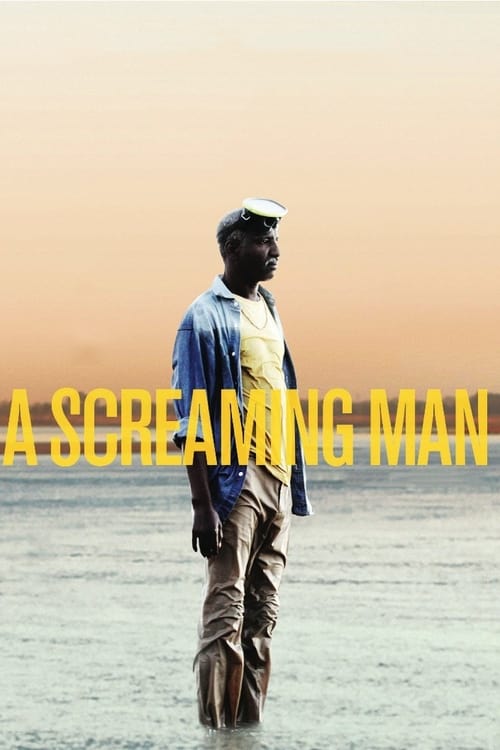
Der Tschad, heute: Der 60 Jahre alte Adam ist schwer enttäuscht, als er seinen Job als Poolboy in einem Hotel aufgeben muss, während sein Sohn Abdel seinen Posten dort behalten darf. Adam verkauft seinen Filius und Konkurrenten an die Armee, die ihn "kidnappt", um seinen angestammten Job, der alles für ihn bedeutet, wieder zu bekommen und gleichzeitig seinen Obolus an den Militärchef des Viertels zu zahlen. Doch die Schuld lastet schwer auf ihm.
In spite of its title, A Screaming Man is rather soft spoken. I'm always impressed when a film that has a much to say as this one does, does so without the level of intensity and overtness that most films aspire to. It suffers from some of the problems that one might expect in a country just attempting to get its filmmaking industry going, some of the acting is stiff and underdeveloped, someone who is supposed to be dead is clearly still breathing in one shot. But I'm not really bothered by those "technical" details in a film this layered, tender, and nuanced.What this film captures, and captures so well, is the intersection of the personal and the political. In one perfectly rendered scene, Adam (Youssouf Djaoro) and Mariam (Hadje Fatime N'Goua) feed each other watermelon, being gentle and loving and romantic with each other, while the news tells of the raging civil war aurally, in the background. The tension between these two parallel moments is first and foremost a reminder that the people in the middle of a conflict are people. They're not heroes or villains; they don't need their lives mythologized, and the greatest respect that can be given to them is to see them for whom they are. And on top of that, the idea that a quiet and beautiful life, no matter how seemingly tender will be interrupted by a changing world regardless if those people want to ignore it or not."I'm really worried.""Why? About the war?""About the hotel privatization."Some of my fellow letterboxd reviewers didn't buy in on the selfish decision Adam makes that leads to the film's tragic conclusion, and I disagree. I feel like this line, and many of the other small moments in the film set it up splendidly. Too often in films of this nature, I find the film leading me to my least favorite thought path: "How could this happen?" which removes me from the events and fails to implicate the audience. They can leave the theater feeling self-satisfied about having watched an important film and then return to their lives essentially unchanged.Adam's decision may be an exaggerated one, but the base idea of it, choosing pride and comfort over doing what's right is a decision that everyone makes everyday of their lives. To be more worried about what might happen with your job as opposed to the encroaching war is a human response. Who can handle the magnitude of war and what it might mean for your life? The potential loss of a job seems devastating enough as is.That Adam isn't painted with the broad stroke of being an awful person but rather someone who is unwilling to change with the times is the film's strength, in my opinion, not its weakness. That people, who are, most of their lives, good people, can make selfish and disastrous decisions during wartime is a fact shown by a mountain of history and at the heart of a very well made film here.
HBSpade5.0
On the 19th of April 2021 (roughly three months ago), Idriss Deby, the President of Chad, was killed by rebels who opposed his unconstitutional “re-election” to power in a military offensive.Since then his son Mahamat has dissolved the parliament and suspended the constitution, suppressing protests and political opponents alike, and establishing a “transitional” military rule until replacement elections in 2022, backed by western powers (most prominently France), who viewed Deby as an ally in the fight against Islamic terror uprising in neighboring Nigeria. Currently there is no government. The rebels who killed him are themselves a splinter group of an earlier, larger militant organization that was involved in the most recent civil war in Chad, which itself intersected with the ongoing Darfur war in neighboring Sudan, with the governments of both countries providing arms to rebels of the opposite country, as foreign powers picked their sides, pretending not to have previously contributed to the political instability, while the UN hemmed and hawed.None of this is ever directly mentioned or explicitly referred to in A Screaming Man, despite the earlier civil war being the backdrop to which the story unfolds. Instead we see its omnipresent influence in the peripheries of Adam’s life – the sound of helicopters, the radio announcements, faceless soldiers dotting the landscape. Just around the corner, always just out of sight. Similarly, other disrupting factors are merely hinted at, only inferable from the tensions they create. The colonial legacy remains in the smooth transference from French to Chadian Arabic in their daily lives; the post-colonial political influence retained by the French through their (possibly UN, but we do not know for sure) troops whose dirty towels Adam picks up to clean after they have enjoyed themselves in the lavish poolside where he works; the sudden employment instability created by Chinese capitalist encroachment through the mass layoffs doled out by the proprietor of the pool, Mrs. Wang; the looming threat of rebel invasion by the number of people who leave the narrative abruptly (they have fled, possibly to Cameroon); the suffocation of nationalism, once used as a means to unite different cultures against colonial oppressors, then left to fester and ferment unattended once the enemy has left the land, eventually morphing into a tool to be used by despots to fill a power vacuum, and now, compulsorily foisted on the population by the ruling government in retaliation to the rebels – represented by Ahmad, who recruits young soldiers on threat of being branded as a traitor to the country. Adam tries to maintain a sense of stability in the midst of this ridiculously turbulent living situation by holding on to his pride – his work at the pool (he is known as “Champion”, because he was the first swimming champion in central Africa) and his loving family. But when that last shred of dignity he holds onto is taken away, he loses his humanity along with it. War thus becomes generational, transferred over from father to son. But not because either has any reason to fight and kill - the warring factions themselves are merely vague entities. It is simply because the conflict itself never ends with one generation. A Screaming Man is an anti-war film, and one of the best, by never showing the fighting directly. This narrative choice lets us see war for what it truly is: common people being groomed, brainwashed, threatened into a corner, and put in positions where they throw away their lives and their humanity in service of desperate attempts at retention of power by a handful of megalomaniacs. It is also a painfully quiet film. Adam’s son Abdel uses a camera to record every day of his life, as if to prove that he exists, and one can’t help but wonder if Haroun is attempting to do the same for his country. In the face of hopelessness, the characters try to cling to the littlest of things to try and live a normal, happy life, to keep the tension without from consuming them within. Near the end of the film, as things come to a head, a scream is almost let out, but Adam forcibly stifles it. He is willing to travel across the Sahel in search of what he holds dear, but he cannot bear to hear another's scream. For even if just one is allowed to be let out, it will spread from person to person like a virus, until the entire country is engulfed in cacophony.Top 250 FilmsMahamat Saleh-Haroun ranked
Jonathan White4.5
Part of Lise and Jonnie’s March Around the World 2017Film 2 – March 2nd - ChadWhen I see the achingly beautiful cinematography, when I see the nuanced and crushingly real portrayals of complex characters by the group of actors … any one of which renders an Oscar worthy performance, when I see Mahamat-Saleh Haroun’s expert direction of his equally accomplished script, and I think to myself … this is Chad, the seventh poorest country in the world, a country rocked by civil war and corruption, I gain a new appreciation that great art can spring forth from even the most inhospitable soil.Like this year’s Moonlight, in its tiny budget and holistic approach, A Screaming Man distinguishes itself by presenting a gripping family drama without swerving into melodramatic territory. It always warms my heart when I see that so much can be made with so little. All it takes is the vision.
More like this
Häufige Fragen
Worum geht es in A Screaming Man?+
Ein alternder Pool-Hallenwart im Tschad verliert seinen Arbeitsplatz an seinen eigenen Sohn und trifft unter dem Druck von Kriegsabgaben letztendlich die tragische Wahl, seinen Sohn für die militärischen Anstrengungen abzugeben.
Wer hat A Screaming Man inszeniert?+
A Screaming Man wurde 2010 vom tschadischen Filmemacher Mahamat-Saleh Haroun inszeniert und gewann den Preis der Jury bei den Internationalen Filmfestspielen von Cannes.
Hat A Screaming Man Preise gewonnen?+
Ja, der Film gewann den Preis der Jury bei den 63. Internationalen Filmfestspielen von Cannes.