





Like a revenge movie except instead Babette trying to murder the people that wronged her, she cooks a really nice meal for people that have been nice to her
We use cookies to personalize your experience and analyze traffic. You can opt out at any time.

Regie Gabriel Axel
Babettes gæstebud
An acclaimed, moving drama.
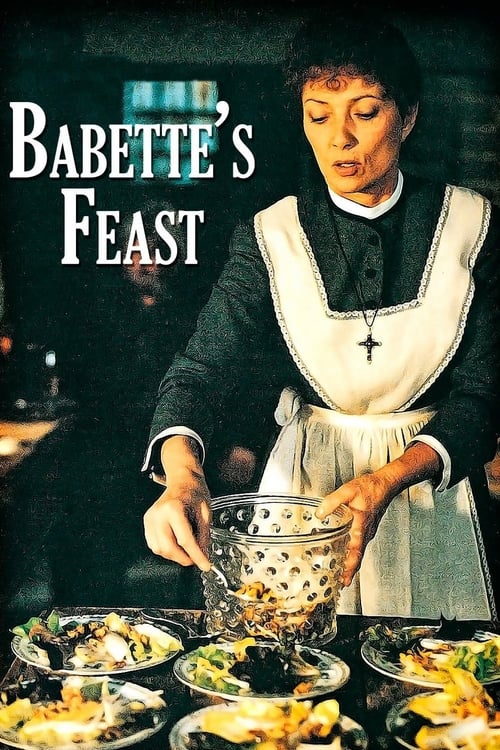
Mitte des 19. Jahrhunderts: An der Küste Jütlands taucht bei den Schwestern Phillipa und Martina eines Tages eine geheimnisvolle Französin auf. Die beiden gottesfürchtigen Frauen gewähren der jungen Frau - Babette - Zuflucht und eine Stelle als Dienstmädchen in ihrem Haus. Als Babette in der Lotterie gewinnt, möchte sie sich bei ihren beiden Wohltäterinnen und deren Freunden mit einem Festmahl bedanken. Die Fräulein sind zunächst misstrauisch und fürchten, gegen ihren Glauben zu verstoßen. Doch dank ihrer Kochkünste gelingt es Babette, ihre Gäste zu verzaubern und ihnen zu bis dato ungekannten Gefühlen zu verhelfen. So hält dieser Abend manche Überraschung bereit - unter anderem die Enthüllung von Babettes wahrer Identität.
Heute keine Spielzeiten für Babette's Feast in Los Angeles.
Spielzeiten zu Babette's Feast, jeden Morgen aktualisiert
Wähle dein Kino und bekomm einen Hinweis, bevor der Film aus dem Programm fällt.


Like a revenge movie except instead Babette trying to murder the people that wronged her, she cooks a really nice meal for people that have been nice to her

This is my third or fourth time sitting down to the table with Babette, and each tasting is more sumptuous and rewarding. After this screening, I realized that Babette deserves a perfect score.The story is simple, lovely, and gentle. It takes it’s time. It’s this unhurriedness that makes you fall in love, gradually and naturally. The first act is solely dedicated to back story, where we are introduced to the inhabitants of a tiny, picturesque, Danish hamlet. The close knit community revolves around a tiny sect led by a moral and just preacher. His two daughters, Martine and Filippa, are named for Martin Luther and his friend Philipp Melanchton, founders of Protestantism. The fracture with Catholicism being the notion that good deeds do not buy you way into heaven, God’s grace is a gift that is given freely. This notion decouples acts of kindness and charity from reward, and elevates those acts because they are given freely. This piety also extends into acts of self sacrifice and the eschewing of earthly pleasures in the quest for a higher path.Martine and Filippa are ravishing, and catch the eyes of two men visiting the town. One, a young officer, Lorens, who is being punished by exile for gambling and unbecoming behavior, the other, an operatic star in the late years of his career, Papin, who is dejected about his future. Both fall in love, both are rebuffed, and both vow to improve themselves. In the second act, years have passed, as has the preacher. We see the spinsters Filippa and Martine carrying on good and charitable deeds, and generally caring for their community. They set examples, live an extremely modest life, and prepare tasteless food. Enter Babette, a refugee from counter-revolutionary Paris. With a letter of introduction from Papin, she begs the sisters to give her refuge, offering to be their maid without pay. This is where the interesting questions start. Martine and Filippa are torn. The idea of a maid is an earthly pleasure that they can’t reconcile, yet, their Christianity cannot forsake one in need. In the end, they reason that charity outweighs their discomfort with the notion of a servant, and they take Babette in.This is much more plot and story than I usually delve into in a review, but it’s really just the setup of the real story, and the real questions and observations. The titular ‘feast’ is when the town celebrates the 100th anniversary of the birth of their Pastor. By a stroke of fate, Babette is able, and wishes to prepare a dinner for the gathering. Once again the sisters are torn. They cannot imagine accepting such a luxury, but at the same time, in the fourteen years that Babette has served them, she has asked for nothing. Graciousness prevails, but not without consternation.One thing that I’ve failed to mention so far is the humor. It’s subtle, like the film, but ever present, particularly In the final act, the feast.Everyone gives fantastic, touching, and understated performances, particularly Stephane Audran as Babette, Dodil Kjer as Filippa, and Birgitte Federspiel as Martine. Cinematography is austere, beautiful, and never distracting. If there is a score, it’s so invisible that I didn’t notice. I see a music credit, but I can’t for the life of me recall hearing it. Needless to say, Babette doesn’t emotionally manipulate you with one if it is there.Babette’s message is simple. A whole and happy life is the embracing of both piety and pleasure. ”Mercy and truth have met together. Righteousness and bliss shall kiss one another. Man, in his weakness and shortsightedness believes he must make choices in this life. He trembles at the risks he takes. We do know fear. But no. Our choice is of no importance. There comes a time when our eyes are opened and we come to realize that mercy is infinite. We need only await it with confidence and receive it with gratitude. Mercy imposes no conditions. And lo! Everything we have chosen has been granted to us. And everything we rejected has also been granted. Yes, we even get back what we rejected. For mercy and truth have met together, and righteousness and bliss shall kiss one another.”A true gem completely deserving if it’s little gold statue.

Three weeks ago, I introduced this film for 35 freshmen at Seattle Pacific, and tonight I introduce it for a gathering at Saint Ambrose Anglican Church in Seattle. You know, I often hear this movie summed up as a story about a "worldly" Frenchwoman who becomes a part of a bone-headedly strict religious community, and how she enlightens them.She does enlighten them, to some extent.But let's not overlook that Babette fled from a civil war in Paris in which her husband and son were shot — and who had the generosity of heart to take her in, give her refuge, and even give her a place in their home? The pious Christian sisters who preserve that strict, "prudish" community. In fact, the sisters are always seeking to preserve peace, and to care for the poor, in that community. Their primary fault is in failing to see that God wants so much more for them. And in time, they catch a glimpse of it. The grace of God — or, if you prefer another vocabulary, the Power of Love (with respect to Huey Lewis & the News) — is in both the extravagance of Babette's sacrifice to serve these poor Protestant separatists... and in their extravagance of generosity in opening their community and their home to receive her.Nevertheless, the most extravagant show of love is one that many — perhaps most — moviegoers overlook. I won't spoil it, but keep in mind what the film shows us early on (and which can easily be forgotten): the man responsible for the deaths of Babette's family is General Galliffet. And this has tremendous implications as we consider who is sitting at the table when Babette serves her feast.- - - - -If you like my Letterboxd notes, check out JeffreyOverstreet.com, the ginormous archive of my posts and reviews going back more than 20 years. If you have questions about my star ratings, check the Q&A in my Letterboxd Profile Bio.
A French housekeeper with a mysterious past brings quiet revolution in the form of one exquisite meal to a circle of starkly pious villagers in late 19th century Denmark.
Gabriel Axel directed Babette's Feast, a 1987 Danish drama that won the Academy Award for Best Foreign Language Film.
Yes, Babette's Feast won the Academy Award for Best Foreign Language Film in 1987. Full schedule on Mood.