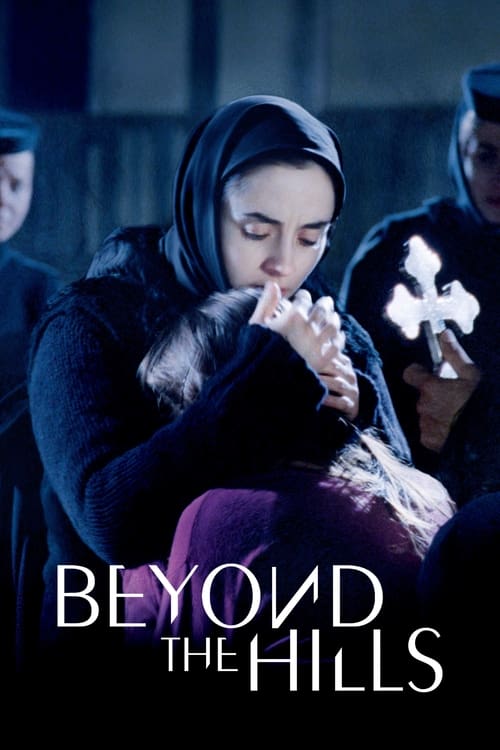
După dealuri is a drama from Cristian Mungiu. Two young women who grew up together in an orphanage reunite after years apart. Alina returns from Germany hoping to reclaim her close bond with Voichița, who has found purpose and belonging as a novice in a remote monastery. What begins as an emotional struggle between devotion to a person and devotion to God slowly escalates into something far darker, culminating in a tragic confrontation with rigid belief and institutional blindness. Mungiu’s signature style, long, unbroken takes, naturalistic performances, gives the film its quiet intensity. Cosmina Stratan and Cristina Flutur are outstanding as the two women. The supporting cast and the bleak winter setting reinforce the sense of isolation and inevitability. At over two and a half hours, the deliberate pacing demands patience, but the payoff is an examination of good intentions and the thin line between care and cruelty. The film’s cyclical plot emphasizes systemic entrapment, but results in a static middle act. Unsympathetic and frustrating characters can alienate viewers seeking more likable protagonists. Beyond the Hills it is not a comforting watch, yet it remains one of the strongest Romanian films of its era.This film is included in my list of the 2500+ Best Films.
”The one who leaves and the one who comes back are not the same.”Beyond the Hills is a disturbing watch but knowing that it is based on a true story makes the whole experience even more painful. Like Cristian Mungiu’s previous film, the incredible and unforgettable 4 Months, 3 Weeks and 2 days this is a disheartening portrayal of the friendship between two women where one tries to stop the other one from the ultimate descent into misery and despair. Mungiu narrates this soul-shattering story with sadistic determination and by asking questions which are almost impossible to answer he creates a nightmarish experience which will put the viewers in a state of shock and confusion for days. Mungiu’s style is more mature here, his perception of life is much darker and the way he approaches his characters is much crueler and at the end of the day it is this pessimism that makes Beyond the Hills the unsettling experience that it is.The film focuses on an Orthodox monastery where you should believe and never ask why, once you enter there as a nun you have to put all your past behind yourself and start a new life, it’s unfortunate to say this but people lose their individuality and worst of all their thinking ability in the process. Although the film is portraying a religious community which is plagued by the narrow-mindedness of its leader but I think eventually its intentions extend beyond just portraying the dangers of religious strictness. The movie never blames the characters for what’s happening, it is not blaming the ideology itself too as an ideology will never work without people who have lost their sensibility, it is blaming the ignorance, illiteracy and lack of knowledge. Most of the nuns who are living in the monastery are poor women who don’t have any where else to go, they are unfortunate souls without a place in the outside world so the only thing they can do is to turn toward the seemingly peaceful monastery. None of them are wicked or barbarous, in fact most of them are kind people looking to help others but their problem is that they have yielded their minds to an ideology which doesn't let them to question its validity. Obey and don’t ask. That’s what ruins minds and lives.Mungiu and his talented DOP, Oleg Mutu, put us right in the middle of all the events, they carefully put their camera in every scene so that we feel like we’re actually an observer who is witnessing all the events but they intentionally stay away from characters and everything that’s happening which means all the time there is an upsetting distance between us and everything. Add to that the long takes which are never interrupted by fancy editing techniques and there you have it: we feel like observers who are paralyzed, observers who are unable to interfere in the events and stop regretful things from happening and that adds a frustrating and suffocating feeling to the whole story. This approach is one of the key elements of the film as Alina herself is also a simple observer who, despite all her efforts, is unable to change anything. This formally intelligent choice means that we are experiencing some of the pain and agony that Alina is going through.Cosmina Stratan and Cristina Flutur, as the main protagonists of the film, give excellent performances. Flutur portrays Alina’s internal conflicts and her ultimate mental and physical crushing with such an admirable determination that sometimes you just want to stop watching her suffer so much. The ever-present doubt that is an essential part of Stratan’s Voichita – which is tearing her apart but all the time she is pretending that there is no doubt and weakness inside her – make her look like a vulnerable character who like Alina is in need of help and while Alina finally reaches peace she remains to suffer for the rest of her life. Although these two are film’s dramatic power unit but almost all members of the cast are impressive. All of them have believed their roles and thus enrich the film with their performances.Some movies are hard to forget, their universe never leaves you alone, they remain with you for days and weeks and upset you with their dramatic power and their bitter subject matters. Beyond the Hills is certainly one of those movies.
Absolutely terrifying. Uses bleak, observational realism to explore the disturbing true story of a failed exorcism while raising a deeply fascinating (and ethical) argument about what happens when religion and the law lock horns. Honestly unlike anything I’ve ever seen and considering it’s two and a half hours long, it does a damn good job at keeping you on the edge of your seat the entire time, immersing you amongst the oppressive delirium of people completely disconnected from the real world because of the sheer dedication to their faith. This is nauseating, stripped-back horror at its finest and is 100% deserving of its Best Screenplay and double Best Actress wins at Cannes.