72An extravagant pulp fantasy with plenty of melodrama to spare. Intensely preoccupied with look and feel - not so much concerned with plotting but rather the opulent intensity of its images and textures. I could stare at this movie all day.
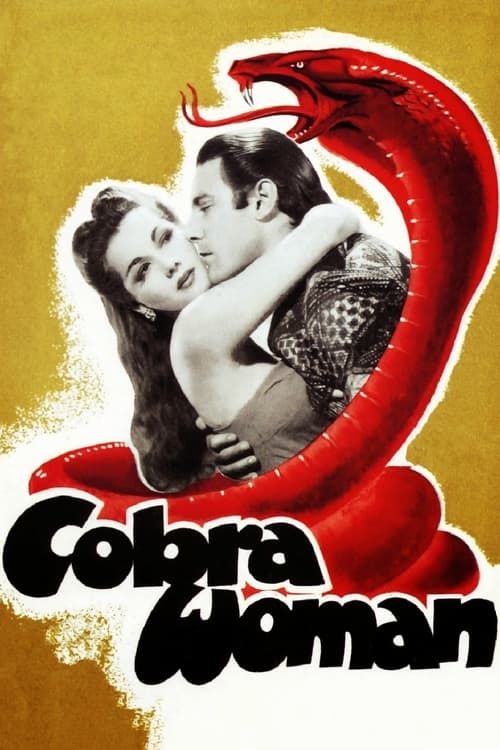
Kurz vor der Hochzeit von Ramu (Jon Hall) und Tollea (Maria Montez) irgendwo in Indien, taucht der angeblich blinde Landstreicher Hava (Lon Chaney jr.) auf und entführt die Schöne. Von seinem Ziehvater MacDonald erfährt Ramu, daß er die junge Tollea mit sich brachte, nachdem er vor der geheimnisvollen Insel Cobra Island Schiffbruch erlitten hatte, um dort dann fast zu Tode gefoltert zu werden. Ramu eilt zur Rettung seiner Verlobten, mit dabei sein Freund Kado (Sabu), der ihm den Rücken freihält. Vor Ort begegnet Ramu dann nicht nur einem sehr seltsamen Stamm und seiner Königin, sondern auch Tollea, die ihn nicht mehr zu erkennen scheint, doch dann bekommt Kado raus, das es hier um einen Erbfolgestreit geht - und um Zwillingsschwestern...
Cobra Woman läuft derzeit in keinem Kino.
Folge dem Film in der App, um benachrichtigt zu werden, sobald Spielzeiten dazukommen.
Spielzeiten zu Cobra Woman, jeden Morgen aktualisiert
Wähle dein Kino und bekomm einen Hinweis, bevor der Film aus dem Programm fällt.
72An extravagant pulp fantasy with plenty of melodrama to spare. Intensely preoccupied with look and feel - not so much concerned with plotting but rather the opulent intensity of its images and textures. I could stare at this movie all day.

In 1993, famous New York avant-garde composer John Zorn wrote a piece about Jack Smith and his film Flaming Creatures in which he reminisced about going to the movies:"One of my fondest memories of Jack was when we went together to a double bill of Cobra Woman and Arabian Nights at the Theatre 80 on Saint Marks street. Jack cried through those films, biting his handkerchief and holding his breath while most of the other patrons laughed at the 'camp'. Jack knew the power of visual images, and the importance of mood in cinema. He once told me he would prefer the worst dub in the world to subtitles, which destroyed the purity of the images, and irrevokably shattered the exotic mood he thrived on... and in fact lived for."When I read this article for the first time in 1999, reprinted in an Italian book in the series Sonora. Itinerari Oltre Il Suono, this passage struck me and has stayed with me ever since, along with the desire to see those mysterious movies mentioned by Zorn. I finally took the opportunity to see Cobra Woman today, and what a weird and wonderful and unclassifiable movie it is.The story is set on an unspecified island, presumably in the south seas; a colonialist man is about to marry a local woman, Tollea, played by Maria Montez, but before doing so she disappears. The man, played by Universal adventure film stalwart Jon Hall, travels to the remote Cobra Island to look for his wife-to-be. He finds a strange, exotic, secluded civilization there that look like a mixture of Egyptian and Aztec cultural elements, as well as a black panther, a chimpanzee, and a volcano. One has to wonder how the panther and the chimpanzee wound up on a remote island in the south seas... Many weird and wonderful adventures later he rescues Tollea, whose evil twin sister Naja ruled over the island with an iron fist, until Tollea stops her in her tracks.The movie is undeniably problematic - the natives speak that particular form of English that doesn't have any use for articles, they are played by white people, and there is a general disregard for even the remotest attempt at presenting an accurate portrayal of any culture; everything is thrown into the stew as long as it is exotic or weird.That said, the movie is heaps of fun. It reminded me of Umberto Eco describing all the old adventure novels, serials, and comics in The Mysterious Flame of Queen Loana - a world only available to the nostalgic mind now, a long lost world of endless possibilities and fathomless dangers, not limited by the confines of electronic communication and immediate availability of data about remote parts of the world, only a keystroke away.Jack Smith and John Zorn were right. More than anything else, it is mood which defines the true cinematic experience. And if you allow yourself to be drawn into the mood of this oddity, you are in for a great time.

Camp taste is, above all, a mode of enjoyment, of appreciation — not judgment. Camp is generous. It wants to enjoy. It only seems like malice, cynicism. (Or, if it is cynicism, it's not a ruthless but a sweet cynicism.) Camp taste doesn't propose that it is in bad taste to be serious; it doesn't sneer at someone who succeeds in being seriously dramatic. What it does is to find the success in certain passionate failures.— Susan Sontag, Notes on CampWretched actress — pathetic as actress, why insist upon her being an actress — why limit her?— Jack Smith, The Perfect Filmic Appositeness of Maria MontezOur hero's little white sneakers. The evil twin who happily makes out with any strange man who swims in the sacred pool. That goddamn monkey. Maria Monez's haughty priestess and her pure, colonized twin. The blue-eyed villain in brownface and a turban, who is suddenly hot just because no one else is. The Oz-looking painted backdrop of Cobraville. The snakebite stigmata.Cobra Woman is the perfect representation of the generosity of camp, and Maria Montez arguing with herself and doing a deranged, joyous execution dance fairly embodies passionate failure; as a whole, it's a wonder to behold.Thanks to Cine, Cupcake, and David for their enthusiastic recs, and to David for the sharing the magic that is David Smith's passion for Maria Montez.
Ein Mann verfolgt seine entführte Braut zu einer abgelegenen Dschungelinsel, nur um festzustellen, dass ihre Zwillingsschwester dort als Hohepriesterin eines gefährlichen Schlangenkults herrscht.
Cobra Woman wurde 1944 von Robert Siodmak inszeniert, einem Filmemacher, der hauptsächlich für seine Beiträge zum Film Noir bekannt ist.
In den Vereinigten Staaten ist Cobra Woman als NR (nicht bewertet) eingestuft.
Cobra Woman wurde am 12. Oktober 1944 in Großbritannien veröffentlicht.