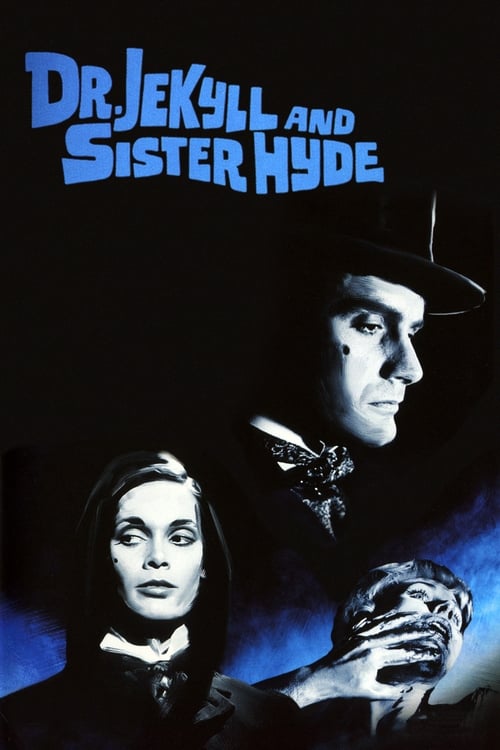




Oh, oh, oh my fucking god.Let's talk about Martine Beswick. Let's talk about the first transformation sequence, in which Dr. Jekyll swallows his brilliant new hormone cocktail and is suddenly, swiftly, and totally transformed into the female persona of Sister Hyde. Her self-realization is gradual and you can trace every inch of it on her face as it appears; Beswick's performance is loaded with the smallest of smallest physiognomic tics. Everything about her is carried so carefully and deliberately, yet effortlessly. She is performing and putting-on but she also feels entirely natural and comfortable. And as she has this first moment of recognition she crescendos from astonishment to joy, touching her face and body, shoulders and hair and breasts, examining herself in disbelief as if needing to make sure her touch won't dispel the illusion like a mirage. Her reaction is one of relief. Of liberation. Of joy, of amazement, of pleasure, of gratitude to be the person that she is. It's euphoric.And then Dr. Jekyll's hand appears where hers once was. The transformation was only temporary and now she is once again haunted by the body that she had before, the effects of her drug wearing off and receding, undoing themselves, in real time and right before her eyes. And then she is back in the other body, the other persona. Yet her determined spirit still lingers, and she would kill to make sure that she never disappears again.Dr. Jekyll and Sister Hyde is, through this recurring and emotionally intense conceit, a very complex representation of transsexuality, dysphoria, hormone replacement therapy, and somehow both the Burke and Hare murders and Whitechapel murders despite the fact that the former took place sixty years before the latter (cue the CinemaSins ding). It's not complex in the way that modern art is complex but complex in the way that your neighbor who shoots stray dogs bringing you the best strawberry pie that you've ever had in your life is complex. Outside of the costume and make-up department there was not, as far as I can tell, a single woman in the production crew except for Sally Jones the script supervisor, let alone any trans women. So how does one accept this representation in good faith? How does one justify enjoying, endorsing, a film which symbolically depicts transsexuality as a man needing to kill "natural" women to sustain his "unnatural" female alter-ego, which nevertheless capitulates to heterosexuality, and which must destroy its gender-fucking monster and reveal its chimerical horror before too many hard questions get asked? How?I didn't think of these questions while watching the movie. I was too busy watching Sister Hyde examine her breast with a mixture of curiosity and pride, and thinking about the first time that I noticed my own breast growth. The way that I examined my silhouette in the mirror, caught off-guard by the first visible changes of my transition, and how I smiled and cried at it finally feeling real. And I was too busy watching the distinction between Dr. Jekyll and Sister Hyde simultaneously collapse and separate as they warred over whose body it was anyway. Given that I'm home for the holidays I have been face-to-face with many pictures of my adult pre-transition self and that person in the pictures doesn't feel like me anymore. We shared the same body, but it isn't me, it doesn't feel like it ever was, instead it feels like I'm looking at a ghost of a long dead stranger that everybody else but me seems to know. It is I who exists, Dr. Jekyll, not you. It is I who will be rid of you.From Dr. Jekyll's very first monologue about the life-changing potential of female hormones I was letting this film wash over me, feeling like everything that I understand about my own transness, and the way that I articulate it, was appearing on-screen as if just for me. I feel like a woman who simply appeared one day fully-formed. So, so much prior to my transition feels increasingly distant and impersonal if not completely gone from my memory. Like Sister Hyde, I feel like the result of a sudden and dramatic impulse that was not made by me but was made by my body. I feel like the result of a decisive action that displaced the person who made that action, because he wanted to be displaced, because he wanted to create me and give me life in his stead. All the time I became more and more aware of her growing dominance within me.I'm still processing this film, still exhilarated by it. I feel like this film just gave me the greatest fuck of my life. Cinematically, it's shot like a beauty. Light from stained glass windows pierces the fog-drenched streets of London with color and Dr. Jekyll's lab is a lavish set, dense and decadently decorated in reds and rich wood tones. But there's some glaringly wooden acting from the goody two-shoes upstairs neighbors and the final act is admittedly a disappointing slog where instead of Jekyll and Hyde having a gender-fuck throwdown we only get a very boring police chase. As I come down from the high of this film I think about the moments that touched me. Admittedly, they are merely small morsels of the movie as a whole, but they touched me that much. The initial transformation/sition sequence, where Dr. Jekyll first drinks the serum, produced a smile on my face so wide and enduring that my tear-stained cheeks still hurt.If only, if only this could go farther, if only it could do more. If only, if only Sister Hyde could survive.