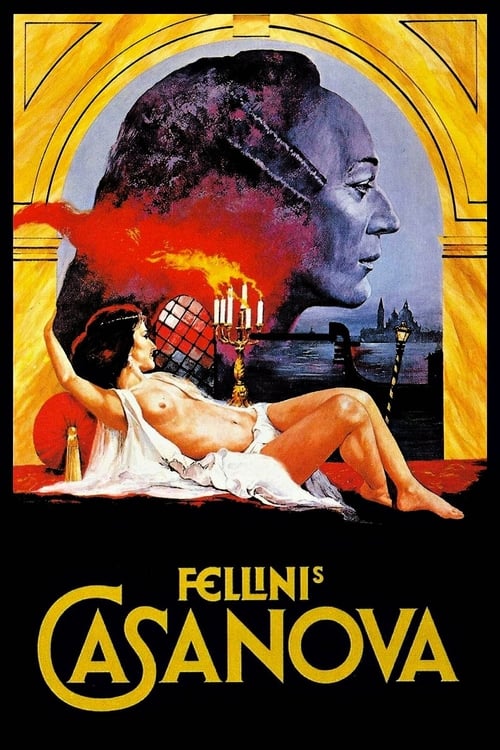
35mmI haven’t watched a ton of Federico Fellini’s earlier black-and-white work yet, but even from watching clips from his earlier work, I can tell Casanova comes from a completely different phase of his career. There’s a shift toward something more exaggerated, more artificial, almost theatrical in how everything is presented. The world here doesn’t feel grounded in reality so much as it feels constructed, like a stage where emotions and desires are heightened to the point of distortion. It’s less about capturing life as it is and more about reshaping it into something surreal and symbolic. That approach can be fascinating, but it also creates a kind of emotional distance that took me some time to adjust to.What really pulled me in, though, is the production design. It’s honestly incredible. Every set feels meticulously crafted, like you’re walking through a painting that’s been brought to life. The textures, the costumes, and the lighting all work together to completely immerse you in this version of 18th-century Europe. However, there’s also something intentionally off about it. The environments feel too perfect, too controlled, almost suffocating in their beauty. It adds to the sense that this isn’t a romanticized version of the past, but a kind of hollow spectacle. It actually reminded me a lot of Ludwig by Luchino Visconti, especially in how both movies explore figures surrounded by opulence yet trapped within it. In both, grandeur becomes isolating, and beauty starts to feel like a cage rather than something to admire.At the center of it all is Casanova himself, and the movie treats him like a cautionary figure rather than a charming legend. There’s something almost mechanical about the way he moves through relationships, as if he’s chasing an idea of desire rather than actually feeling it. The more he indulges in pleasure, the emptier it all begins to feel. That’s where Casanova really landed for me. It’s not celebrating excess. Instead, it’s exposing how repetitive and hollow it can become. By the end, you’re left with the sense that a life built entirely on indulgence and image eventually starts to lose its meaning. It’s a strange, sometimes distant experience, but one that sticks with you in unexpected ways.
An orgy of miraculous mise-en-scène. There is no other appropriate way to describe it. A clear contrast is made between life and death, between reality and fantasy, between the search of something alive and the filthiness of the means used to seek it, between natural and artificial. Sutherland's best performance in his entire career highlights this as he ventures into the most wonderful act in the world between two people in the most dehumanizing way possible.There are little things to be added to William Tell's all-encompassing approach. This is Fellini's opera out of control, and yet assured by an immaculate direction featuring an anarchic disorder that only Europe could conceive during the worldwide New Wave film movements and exploited during the 70s through visual transgression and cacophonic poetry. It is a controlled explosion, to say the least, Fellini's masterpiece in his own eyes, his most ambitious epic yet unquestionably, not married so much to Pasolini's pace and aesthetics as Satyricon (1969) was (that film was actually a predecessor to Pasolini's Trilogy of Life) as it is to a Bergman-esque stream of consciousness through the superficial lavishness and abundance of immorality of 18th Century Europe.And there are certainly highlights, not limited to:-The impressionistic opening and the drowning metal head-The sea made of trash bags-The Thames vision in London-The chandeliers descending in the Dresden theater-The organ concert out of control in Württemberg (fantastic scene, much aligned to Ken Russell's style during the infamous 1971 crucifix scene)-The mechanical doll as a culmination of his wooden, inhuman existence, no more mechanical than the acquaintances that plague Casanova's life86/100
"I am a creature of the elements, of air, of water—""—and of fire too, from what I've heard about you."Sexual politics writ largeFellini was fascinated with figurative Casanovas — his films are littered with them — so it only seems right that he eventually adapted the story of the real, literal Casanova. Curiously enough, however, he hated the character, referring to his life in an interview as a "void," and in the film he seems to wield this antagonism not just at the one man but at the entire European ruling class, from Italy to France to Germany. And Casanova is a sensible subject matter for this sweeping social analysis: his autobiography is considered "one of the most authentic sources of information about the customs and norms of European social life during the 18th century."But where Casanova's autobiography was factual, Fellini's account of his life is fictional and fanciful, providing more of a symbolic account of European high society than a literal one. One of the funniest throughlines for me is how everyone believes in some kind of magic or mysticism. Early on, Casanova is imprisoned by the High Court in part for "practicing black magic," and whatever the veracity of this accusation, he does seem to practice a kind of alchemy, as does almost everyone else he comes into contact with, whether it's astrology or entomology or something else entirely. Everyone's lives are filled with strange rituals and traditions, most notably Casanova's own sexual rituals involving a avian automaton.In this way, these overabundant "magical" rituals and customs of the European upper crust take on a kind of fetishism, mirroring Casanova's ceremonial practices and reflecting the orgy of sexuality taking place throughout the film onto the more mundane moments of casual social intercourse. Everybody here is constantly having sex and discussing sexuality, whether they're actually fucking each other or simply debating the supposed inherent merits of men and women as sexual identities. This is also why Casanova seems to fall in love with every attractive (and usually very young) woman who crosses his path: sex is not love for these people, it is just another meaningless ritual, it is just a lazy, casual pastime. As such a lover of love, Fellini seemed a strange candidate to critique Casanova at first blush, but by the end of the film it beings to make sense: sex isn't about love for the aristocracy, it's just another attempt to absolve their boredom, another aimless, ceremonial self-delusion, another alchemy, another avian automaton. Sex is just another form of power, and Fellini delights in watching Casanova lose his.1970s | Fellini | ItalyThe Years of Lead