

Texas seems like a horrible place to live.
1988: In der Kleinstadt Odessa, Texas, kreist das Leben nur um Football. Auf Coach Gaines lastet der ungeheure Erwartungsdruck, in seinem dritten Jahr das Team zurück zu alten Erfolgen und dem Gewinn der State Championship zu führen. Mit dem Supertalent Bobbie Miles, außerhalb des Feldes ein arroganter Maulheld, beginnt zunächst eine traumhafte Siegesserie. Als Bobby sich am Knie verletzt und seine Karriere beenden muss, können seine Kameraden den Verlust an Spielstärke nicht kompensieren.
Friday Night Lights läuft in 1 Kino in Los Angeles - nächste Vorstellung Donnerstag, 19. November um 19:00 im Los Feliz 3 Theatre.
Nächste Vorstellungen: Donnerstag, 19. November.
Vollständiger Spielplan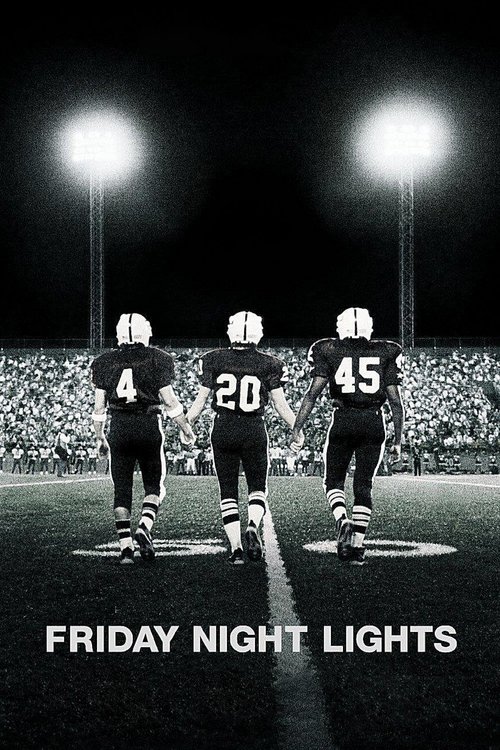
Spielzeiten zu Friday Night Lights, jeden Morgen aktualisiert
Wähle dein Kino und bekomm einen Hinweis, bevor der Film aus dem Programm fällt.
Texas seems like a horrible place to live.

CW: racism, sexism, ableism, homophobia (implied?), capitalism, AmericaIt's not even coded. It's not subtext. The final team to beat is "black." The film acknowledges this within the context of the story, but it doesn't acknowledge the full sociological or historical context of it. It doesn't seem to understand that posing the Panthers as a mostly white-led team desperately trying to win as underdogs against African-American non-characters is part of the tainted tapestry of American history, the densely woven narrative that has demonized and commodified African-American physicality for centuries. That the film frames these underdogs effectively as people to root for makes me uneasy. Further, the touching father-son drama between abused and abuser is horrifying in its emotional impact.This is intricate Americana. It embodies the flaws of America and relishes the most American of sports (to hell with baseball). It draws on the classic American dream (one of the players even references homeownership) of fame, fortune, and familial security. It revels in the wide open spaces of Texas, the community-spirit-infused commercialism, the pettiness and pride, the overwhelming masculinity, and the grand spectacle of sports. It also softly whispers that there is nobility here, that what these children embody is something more than the exploitation they are subjected to, that their leaders have hearts and minds that serve as a bridge, a vessel to convey love amongst them past the barriers crafted by toxic patriarchy. To put it another way, within the context of the Sports Movie, men are allowed to be vulnerable, to show fellowship, to be human, even as the films perpetuate the idea that they are invincible (if only in spirit), titanic individuals (celebrities and superstars on a team together), and symbols (totems for small towns and America itself). Having seen the show (and, like anyone with a heart and the ability to interpret Kyle Chandler's body language, loved it), I find positive associations here. Stylistically, the show borrows heavily from the film. The quiet moments of setting-porn, detail shots, atmospheric Explosions in the Sky soundtrack, tastefully deployed montages, classic locker room speech monologues, and that Texas-Americana spirit all are shared between the two. The association of those qualities with the show benefit the film, carrying over some of that goodwill. Perhaps because of the increased temporal space, perhaps because Jason Katims and his team are more empathetic, perhaps because of some matter of style or economy, the show improves upon the film in its depiction of women, people of color, people with disabilities, and even queer people (the latter only very quietly). It's not perfect on any count, especially not people of color, but it's so much better than the film. Connie Britton has almost no lines (she makes the most of her time on screen), and the one other significant female character is an unwell elder whose screen time is also mostly silent and teary eyed. The film is compact, hewing closer to reality than the show (the film takes this bullet for the show, allowing the showrunners to explore fictionalized versions instead, giving them freedom), but in doing so bearing the faults of actual America. What gets cut out are all the things that America always cuts out. What gets downplayed, what gets Othered. The film serves as a blueprint of what the show needed to do and what it needed not do. It filled out the personal relationships. It changed the injured-player storyline. It introduced women as characters and not props (and let Connie Britton shine in her role as the best television character of her era). It acknowledged the role of race (poorly at times), and it made the sports just a part of life, effectively conveying the impact of High School Football on the community without sacrificing the community-as-character as the film seems to. To put it another way, it makes great use of its breathing room. This is a piece of a strange media tradition, of the history of media-crossing adaptations. (Reality to book.) Book to film, film to book, film to television, television to film, and so on, these transitions always involve new imprints, new ideas, new creators filtering old ideas, old stories, old truths into completely different realms. The friction between these versions of the same story then create stories unto themselves, and it all becomes this constructed context that every part of the story, every stop on the road, is retroactively influenced by. No doubt resident of Odessa have started remembering things differently (either in defiance of or agreement with changes made in film or on television or in print). No doubt the original author's objections and approvals affect how some people view media interpretations, and the references to each version in each new version (as I say above) create associations. This, too, is Americana, an infinite feedback loop through history where truth and fiction battle, where minds change, where contentment and frustration mingle. The film is a reflection of this complexity, even as it is a distillation of it, a watering-down of it.What it suggests, not in the text of the film but simply by being part of the cross-media continuum, is that nothing is as easy as any single media can convey. Yet the potency of its imagery, of its climatic battle, of its bittersweet (really, sweetbitter) tone, of its solution of quiet and loud, of its mythopoeic energy defies that idea, because what you feel something, and feeling, emotion, is what motivates us to act (not fact, not reason, but emotion). That this flawed fragment of the forever incomplete American narrative has that power is the essence of the impossible complexity of the same American narrative, somehow conveyed even in this broken form.(And because I can't stop myself: Clear eyes, full hearts, can't lose.)

The 1988 Odessa Permian Panthers are the worst losers in the history of sports. Absolute bums with a Mickey Mouse schedule and a disgraceful performance in a Texas State Championship they only got into on a coin toss.
Eine turbulente Stadt ist besessen von ihrem High-School-Football-Team, wo intensiver Druck und soziale Spannungen nach einer frühen Verletzung des Starspielers ihren Höhepunkt erreichen.
Friday Night Lights wurde 2004 von Peter Berg inszeniert, einem amerikanischen Filmemacher, der für seine charaktergetriebenen Dramen bekannt ist.
In den USA ist Friday Night Lights als PG-13 eingestuft.
Friday Night Lights wurde am 8. Oktober 2004 in den USA veröffentlicht.