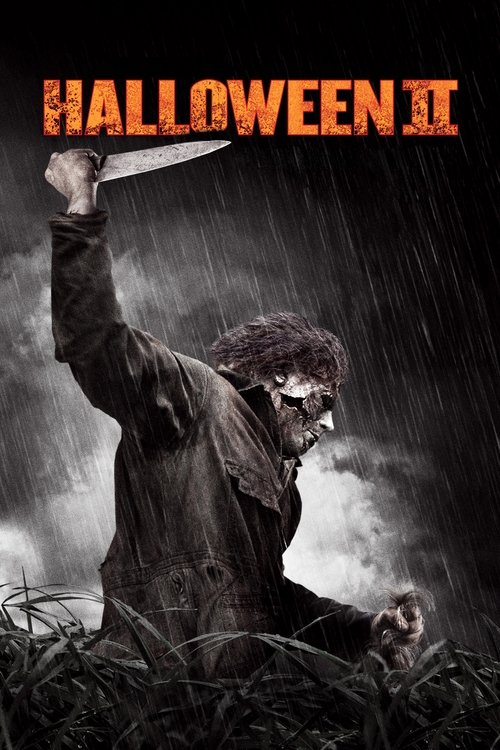
100In Rob Zombie's Halloween (2007), there's a moment where Laurie discovers Annie laying on the floor of the Wallace residence, all cut up by Michael Myers while her boyfriend's body is hanging from the ceiling, a pumpkin stuck on his head. Laurie checks on her and then runs to grab a phone to dial 911. Annie starts to call out Laurie's name, over and over, a tired repetition setting in, feeling fruitless and desperate. It turns out that Michael Myers is still in the house, and was patiently waiting behind the front door. The audience knows this, and so does Annie, but not Laurie. Rob Zombie forces us to listen to Annie's pleas, but in the midst of this traumatic experience, she can't say anything besides Laurie's name. Plenty of horror films, especially recently, have supposedly had things to say "about trauma", which is silly considering Horror in its entirety is usually based on traumatic events, but few compare to Rob Zombie's duology, particularly this second film. Not only do these films depict a visceral, and realistic, scenario of terror, but Halloween II refuses to shy away from the aftermath of its violence. Watching the Unrated Director's Cut for this film is essential. Rob Zombie has elaborated on why:"The way we cut it for the theatrical, Laurie Strode’s character is the main difference in the two. (In the theatrical) She’s holding it together, getting her life together and it starts spiraling downward. In the other version, she’s an incredible mess and gets worse. She never has any good moments, she’s just messed up, she’s lashing out at everyone, she’s horrible. Messed up on drugs, she’s just completely spun out through the whole movie. It makes for a real challenging movie to watch and I feel like I don’t know if fans would’ve embraced so much darkness."What's so powerful about Halloween II is the sense that no one from the first film has fully recovered, and any new supporting characters fail to understand the extent of the anguish from our returning cast. The 1981 sequel was set on that same Halloween night as the 1978 classic, so it's more of an extension than anything else, and other films in the series which revolved around Laurie's trauma have been grander in scope (H20, Halloween '18). Rob Zombie's sequel is bruising and intimate, with Laurie living with Annie and her dad, Sheriff Brackett in a creaky old farmhouse. They're all struggling, and failing, to cope with the murders just two years prior. And Michael Myers returns not quite as a spectral vision of death as in the usual Carpenter mode, but a manifestation of trauma, a void of familial decay and cruelty, a blank face barely hiding behind the mask. Rob Zombie examines Laurie's relationship with her therapist, her addiction to prescription meds, as well as her rocky personal relationships, not to mention the eventual exorcism of her family history, all while pursuing a level of darkness and savagery not found in any other modern horror film. The opening twenty minutes or so is a mini-masterclass of a Slasher, and almost unbearably sadistic. But not without purpose. Not just a mere dream sequence - it establishes the physicality of Laurie's trauma. She lives through nightmares like that every night, over and over again, an echo that manifests itself in this sequel as vinyl record skips when Annie is murdered by Michael. Here, Laurie calls out Annie's name as she discovers her body on the bathroom floor. This time, she's too late. Telling her friend to call the police, she slips right back into that mode of survival and resilience, because the experience has never gone away. She's relived it ever since that Halloween. The 16mm photography by Brandon Trost not only captures the grime of the gore, but the encroaching darkness and evil returning to Haddonfield. Bright patches of white light smothered over pitch black forests and fields of land. It feels like the only source of light is from the dreamy images of Michael's mother and his younger-self, bathed in angelic calm and sincerity. Otherwise, the film is as hopeless as any other I've encountered. What was autumnal and jolting in the 2007 film is now bitterly cold and sinister. Halloween II feels like the late-night hours of All Hallows' Eve, when it's technically November 1st and the brisk air is not necessarily a Fall chill anymore but a calling card for Winter. Brad Dourif's performance, much like Scott Taylor-Compton's, should've received an Academy Award. His scream and murmurs of pain when he discovers the body of his daughter is so terribly sad, I can hardly bear it. Just as affecting is when Laurie lays with her, petting her hair and calling her 'baby', just hoping that she wakes up, that this experience itself is a dream. Rob Zombie knows there is no escape from the wounds of the first film, and anything happy or joyful is a fleeting ray of sunshine amidst an ominous cycle of agony. There isn't a horror film from the 21st Century that I appreciate more than this one.
Fuck this movie.Fuck that pointless first 20 minutes.Fuck that white horse.Fuck the cringe worthy dialogue.Fuck Rob Zombie for thinking women/teens/human beings really talk like this.Fuck Rob Zombie for turning Michael Myers' story into some weird LSD pipe dream that only he understands.Fuck the studio for forcing Rob Zombie into making this movie because they couldn't leave well enough alone.Fuck every character who was remotely likable/bearable in the last movie who decided to turn into huge assholes in this one.Fuck "new Loomis". He's such a cunt.Fuck new Loomis' cunty mustache while we're at it.Fuck new Laurie, who is way too unlikable to sympathize with.Fuck new Michael and his LSD pipe dreams.Fuck new young Michael, who looks nothing like the old new young Michael from the last film.Fuck the fact this movie angered me even more than when it first came out; this must me what Laurie was talking about when she was talking about her "0 to 100 rage".Fuck the asinine writing, fuck the unbearable characters, fuck Rob Zombie's self-indulgence...fuck this shit!Fuck this movie!But let's not fuck Halloween II for trying to be different from it's original material.Fuck Halloween II for trying to be different and turning out to be really dumb.And while I'm at it, fuck the Letterboxd community for convincing me to see this again with all your praise and five star reviews. You fuckers trolled me! Fuck you guys...I'm going home.(I'm joking btw. I love you guys, but you're full of shit if you say this is a masterpiece. You're entitled to your opinion, but I'm entitled to say you're full of shit. With that said, I wanted to like this as much as you guys. I really did. Again, I appreciate Rob Zombie for trying something different with pre-existing material--especially that, from what I've read, he wanted to be one and done after the first Halloween, but when the studio insisted on a sequel with or without him, he came back to ensure his vision would be intact--and he gets a couple cool looking shots and visuals in. Not to mention, Brad Dourif is a great sheriff. But I hated it as a whole; so much that whatever few positives I could spew about this get tossed out the window. Yeah, he tried something new, but very little to none of it is good and when it's good, it's poorly executed, like I think the psychic link stuff had potential; I kinda liked it in Halloween 5. It's not often that I hate films nowadays or even write reviews this long, but alas, that's the case right now. Sorry, but not sorry.Happy Halloween)
This was initially only going to be a comment, but I spent enough time on it that I thought I should utilize it as a review, for it sheds much more light, than my previous review, on why I hold this film in such high regard. Halloween II is really the only one of Rob Zombie's films that I'd go as far as saying I love, and I love it deeply, because it -- for me, next to Lynch's Twin Peaks: Fire Walk with Me -- handles the treatment of post-traumatic stress disorder, whether directly or peripherally, better than almost every other English language film that I've seen. As a diagnosed sufferer of PTSD myself, a film on the subject matter really only needs to execute three aspects effectively in order to completely win me over: 1) atmosphere, the atmosphere of PTSD being wholly inexplicably, aside from something that I could potentially describe as being soaked in dread, though I won't even attempt to describe what this atmosphere is or how it feels, because I've been trying and failing to describe such an atmosphere to therapists for years now, so I doubt I'd be able to flesh it out in a capsule-sized Letterboxd review... but I digress, no film has ever nailed this atmosphere fully, though here, Zombie does come close, 2) performance, in the sense that the performance of the sufferer must be -- at the very least, in my case -- as violent and abrasive, in the non-physical, response-driven sense, as the trauma that was inflicted upon them itself... it must be chaotic, it must be loud and, most importantly (again, for me), it must be confused, because being trapped in a state of post-traumatic stress for an elongated period of time is the most baffling experience that I could ever attempt to illustrate to a non-sufferer; Taylor-Compton somehow achieves this feat, and more effectively than most of the other actors I've seen in her position and 3) a sense of the present being enveloped by the past, a sense of a non-present, an existence fully consumed by the trauma of preceding events, an inability to move forward, as if trapped in a thick, murky swamp or pool of sinking sand, and this is what I admire most about the film. I'll conclude by mentioning -- due to so many detractors having qualms with Laurie's lack of charm -- that characters suffering from PTSD are often not going to be portrayed as easy to like, and accurately so. When your life becomes consumed by a previous portion of your existence, and you lose your sense of (present) self, you become detached. You lash out. You're angry, unable to form or commit to relationships with the human beings in your environment. You're suffering from a psychological disorder, an imbalance of the mind, and thus whether or not you're a pleasant person sort of falls to the wayside, at least with regard to reading the film, and should become a background point of your character's disposition (it's almost analogous, in my eyes, to finding the schizophrenia-suffering main character of Clean, Shaven unpleasant, and thus docking points from the film as a result). I hardly even view Halloween II as a horror film in the traditional sense, or a slasher; I more so view it as a vehemently brutal, psychological family drama purely containing instances of extreme violence to assist in the expression of a perpetual sense of unease and trepidation looming over each and every individual in Laurie's existence.