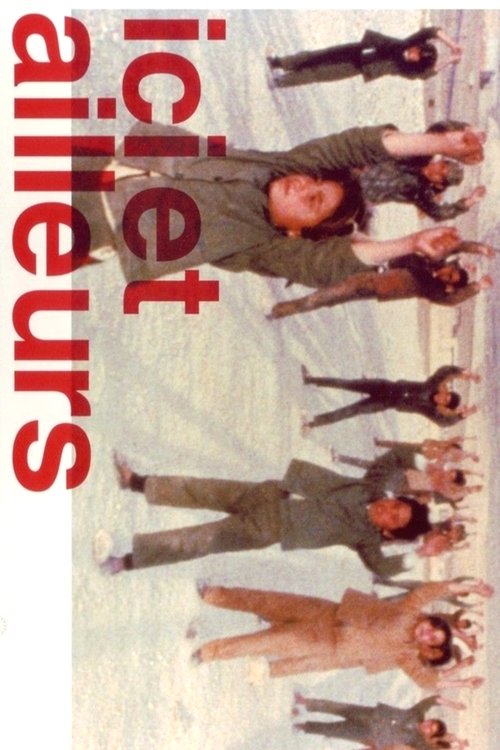
"Hier ist eine durchschnittliche französische Familie vor ihrem Fernseher. Anderswo sind es palästinensische Kämpfer, die vor den Massakern des Schwarzen Septembers gefilmt wurden." (JLG, 1976). "Wir sind hierher gekommen, um das zu studieren: um zu lernen, um Lektionen zu lernen, wenn möglich, um diese Lektionen aufzuzeichnen, um sie dann hier oder anderswo auf der Welt zu verbreiten.“ Vor fast einem Jahr untersuchten zwei von uns die Demokratische Front. ein anderer ging an Vater. Wir lesen die Texte und die Programme. Als französische Maoisten haben wir beschlossen, den Film mit Fath zu drehen, dessen Titel „Bis zum Sieg“ lautet. Wir ließen die Palästinenser während des Films selbst das Wort „Revolution“ sagen. Der eigentliche Titel des Films lautet „Methods of Thought and Work of the Palestine Liberation Movement." (JLG, Manifest, Juli 1970)
Embodies the 70s Godard aesthetic of excessive stimulation not only because it employs it, but because that’s what it’s dealing with on the thematic level as well. Even in the bourgeois French home, the children watch TV, then do homework, then eat dinner—an itinerary with little room for deviation. The idea of overstimulation is similar: if we are being faced with an unending succession of stimuli, which will each naturally seem to build upon the prior given the simple fact of how these signals are interpreted, how can we deviate and watch/listen to something else.By assaulting our senses and thoughts (is it possible to fully process such wordy musings given the speed at which they’re related to us?), Godard and Miéville alert us to the fact that our (read: Westerners’) perception of the exterior has, essentially, been colonized. What we perceive is actually fragmented, already processed, the range of response is predetermined.It is not the filmmakers’ task, nor is it within their power, to provide answers or show us a way out of this situation. To do so would be to assume the same function of the TV movie that provides the basis for this experiment: present the materials in an undeniable cause-and-effect sequence to impart a personal interpretation of events. Instead, the gonzo formalism undermines the pre-processed image. They are not allowed to make their case, complete their statement. The result is the revelation that pre-processed stimuli have led to a sublimation of self. Robbed of the ability to interpret the world freely, who do we become?
joakim dreams of peace4.5
Ici et ailleurs, Here + Elsewhere, Everywhere and Nowhere"Learn to see here, in order to hear elsewhere"To Jean-Luc Godard, the extreme leftist years 1968-1972 were all about aggressive attemps to influence the audience with Jean-Pierre Gorin; and then, poof. What was something idealistic and seemingly simple (Jusqu'à la victoire - Until victory), faced the cold truth: death.We are but an endless montage. Sequences in space and time, images, sounds, triumphs, failures, truths, lies. Shouldn't the world be so simple, or did something just complicate and corrupt it? War, politics and how easily cinema can manipulate reality. Should we ever allow lies, even for a good cause? Hopes and dreams turn to dust, noise to silence. Here and Elsewhere... and they say that Godard, the self-proclaimed God of cinema, isn't capable of self-criticism. Godard abandons the overtly & overly done Marxist propaganda of his Groupe Dziga Vertov days, returning to examine the shortcomings and perhaps the true meanings behind that period through fragments of a film with his partner Anne-Marie Miéville. Not a one-sided manifesto unable to resonate with our reality, a dialogue. Godard's sense of despair and failure pitted against Miéville's criticism and cautious optimism results in grim, powerful moments, yet also somehow leads the audience to a kind of gentle Ōbayashian message – we can't change the past, but if we learn from it maybe all hope isn't lost, and we can change the future. Or, we can simply be consumed by our couches and TVs. Your choice.Here and Elsewhere is an essential film, a picture which echoed in Godard's work for decades all the way to 2018's The Image Book. JLG didn't only confront his past and bury the remains, but he chose to move on and surpass himself. I don't know if Miéville was the key to Godard's salvation and reincarnation, yet one thing's for sure: in 1976, the king had returned.
Matheus Fiore5.0
“(…) Mas de onde vem o fato de a gente ter sido incapaz de ver e ouvir estas simples imagens e que nos, como todo mundo, disséssemos outra coisa sobre elas? Outra coisa diferente daquilo que elas disseram? Com certeza é porque não sabemos nem ver, nem entender, ou pode ser que o som esteja tão alto que cubra a realidade. Aprender a ver aqui para ouvir lá. Aprender a se ouvir falar, para ver o que fazem os outros. Os outros, esse lá do nosso aqui”.Entender o que nos é vendido e como é vendido para entender o que é omitido. Entender a máquina de propaganda para entender o que ela esconde. Entender que tudo é reflexo da realidade, mesmo aquilo que muito tenta fugir dela. Tudo que é projetado aqui dialoga, a família francesa só está em paz em seu sofá vendo televisão porque em algum lugar do mundo tem outra família sendo massacrada. Tá tudo na montagem.Ademais, “Israel” é um estado ilegítimo e precisa acabar. Liberdade para a Palestina, custe o que custar.
More like this
Häufige Fragen
Worum geht es in "Here and Elsewhere"?+
"Here and Elsewhere" kontrastiert Aufnahmen von palästinensischen Kämpfern mit Szenen einer gewöhnlichen französischen Familie, die fernsieht, und untersucht, wie die Medien politische Kämpfe verzerren.
Wer hat "Here and Elsewhere" inszeniert?+
"Here and Elsewhere" wurde 1976 von Jean-Luc Godard und Anne-Marie Miéville inszeniert.
Wann wurde "Here and Elsewhere" in Frankreich veröffentlicht?+
"Here and Elsewhere" wurde am 15. September 1976 in Frankreich veröffentlicht.