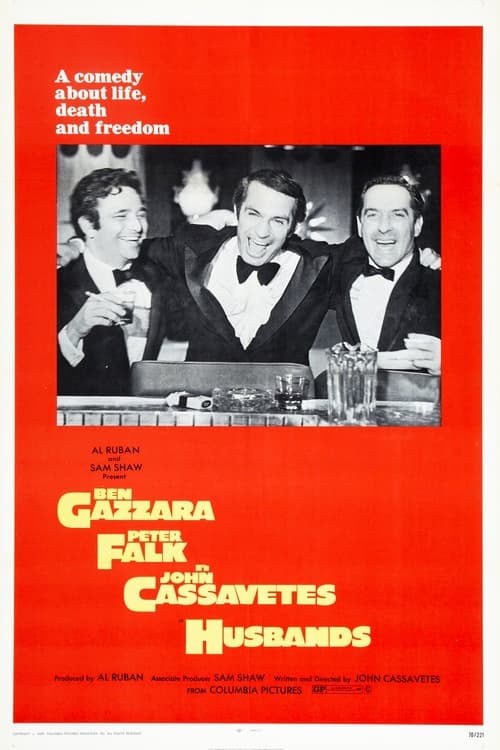





Husbands is a survey of the male midlife crisis as depicted by three friends who abandon home, country, responsibility, civility, and sanity when confronted with their own mortalities in the wake of a beloved friend’s death.It cannot be overstated how alienating this experience was for me, a woman. Seeing John Cassavetes, Ben Gazzara, and Peter Falk traipse about New York City and London in madcap fashion on the hunt for booze and cooze wasn’t exactly an unfamiliar antic in the tropes of film (or in the lives of ordinary people), but it was the potency of their iniquities that induced in me at turns woeful embarrassment, anxious alarm, putrid disgust, rankled confusion, tearful shame, and vacant hollowness. They show their capacity, in the most transient of microseconds, to be charming, but those moments are eclipsed by their own fears and how darkly they manifest on the screen.There are two modes of intercourse within the story, the interplay of the three titular husbands with one another, and the interactions they have with the women featured in the film. As intimates, we see Gus (John Cassavetes), Archie (Peter Falk), and Harry (Ben Gazzara) feed on a fraternal dynamic; the energy, even at its most aggressive, seems to nourish them, as if they had been feasting on this familiar, yet decomposing, power exchange for years. They know each others secrets, their aspirations, their doubts, and there is an obvious acknowledgement of their bond being a steady vessel, cutting through the mundane waters of middle life until the fourth member of their crew, Stuart, passes away. The boat is now unevenly ballasted, and they’re down a crucial oarsman. Their staid trajectory starts to veer into a storm, and as they scramble to acclimate they push the boundaries of their friendship in a way that is palpable as the torrents of their uncertainty and pain. They compete for dominance, they argue and they jest through the unwieldy, sloppy navigation; they’re not sure if the boat will overturn, but they refuse to abandon ship. The women who encounter the trio amidst their monsoon of grief and existential impasse are collateral damage that these men use as fodder. While there is an unnerving, competitive undertone to the male friendship, it is also one that is built on a mutual respect. These fleeting interludes they have with women (be they barfly compatriots, wives or one-night-stands) show a callousness and disregard for female humanity. The husbands use these women like vessels, draining them of their dignity and refilling them with their own masculine insecurities. One such victim, a local day-drinking former beauty entering retirement years, is roped into singing a cappella for the intoxicated threesome and subsequently receives a castigation so viscerally triggering—complete with threats of violence, physical abuse, and sexual assault—that my boyfriend had to pause the movie for nearly ten minutes while I curled into a corner of the couch and cried intensely. This proved to be the first of several repugnant episodes with women, save for the scene with the imperial Delores Delmar.As the rascals cruise a London casino for available women, Archie finds himself entangled with an elderly, aroused Countess who with the turn of her head and click of her teeth completely swaps the conventional gender roles of predator versus prey and disarms the trapped cad by forcibly objectifying and propositioning him. I hurrahed and cackled and honestly felt it was the only time in the 141 minute runtime that Cassavetes softened his vice-like, claustrophobic chokehold on my psyche. This film is an anxiety-inducing, bitter pill, but one that exposes a lot of raw truths that most directors (and actors) don’t dare tackle with such honesty.