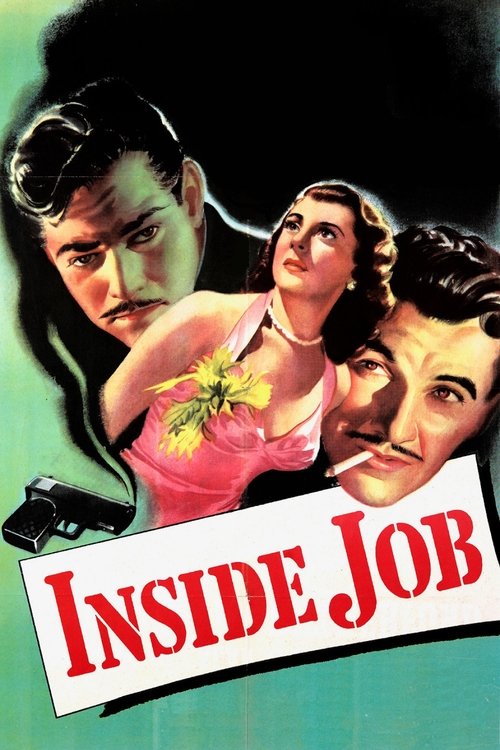



There is some great, repeated imagery in Inside Job, with smooth gangster Bart Madden (Preston Foster) keeping an eye on his former partner/blackmail victim Eddie Norton (Alan Curtis) by standing outside the department store window in which Norton works. While Norton wears dark eyeliner and acts as a mechanized model, staring blankly into space, Madden comes and stands front and center. And, inevitably, Eddie drops his eyes to Madden, acknowledging his presence. Which, really, is all Madden wants — just to be an irritant in Eddie's life; to feel as if he has power over him. Sadly, nothing else about the movie is as compelling as those moments, and the relationship they suggest. Immediately after discovering Eddie is back in town, Madden pressures him to again take part in a robbery, this time of the department store in which both Eddie and his wife work. Eddie is resentful and angry, but it takes him literally ten seconds of conversation with his sweet, innocent (?) wife — who had no idea he was an ex-con — to shift from dismay over Madden threatening to ruin his life and torpedoing his chance at reform to a determination to do the robbery himself, and take all the money. His commitment to changing his life was, it appears, was extremely weak, because he and his wife (Claire, played by Ann Rutherford) immediately start dreaming about the life the stolen money will grant them.The rest of the movie is spent with Madden and the cops trying to catch up with Eddie who, none too wisely, vanishes when the money is stolen. There is a potentially fun storyline of Claire and Madden mutually trying to seduce one another to nefarious ends, but it's nipped in the bud before anything complicated can happen. Similarly, there is another gesture toward something interesting in Claire's dream of the one thing she really wants in life, which goes unnamed — if we want to be charitable to the movie, we can imagine that thing will lead her and Eddie into more robberies in the future but, realistically, there's no reason to believe that. So, in the end, things go as expected: the bad guys get their comeuppance, and the wayward good ones go off to do their time and reform (again).