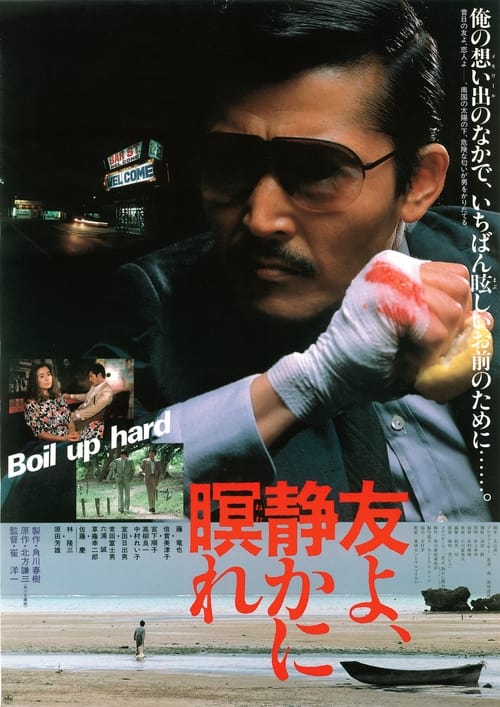
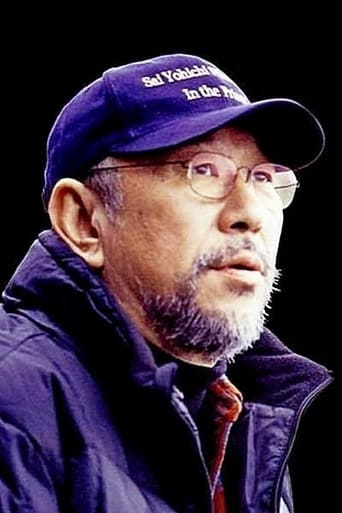
The Searchers Film Podcast - Ep. 78Guest Odie ArbuckleSpotify - Apple - PodbeanThe missing father figure is a commonality in the gangster genre, as the disgruntled youth looks to the first kind hand that reaches forth. The Henry Hills, the Noodles, the Jesse Pinkmans of the world... the overarching, rebellious system becomes the replacement for the protector and breadwinner of the family. Hypothetically, it's a system to counter the system. Every inch of Yôichi Sai's film is potentially darker than the photography of Don Vito's compound, with nary a candle for a close-up, but the darkness harnesses the fatalistic tendencies of the greatest noirs while carrying its sole ray of optimism. It's not that the protagonist succeeds with what he sets out to do. Shindo (Tatsuya Fuji) has a clear reckoning. Hayley Scanlon astutely writes, "his preoccupation is with a failure of masculinity". Masculinity isn't a state of power hunger (Michael Corleone) or sweaty muscles and drugs (Tony Montana), it's not a reckless use of sex (Tony Soprano). It's filling a role that holds up the other half. It's a quiet man who serves. But without being pedantic, the film adopts this truth within the narrative, utilizing subtle visual cues and a camera always intent on slowly crawling or spinning around a room. Every frame is like a contemporary masterpiece you'd think was found in deleted scenes of Thief (speaking of father figures and the desire to fulfill that role). The general pessimism recalls Hiroshi Teshigahara's The Man Without a Map in how the lead detective finds his case so disheartening. Exactly how many lies and untold details must one man go through to find truth? Perhaps the symmetry of digging through lies handles a catharsis of dealing with one's own. The distractions life offers makes it easy for us to lose our identities, struggling to build them all the while, which rings close to home for the Japanese.In the description of the film, Shindo's character is described as "charming young men, softening a hard woman, and busting a few heads" while confronting the powers that be. His presence creates a series of ripples when the realization of what kind of man he is counters the status quo. His conversations with Shima (Mitsuko Baishô) ponder of the manifestation of a "nice guy". Whether Shindo is just the vessel for change in the corrupt throes of societal normalcy or a potential symbol for a good man, Let Him Rest in Peace poetically depicts the moral showdown like Mitchum's Marlow in Farewell My Lovely. It's a stunningly crafted picture that creates commentary on the past and present with a glaring and mystifying hope for the future.
Pretty good Japanese neowestern. A stranger arrives at a corrupt town looking for a friend, and a place taking over by a developer with criminal connections slowly reveals itself. To sell out seems preferable to wasting away, although that is what everyone is doing in a way or another, outside if outburst of violence. The movie constantly shifts between a resigned withdrawal and macho displays of desire of ownership. Lots of signifiers about how the place used to thrive due to post-war American presence that is long gone. Very good dark-lite cinematography and great attention to sets. It is very downbeat and careful observes the town. It is very uninterested in genre payoffs or much narrative drive, it seems far more interested in evoking associations and iconography.
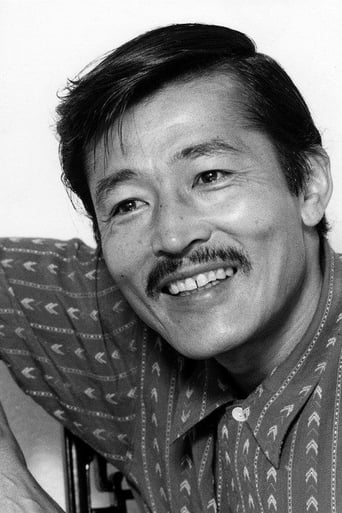
A failed Doctor, Shindo (Tatsuya Fuji) travels to a rural Okinawan town to help a childhood friend who has been locked up on suspicious charges that seemingly go against his nature. On his arrival he is met with deep distrust from the locals as he doggedly investigates the truth behind his friends incarceration and finds that the town is under the iron grip of a Yakuza backed construction firm with police protection that is buying up all the local properties.Yoichi Sai's Noir tinged, slow burn Neo-Western is a fascinating and gripping thriller centred around an almost ghost town, whose scars from the American presence just won't heal. A fantastic opening shows Shindo driving through a once prosperous town that has completely lost its identity, a fact reflected in the distrusful population who can barely hold his gaze or even speak to him, let alone give him directions to the decrepit hotel he is looking for, owned by his old friend and current persona non grata for not selling out to the construction company. Old, worn signs adorned with Donald Duck, Coca-Cola and American slogans litter the long shuttered businesses of the town, with the few local residents clinging on to whatever business they have left in the desperate hope of new money somehow revitalising the area. Sai then teases out his story at an almost glacial pace, as the real reason for Shindo's friends imprisonment is revealed via the various residents he meets. Bar girls and their mama, a small boy being threatened for a signature, an ex boxer working for the Yakuza and a young gay man all cross his path in his search for the truth before a fateful showdown through an 80's lens reveals the films title personified. I must admit I wasn't a fan of this film at all on a first viewing a few years ago, but this time it really, really clicked. Sai's cinematography choices does indeed leave a little to be desired, with some scenes feeling very underlit, though watching on a new TV this was less of a problem this time around and certainly seemed an intentional choice by the director in order to convey the fatalistic mood of the film, though I certainly understand why it could be a problem for some viewers.The cast is uniformly excellent, with the ever reliable Tatsuya Fuji leading the charge with a superb, understated performance as Shindo. Presented initially as a drifter, his character slowly unfolds over the course of the film and leaves quite an impression by its ending, it's a quiet unassuming role that oozes charisma and a quiet unspoken masculinity which Fuji excels at. Joining him is fellow tough guy Yoshio Harada in a small but important role as the ex boxer, fulfilling his preceived debt to company president Kei Sato, both actors are of course very good as before their status and it would be remiss to not to mention fellow veteran, the one and only Hideo Murota as the stubbled, beleaguered local dirty cop. Perhaps most impressive though, outside of Fuji himself is the wonderful Mitsuko Baisho in a stunning multi layered performance as the wife of Shindo's friend. Wife, mother, bar mama, hotelier, confidant, she is the films backbone and plays an important role to proceedings as the glue holding together a bunch of disparate characters, it's a very subtle but nuanced role that constantly questions the central themes of the film in a brilliant way.Let Him Rest In Peace isn't for everyone, it certainly didn't work for me first time around either but it's one that I would highly recommend, a slow burn thriller, armed with a terrific cast and a great payoff that plays with some really engaging and interesting themes. I have to say too that between its central themes and characters, this film perhaps more than any other in Yoichi Sai's filmography made me see the influence that he had on Takeshi Kitano's career as a director.