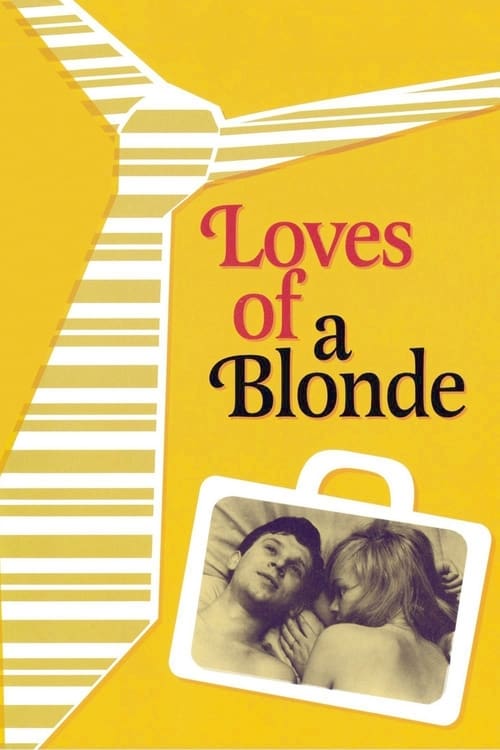
A bold film with a sharp look at the fragility and collapse between the individual and the external forces that shape their destiny. It was produced during the height of the movement known as the Czech New Wave. Under communist rule, the country was living the years leading up to the Prague Spring, a brief moment of attempted political and cultural liberalization. However, despite the state supporting artistic freedom, it was actually very limited, and the director took the opportunity to fearlessly portray the silent struggle for authenticity in a society deeply marked by censorship, state surveillance and repression of individual freedoms.The protagonist, Andula, is one of the symbols that embody this criticism, she represents passive resistance and serves as a vivid portrait of disillusioned youth, trapped between the empty promises of the system and the human desires for freedom and love.Creating this narrative that pretends simplicity, but vibrates with the underlying complexity, the film shows us the falsehood of the communist dream without resorting to didacticism, which unsurprisingly, led to its ban from distribution throughout the Soviet Union.The film is like a mirror of their country, revealing not only the contradictions of the regime but also the intrinsic fragility of human emotions and resilience, fighting for space in this controlled and suffocating environment. The interactions in general are both a comedy of manners and an existential, subtle tragedy, but on the line between bitter irony and melancholic lyricism, an allegory of the impossibility of finding fulfillment in a system that reduces love to a transaction.
Revisited this gem on the new Second Run Blu-ray (titled A Blonde in Love). I love this film. So funny and a really great lesson on real time conversations and interactions on film. Blu-ray is Region-Free .Extras are great but it appears I have to watch Black Peter asap.- Trailer - trailer promoting the 4K restoration of Loves of a Blonde. In Czech and English text, with optional English subtitles where necessary. (2 min, 1080p).- Life As It Is: Milos Forman on his early Czech films - Part 2 - the first part of this wonderful documentary was included on Second Run's release of Black Peter. Here Milos Forman discusses in great detail how he managed the professional and non-professional actors during the shooting of Loves of a Blonde, the type of atmosphere that he sought for the film, his extremely important professional relationship with cinematographer Miroslav Ondrícek and assistant director Ivan Passer, the 'proper' type of humor films like The Firemen's Ball needed to survive, etc. (The Firemen's Ball was actually banned after the a top member of Politburo saw it and went berserk). The late director also explains how Claude Berri and Francois Truffaut helped him escape from Czechoslovakia after the Soviets invaded the country in 1968. The documentary was produced by Robert Fischer for Fiction Factory. In English, not subtitled. (27 min, 1080p)- The Projection Booth - this podcast features Kevin Hefferman, Samm Deighan, and Mike White. It was recorded exclusively for Second Run's release.- Booklet - 22-page illustrated booklet featuring an essay by critic by Michael Brooke and technical credits
I fucking lost it when the blinds fell to the ground. I generally accept that old adage that comedy is cruelty. Perhaps I work too hard to find the cruelty in some jokes (puns, for instance, are cruel to those who hear them, and that's where I derive pleasure from them), but in this film, I need not have worked at all. From the moronic soldiers trying to work up the gumption to get laid to Milda's tangle with the blinds to the agonizing discussion his parents have in front of Andula about her presence, the film is one long, cruel laugh. But not in an inhumane way.It wisely positions Andula as a sympathetic protagonist and making those around her the real butt of the jokes. There are a few awkward moments where she seems to fall victim, but even in the bizarre shin-kicking bit, Milda comes off more the fool than she does. When the final joke kicks in--the most cruel joke, the climax of the film, wherein she learns how unwelcome she is--it's not a funny joke so much as a dark twist of fate. What would be and was mined for comedy moments before turns on its head, because she has been the one we root for.Atypical to most romantic comedies or sex comedies, this doesn't come with a prepackaged happy ending or a weak-willed heroine. The ending is arguably happy, but it's not the one Hollywood would have chosen. And the heroine isn't perfect, and certainly comes off as naive, but she isn't without agency. It also eschews any judgment of the sexual adventure Andula partakes in. Her naivete comes across, but Milda comes off as the villain rather than Andula as the fool.May count: 4/30. Country: Czechoslovakia.May rules: For my 30 countries, 30 days, I am instituting a few rules of my own. I have been watching more than 30 movies a month for a while now, so this will probably be more like 30 countries, 15 days. I have no particular goal there. Because Netflix is erratic with what it sends me, I may end up watching movies I did not intend to watch this month. If they are from a country I haven't yet seen a film from, I will count them. If they are a duplicate, they simply will not be counted. I am not counting any American pictures, because I'm with the Clash on the USA. For films that are a co-production between countries, the country is whatever I fucking say it is.