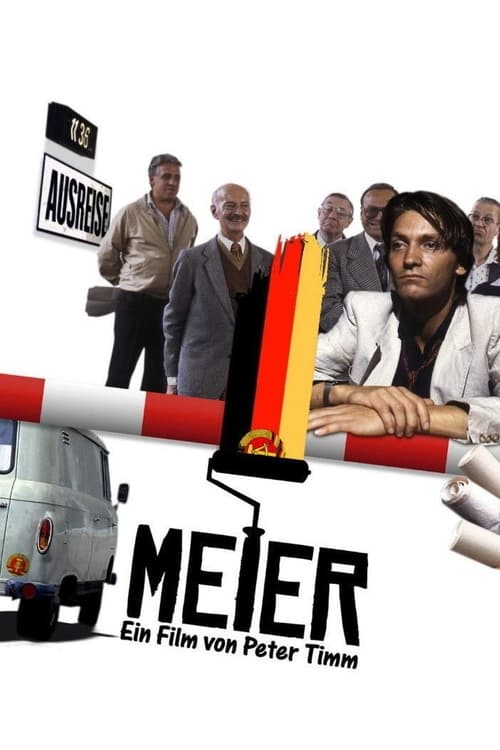


- english version below -Eine Komödie über das Leben in der DDR und West-Berlin, die noch vor der Wende produziert wurde. Spätere DDR-Komödien orientieren sich an diesem Stil. Das Zustandekommen des Films und die Hintergründe des Filmemachers wären sicher einen eigenen Film wert.Ede Meier aus Ost-Berlin kann aufgrund eines Erbes und Fluchthelfern eine Weltreise unternehmen. Danach reist er als Tagestourist mit seinem gefälschten West-Berliner Ausweis wieder in die DDR ein. Dort arbeitet er als Tapezierer und nutzt nun jede Nacht ein Tagesvisum, um in West-Berlin die begehrte Raufasertapete in den Osten rüber zu bringen. Seine Freundin Lore wird mit der Zeit misstrauisch, was Ede jede Nacht so lange macht.Die Raufasertapete erfreut sich im Gegensatz zu den im Osten verfügbaren Mustertapeten hoher Beliebtheit. Er gibt vor, eine Maschine zur Produktion von Raufasertapete entwickelt zu haben. Durch die effiziente Arbeit erfüllt seine Brigade Traumwerte bei der Planerfüllung und Ede wird als „Held der Arbeit“ ausgezeichnet. Durch die Feier kommt er angetrunken und verspätet zum Grenzübertritt. Er wird enttarnt, da er seinen DDR-Ausweis zeigt.Die Stasi steckt nun in der Zwickmühle: Es wäre unmöglich, den frisch gekürten „Held der Arbeit“ einzubuchten. Zudem deckt der Fall unerwartete Lücken im System auf, für die sich niemand verantworten will. Ede Meier wird freigelassen und zum Schluss stellt sich heraus, dass die Raufasertapete im Osten für den Export in den Westen produziert wird.Die Kritik an den politischen Systemen ist recht ausgewogen. Im Osten Mangelwirtschaft, Planerfüllung, Stasi, Spruchbänder und verwahrloste Gebäude. Im Westen konservative Verwandte mit kleiner Handwerksbude, die nicht verstehen, warum man wieder zurück in den Osten will. Zudem gierige Fluchthelfer, die überlegen, für Geld auch einen Fluchtkanal vom Westen in den Osten aufzumachen.Damit wird etwas angerissen, womit selbst die Stasi nicht gerechnet hat: Die Behörden waren offenbar so sehr damit beschäftigt, Menschen aus dem Osten nicht in den Westen abhauen zu lassen, dass sie niemals auf die Idee gekommen wären, dass jemand aus dem Westen in den Osten abhauen könnte.Der Kabarettist Dieter Hildebrandt hat einen bemerkenswerten Gastauftritt als Kellner in einem HO-Fischrestaurant, in der er alle Gerichte kommentiert mit „hamwanich“.Das Drehbuch stammt von Peter Timm, der auch die Regie übernommen hat und hier seine persönlichen Erfahrungen mit dem politischen System verarbeitet. Als junger Mann war er zunächst Funktionär, wurde dann in den 70ern aufgrund von Querelen verhaftet und später aus der DDR ausgebürgert.Studium und Arbeit führte er im Westen fort. Timm macht sich nach der Wende einen Namen mit deutschen Komödien wie „Go Trabi Go“ und „Manta – Der Film“ (Nicht zu verwechseln mit „Manta, Manta“ aus dem selben Jahr).Peter Timm war bei der Filmvorführung anwesend und konnte etwas zur Entstehung und den Folgen erzählen. Sein Vater war IM und Stasi-General – der ebenfalls anwesende Roland Jahn (Letzter Bundesbeauftragter für die Stasi-Unterlagen) konnte zur Position „Kundschafter“ allerdings auch nur sagen, dass dies alles Mögliche sein konnte.Obwohl er eher akademischen Kreisen angehört, war ihm damals auch der Kontakt zum „Proletariat“, z. B. Tapezierer nicht fremd. Über die Grenze hinweg konnte er den Jazzpianisten und Komponisten Günter Fischer für die Musik zum Film gewinnen. Laut Timm verkörpert seine Musik den Zeitgeist Ost-Berlins in den 80ern. Für den Film ist allerdings das Pseudonym „Peter Goldfuß“ genutzt. Nach der Wende wurde bekannt, dass Günter Fischer offenbar als IM gearbeitet hat.Ebenfalls nach der Wende stellte sich heraus, dass die Stasi schon frühzeitig darüber informiert war, dass der Ex-DDR-Bürger Timm einen Film dieser Art drehen wollte. Timm erzählt, dass er das schon unmittelbar nach der Fertigstellung des Films vermutet hat. Auf einem Filmfestival in Karlovy Vary (Karlsbad in Tschechien) wurde er angesprochen, ob er 150 VHS Kopien zur Verfügung stellen könnte. Er geht davon aus, dass diese für die Stasi sein sollten. Was diese allerdings mit dieser Menge vorhatten, kann er sich selber nicht erklären.---A comedy about life in the GDR and West Berlin, produced before the fall of the Wall. Later GDR comedies are based on this style. The making of the film and the filmmaker's background would certainly be worth a film of its own.Ede Meier from East Berlin is able to take a trip around the world because of an inheritance and escape helpers. Afterwards he re-enters the GDR as a day-tripper with his forged West Berlin identity card. There he works as an paperhanger and now uses a day visa every night to bring the desired woodchip wallpaper over to the East in West Berlin. Over time, his girlfriend Lore becomes suspicious of what Ede is doing every night.Unlike the patterned wallpaper available in the East, the woodchip wallpaper enjoys great popularity. He claims to have developed a machine to produce woodchip wallpaper. Due to the efficient work, his brigade achieves dream values in the fulfilment of the plan and Ede is awarded the title of "Hero of Work". Due to the celebration, he arrives drunk and late for the border crossing. He is unmasked as he shows his GDR identity card.The Stasi is now in a dilemma: it would be impossible to imprison the newly crowned "Hero of Labour". Moreover, the case uncovers unexpected loopholes in the system for which no one wants to take responsibility. Ede Meier is released and in the end it turns out that the woodchip wallpaper is produced in the East for export to the West.The criticism of the political systems is quite balanced. In the East, the economy of scarcity, the fulfilment of plans, the Stasi, banners and rotten buildings. In the West, conservative relatives with small handicraft shops who don't understand why people want to go back to the East. In addition, greedy escape helpers who consider opening an escape channel from the West to the East for money.This touches on something that even the Stasi didn't reckon with: The authorities were apparently so busy trying to prevent people from the East from escaping to the West that it never occurred to them that someone from the West could escape to the East.Cabaret artist Dieter Hildebrandt makes a remarkable guest appearance as a waiter in a HO fish restaurant, commenting on all the dishes with "hamwanich" (we do not have).The script was written by Peter Timm, who also directed the film and here processes his personal experiences with the political system. As a young man, he was first a functionary, then arrested in the 70s due to quarrels and later expatriated from the GDR.He continued his studies and work in the West. Timm made a name for himself after the fall of the Wall with German comedies such as "Go Trabi Go" and "Manta – The Movie" (not to be confused with "Manta, Manta" from the same year).Peter Timm was present at the screening and could tell something about the making of the film and its consequences. His father was an IM (Unofficial collaborator) and a Stasi general - Roland Jahn (the last Federal Commissioner for the Stasi files), who was also present at the screening, could only say about the position "scout" that it could be anything.Although he belonged more to academic circles, he was also no stranger to contact with the "proletariat" at the time, e.g. paperhangers. Across the border, he was able to win jazz pianist and composer Günter Fischer for the music for the film. According to Timm, his music embodies the zeitgeist of East Berlin in the 80s. However, the pseudonym "Peter Goldfuß" is used for the film. After reunification, it became known that Günter Fischer had apparently worked as an IM.Also after the reunification, it turned out that the Stasi had been informed early on that the ex-GDR citizen Timm wanted to make a film of this kind. Timm says that he suspected this immediately after the film was finished. At a film festival in Karlovy Vary (Carlsbad in the Czech Republic) he was asked if he could provide 150 VHS tape copies. He assumed that these were to be for the Stasi. What they intended to do with this amount, however, he cannot explain himself.