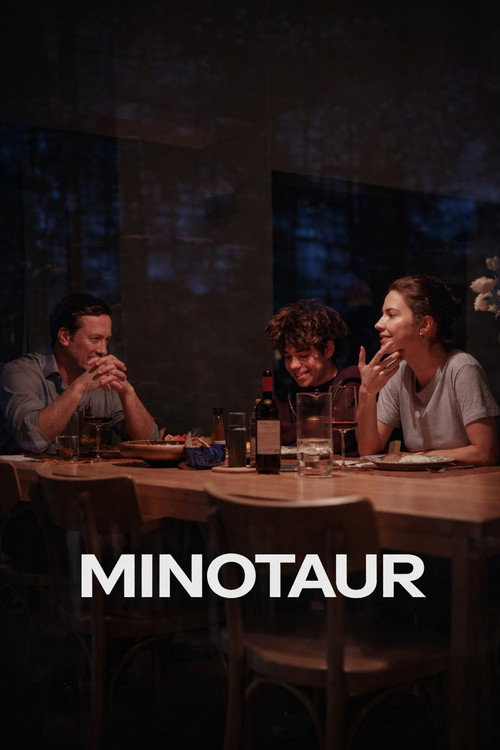






Beyond Fest | West Coast PremiereMinotaur got under my skin because it never treats its political ideas and its human drama as two separate things. On the surface, it is about Gleb, a wealthy businessman whose carefully controlled life begins falling apart when he discovers that his wife, Galina, is having an affair. At the same time, the state places him in the horrifying position of having to provide employees for military conscription in the war against Ukraine. What makes this devastating is the way these two crises gradually begin to resemble each other. Gleb’s marriage is built around control, secrecy, resentment, and emotional repression, while the system surrounding him operates through the same mechanisms on a much larger scale. He is a man accustomed to deciding what happens to other people, yet he is also trapped inside a political structure where decisions are being made for him. The more I watched, the more I felt like Andrey Zvyagintsev was showing me how a corrupt political system can seep into the most private parts of someone’s life until there is almost no distinction between what is happening inside a home and what is happening outside of it.That is also where the title Minotaur became interesting to me. The obvious connection is to the mythological creature that demands human sacrifice, and the movie makes that idea impossible to ignore. Gleb is literally put in the position of deciding which workers will be sacrificed to the machinery of war, but I don’t think the Minotaur represents only the state. To me, the Minotaur is the entire system of power that consumes people while convincing everyone inside it that they are simply doing what they have to do. It is greed, masculinity, fear, political corruption, emotional violence, and the instinct to protect yourself at someone else’s expense all rolled into one monstrous structure. Gleb can be both victim and participant in that system at the same time. He is capable of being crushed by forces larger than himself while also becoming one of the people doing the crushing. That contradiction is what makes him so disturbing. Zvyagintsev doesn’t give us an easy monster to point at because the real monster is much harder to isolate. It is a system that people learn to live inside, reproduce, and eventually mistake for normal life.I won’t say anything about what happens in the end, but that final prolonged shot absolutely destroyed me. Instead of giving me the relief of a conventional conclusion, Zvyagintsev makes me sit there with everything I have just watched and actually process it. It feels almost cruel in how long he allows the image to continue, because by that point the movie has accumulated so much dread, anger, sadness, and moral ugliness that there is nowhere for those feelings to go. I just had to sit with them. That final image made the entire movie feel larger than the story I had just watched. It felt like I was looking at the aftermath of a society spiritually exhausting itself.By the end, Minotaur transforms from a tale of a man’s crumbling marriage into a visceral depiction of a society’s spiritual demise unfolding in real time. This is easily one of my favorite movies of the year, and honestly, I think I found a new favorite director in Andrey Zvyagintsev. After this, I completely understand why his movies are so often concerned with families, institutions, power, and the ways they can destroy each other. I can’t wait to dive into the rest of his filmography.