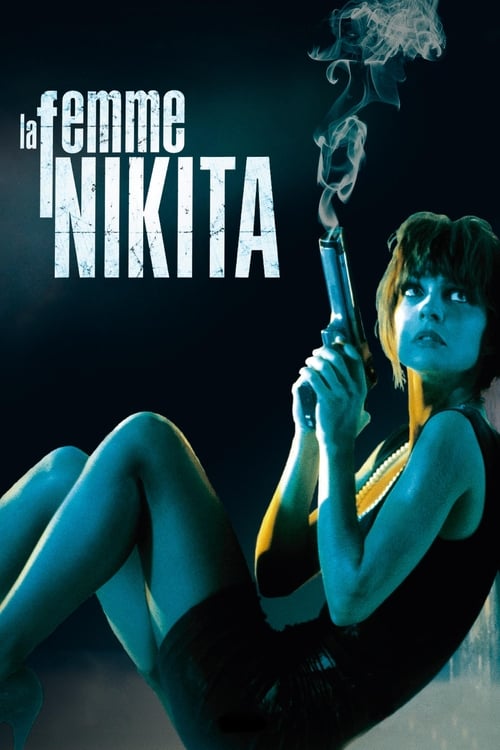
This is a pretty big case of "dude writing a 'female power fantasy' that's actually a male sex fantasy." If you needed more confirmation of this, the final scene of the film isn't Nikita going off and living a happy life, it's the two most significant men in her life having a lovely chat about how they'll both miss her after one of them has torn up a note she left for the other out of jealousy.
La Femma Nikita is the film Lub Besson made before Leon.So obviously some hype is there.But unfortunately, it does not reach the same heights as Leon.Nikita suffers from something I don't see much in films.Its best part is in the middle. It is bookended by two rather dissapointing parts, at least for me.The first part of the film is a little confused, and honestly a little annoying.I get that Nikita is a drug addict, and now she will have to come clean.But, she comes off as incredibly annoying.For the first part, she is just an annoying drug addict.We see her training, but I never cared for her.Only after she changes her looks (around her first mission), does she become more likeable.Then starts the best part of the film.Nikita meets a men, Marco. They begin a relationship.They seem happy together, and the chemisty between the actors is great.Nikita is then given a free holiday for her engagement to Venice.In Venice, while with her future husband, she is ordered to pull of an assassination.This part was simply the best. It combined the pressure from killing her target, and dealing with her private life.If the rest of the film would have been more like this, it would have been a lot better.Sadly, the last part is not as good. It deals with an important job, but we never really see the planning. The job goes awry, but it was not really exciting. Perhaps because we knew nothing about it.Aside from that, I also found Anne Parillaud to be rather annoying.When she was quiet, she was good.But for some reasons, once in a while she simply started over-acting, screaming her lines. I really hated that.Stikk, Nikita is a decent french film by Luc Besson. Sadly, it does not reach its full potential.
the whole perverse mental apparatus of Besson is visible here; La femme(!) Nikita is very much the epitome of what his mind would produce in the following decades. Besson’s fetish object as usual: a naive (not so innocent) but wild animal. a young woman as an enigmatic beast, of violence as much as of sexuality. "girls just wanna have fun" is a sentence that Besson is aware of, being very scared of it. first she’s becoming the victim of drug addiction, through a punk adoring her, then she learns more about his world through her 'parents'. Nikita feels like an alien throughout the whole film. specifically in the communication with Jeanne Moreau as elderly advisor (aka her mother figure/inner mother object) telling her that "there are two things that are infinite: femininity and means to take advantage of it" it’s getting clear that women are reduced to be objects to men: a very dangerous one, as it is not controllable. they have this 'superpower' to take control of the subject, that will get annihilated by the object, by his own desires.Besson tries to get a hold of the object narratively; he installs a masculine double face: the cop training her (aka Nikita’s father figure/the inner father object - of course crossing the incestuous line) and the romantic love interest. the first one clearly being sadistic (even called out on that by his 'daughter'), punishing her for her ferocity and tigerishness, betraying the love that she builds up for him naturally, playing with this to get out of her what he needs: death/thanatos (instead of eros/sexuality, which could be the translation).on the other hand the guy who falls in love with her. this part gets noticeably a lot of space in the middle part of the film, letting the pace suffer (which is 1. only if you see this as an action flick and 2. nothing uncommon in Besson’s turbulent oeuvre anyway). he might function as the good counterpart to the sadistic father, being morally 'clean' and by the end acknowledging her 'inner darkness' and still standing by her side. she will hurt him, he knows this, but the true love to her is stronger. this is what romanticism probably means to Besson.what’s Jean Reno in all this? the protector, knowing of his own dark side all too well, not touching the girl, just guarding her. i’d call him 'the ideal image' - a wishful, non-realistic, comic character. something not reachable for the self. Besson would construct a whole movie around him - his most successful, most iconic one - right after Nikita.at the end both men - the father and the lover - sit opposing each other, knowing both have lost 'la femme'. eventually she’s inapproachable for them. as 'happy endish' as this might seem, it’s the truthful nightmare of Besson, already admitting that he - the subject - will never be able to possess the object of desire.