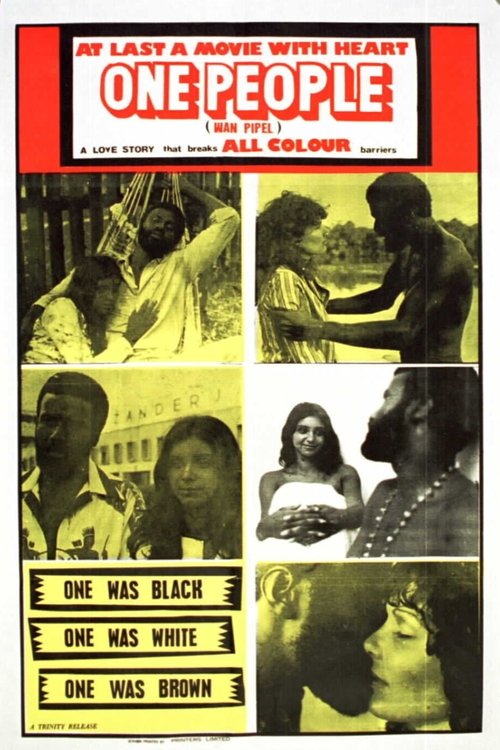


I know next to nothing about Suriname, so if my interpretation here is off, forgive me. However, I am fairly confident in it, considering this film's straight forward metaphors.Made in the wake of Surinamese independence, this film is both a rallying cry and a love letter. Following the story of a Surinamese man returned to his native country after a spell studying in Holland, it takes pains to look at every facet of the melting pot of Suriname and explore at least briefly the good and bad sides of them. Bluntly--egregiously bluntly, but I liked it anyway--it begs Suriname to unite despite the frictions caused by the melting pot and history and colonialism.The colonialism is represented by the constant allure of Holland, the temptations of what Roy (the protagonist) left behind there, and the languages spoken--a person with a better ear and a better understanding of the languages spoken could write several essays about the use of language in this film. Karina, Roy's girlfriend back in Holland, represents her home country's hold on Suriname even in the wake of independence, and the ultimate rejection of her could not play more obviously as a rejection of Suriname's ever returning to Holland's power.The union of Roy and his Hindu girlfriend Rubia, meanwhile, gets spelled out by Rubia in a discussion of why her family has rejected Roy. She describes them as having two hearts, describes them as being divided, and how this condition will be the death of them. This heavy handed but poetic manner of describing the state of Suriname's racial diversity is actually rather stirring, and the moments where Roy repeatedly declares his love for Suriname while rejecting this racial divide are some of the best parts of the film.It's interesting to me that the film starts with Roy's mother's death. There's an entirely different story that could be derived from reading Roy's sudden love of Suriname as seeking a surrogate mother in the wake of his loss. That he comes into conflict with his father and rejects the influence of the Netherlands at the same time could be a further parental metaphor to be found here--a conflict between motherland and fatherland. This divide comes up several times, as when Roy's brother-in-law (a father) abandons his wife (a mother) for Holland (the fatherland) or in the fact that the fathers are entirely the ones represented as seeking to maintain the status quo.What this film mostly accomplished, though, was making me want to go to Suriname. I am under the impression it went through civil wars in the recent past, and I am unsure of its current status. I expect it's no longer the fresh faced, newly free nation it was when this was made, though, sadly.May count: 5/30. Country: Suriname.May rules: For my 30 countries, 30 days, I am instituting a few rules of my own. I have been watching more than 30 movies a month for a while now, so this will probably be more like 30 countries, 15 days. I have no particular goal there. Because Netflix is erratic with what it sends me, I may end up watching movies I did not intend to watch this month. If they are from a country I haven't yet seen a film from, I will count them. If they are a duplicate, they simply will not be counted. I am not counting any American pictures, because I'm with the Clash on the USA. For films that are a co-production between countries, the country is whatever I fucking say it is.