


"Isn't that a woman's fate?""Our fate is the same"Misogyny, a custom so old and culturally ingrained it's in the damn architecture.
Preisgekröntes Drama, dessen Handlung sich im vorrevolutionären China abspielt. Die Junge Chinesin Songlian muss aufgrund finanzieller Nöte in eine wohlhabende Familie einheiraten. Sie ist nicht die einzige Ehefrau und versucht sich gegen ihre Konkurrentinnen durchzusetzen. Der Film wurde in Venedig mit dem Silbernen Löwen ausgezeichnet und mit einer Oscarnominierung geehrt.
Raise the Red Lantern läuft in 1 Kino in Los Angeles - nächste Vorstellung Samstag, 7. November um 14:00 im The Egyptian Theatre Hollywood.
Nächste Vorstellungen: Samstag, 7. November.
Alle 8 Tage & ZeitenPasst dieser Tag nicht?
Alle 8 Tage & Zeiten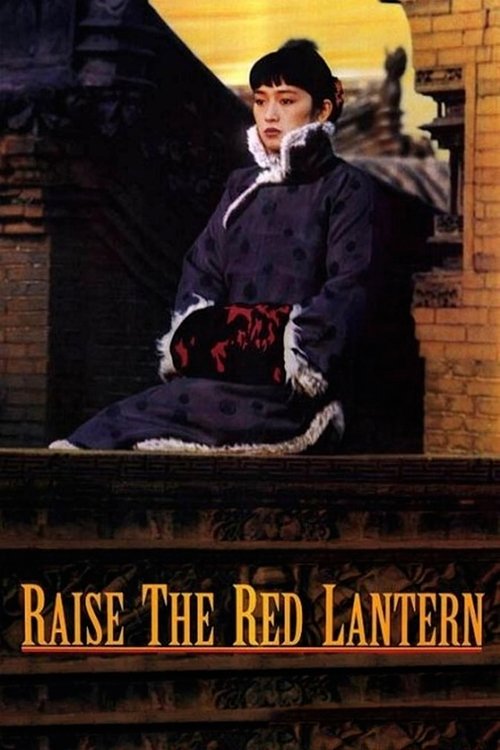
Spielzeiten zu Raise the Red Lantern, jeden Morgen aktualisiert
Wähle dein Kino und bekomm einen Hinweis, bevor der Film aus dem Programm fällt.
"Isn't that a woman's fate?""Our fate is the same"Misogyny, a custom so old and culturally ingrained it's in the damn architecture.

Somber, tantalizing, and contemplative, Raise the Red Lantern is a thought-provoking and powerful portrait of a young woman who, after marrying a significantly older and wealthier man, finds herself confronted with the surreptitious conspiracies pervading the relationships between his three other wives—and soon, her relationships, too.What begins with a static, yet powerfully stirring closeup of our protagonist, Songlian, soon unfolds into a nearly bewitching picture of four women constantly pitting against each other only to win their husband’s affection for a mere night—and with it, the brightly lit red lanterns raised in front of their house. Zhang Yimou gives the characters the time and space they need to resonate with the audience; as a consequence, this film slowly lures us into its world, much like the main character is sucked into its endless web of deception, and before we know it, we’re hypnotized by Zhang’s intense colors and static wide shots. Raise the Red Lantern ingeniously uses cinematography and framing to their fullest extent, almost as if they were telling a story on their own. Beginning with red lanterns standing out against a sea of brick walls, this film brilliantly utilizes color to reflect the progression of the narrative and the emotions the characters experience. In the beginning, the grey walls seem dull, but with a few blazing red lanterns, the houses look almost festive. As the movie progresses, however, our protagonist begins to experience the confinement and solitude that had come with her marriage: Now, static wide shots of the grey walls surrounding her dominate, emphasizing her status as more of a prisoner than a mistress. Zhang shows us a multitude of those grey, practically claustrophobic shots—to the point where the sea of grey is almost engraved in our minds. Closeups are scarce, but whenever someone’s face does take up the screen, it’s mostly our main character’s in moments of silent despair or raging anger. The Chinese character 囚 (which means prisoner or captive) visually and literally resembles the situation the four mistresses find themselves in: 人 is the character for person, and four walls surrounding this person makes them a prisoner. Over the course of the film, especially towards the end, this visual metaphor is reflected in lone shots of Songlian: We see her pacing the space between the barriers holding her captive—four grey buildings. At its most obvious level, this film is a commentary on patriarchy and its subsequent oppression of women. Not once does Zhang show the man’s face, all we see are shots of his back or shots lit in a way that his face is barely visible. And yet, his presence is looming over every single frame, reverberating in every single note of the opera sung by the third mistress, and caught in every red lantern lit because of his visit. He chooses to pit the four women against each other, and it is because of him that the scarce red turns into black before it eventually turns into a blinding sea of red.Overall, Raise the Red Lantern is a spellbinding film carefully examining the results of patriarchy set against the backdrop of 1920s’ China. While the exact form of patriarchy presented in this film doesn’t exist anymore, this film’s discussions are just as relevant today. This was actually my first “real” film from Mainland China (apart from some random Chinese blockbusters I saw when I spent the summer there), and I couldn’t be more in awe of just about every aspect of this film!! I’m definitely going to watch more of Zhang Yimou’s work and more Chinese films in the next couple of months! 2021 First Time Watches Ranked < One Night in Miami> I Was a Simple Man

Raise the Red Lantern is a mournful tribute to Chinese women of past generations, whose existence merely served in accordance to men's needs, or as the movie itself puts it, was "like dogs, cats, rats, but not people." In this daunting tale of jealousy, murders and lies, we follow Songlian, a college dropout forced by her stepmother to marry a rich old man who already has three wives in his labyrinthine, ritualistic household, as she juggles deflecting the malignant jealousy from her fellow concubines, and forming her own understanding of survival of the fittest. It's truly an edge-of-your-seat experience filled with catty fights, both large-scale and subtle, among the calculating wives. We witness the equal parts hilarious and saddening extremities these concubines take vying for the nightly "love" from the "master", whose presence is tactfully marginalized without even a close-up shot. Acting wise the female cast were simply brilliant, namely Gong Li, whose portrait of Songlian was out of this world, thanks to her equal parts fierce and reserved delivery. The actresses playing other wives and Songlian's maid respectively were equally mesmerizing in their believable efforts to demonstrate the thrilling power dynamics within the deadly household.Zhang Yimou's usage of traditional Chinese music as scores, a red, yellow and white dominated color palette and his ingenious choice of the quaint and sublime filming location definitely helped bring out the melancholic vibe of the original book. By ways of a disturbing tale depicting women, deserted by a patriarchal society, trying to cancel each other out in order to survive, Zhang was extremely respectful and stealthy in revisiting a dark piece of true history that's just not encouraged to be touched upon. I prefer the movie to end several minutes earlier to leave more space for the audience to ponder upon, but Raise the Red Lantern is already by itself an enthralling piece of art about Chinese feminism that's both stylishly unique and emotionally universal. Highly recommended.
Im China der 1920er Jahre wird eine 19-jährige Frau zur vierten Konkubine eines wohlhabenden Lords und gerät in einen erbitterten psychologischen Wettstreit mit den anderen Frauen.
Regie führte Zhang Yimou im Jahr 1991, was ein bedeutendes Werk des chinesischen Films der fünften Generation markiert.
Ja, er gewann den Silbernen Löwen für die beste Regie bei den Filmfestspielen von Venedig und erhielt eine Oscar-Nominierung für den besten fremdsprachigen Film.
Spielpläne und Spielzeiten finden Sie auf Mood.