

"Tidak ada mulut yang lebih bisa diandalkan selain yang selalu diam"
Wir nutzen Cookies, um dein Erlebnis persönlicher zu machen und den Traffic zu messen. Du kannst jederzeit widersprechen.
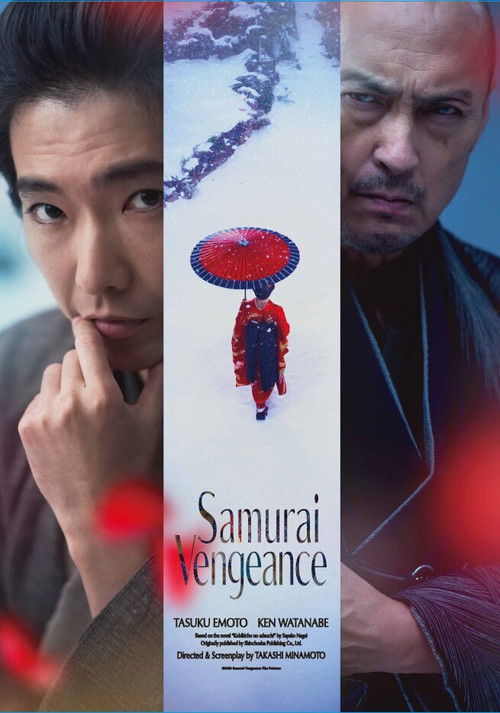
In January 1810 in Edo, Kikunosuke, the 17-year-old-son of a murdered samurai, takes revenge on his father's murderer, Sakubai, who was his father's former retainer. Kikunosuke gloriously defeats the swaggering Sakubai in single combat in front of a theater, witnessed by a huge audience that had just finished watching a production of 47 Ronin. With Sakubai's severed head, Kikunosuke has achieved his revenge and ensured that his family won't be exiled. 18 months later, a ronin named Soichiro Kase from Kikunosuke's domain arrives at the theater. While he seems silly and smooth-talking, he's very keen on finding out more about the incident and Kikunosuke's time working at the theater. The theater's staff – the barker Ippachi, the swordsmanship teacher Sagara, the costumer Hotaru, the craftsman Kyuzo, and the playwright Kinji – are apprehensive and suspicious at his digging. However, not everything is as it seems.
Heute keine Spielzeiten für Samurai Vengeance in Amsterdam.
Spielzeiten zu Samurai Vengeance, jeden Morgen aktualisiert
Wähle dein Kino und bekomm einen Hinweis, bevor der Film aus dem Programm fällt.


"Tidak ada mulut yang lebih bisa diandalkan selain yang selalu diam"

First hour is just "samurai Columbo," and obviously I'm very into that. Second hour is much more concerned with flashback and the underlying mechanics of the mystery, which aren't quite as clean, but it's got a sharp enough cast and visual aesthetic to get by. The characters seem to have a little bit more to them in the first half, but once the reveals start coming some of them get kind of flattened out, which is a shame, but this is still a pretty satisfying novelty.

A little less conversation and a little more action, please. It took me a while to settle on a rating for Samurai Vengeance because, while I found myself undeniably bored for long stretches, it is not technically a terrible film. Yaël and I were simply the wrong audience for it. The rest of the crowd at CameraJapan, on the other hand, were eating up every single second — or so it seemed, going by the reactions. Their level of hysterical investment made it so that at one point Yaël and I just looked at each other in disbelief, silently asking; “Is this literally the first time these people have ever watched a movie?!”. One woman in particular gasped so audibly at the reappearance of a prop that you would have thought a real killer had just jumped through the screen to behead her with a samurai sword.The title had looked promising, and given that this was the only time-slot I could fit into my planning this year, I went in hoping for a fast-paced genre piece. Instead, the narrative gets hopelessly bogged down in endless exposition and tedious posturing. When the action arrives, it is competent enough, but it lacks the visceral weight or stylised flair needed to justify the long, dry stretches of dialogue that precede it. The slick production values and crowd-pleasing antics might carry it for festival diehards, but stripped of that performative audience energy, there is precious little underneath.
Im Edo des Jahres 1810 untersucht ein Ronin die Umstände eines theatralischen Rachemords an einem jungen Samurai vor einem Kabuki-Theater.
Samurai Vengeance wurde von dem Filmemacher Takashi Minamoto inszeniert und 2026 veröffentlicht.
Der Film verbindet Historienmysterium, Komödie und theatralische Darbietung, um Themen wie Rache, Pflicht und Geschichtenerzählen zu erkunden.