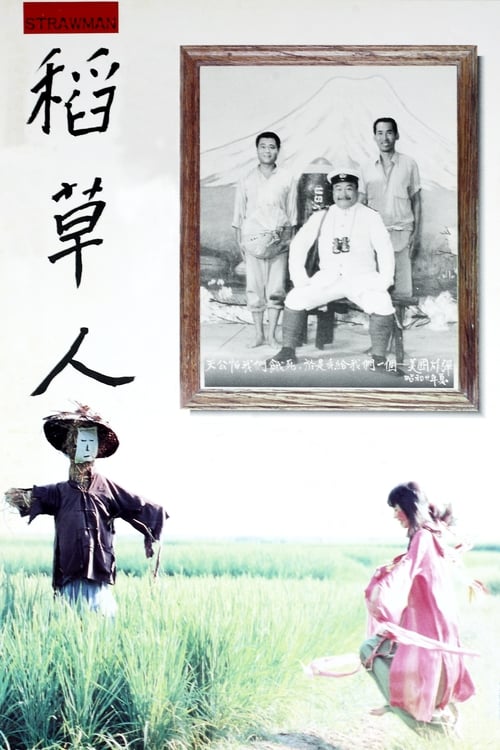


At first blush, Strawman seems a quaint kind of comedy, with its rural setting and farmer protagonists. But the passage of years—and the immense changes to Taiwan in the meantime—has obscured its significance. In 1987, Strawman was downright revelatory, treating subjects that had rarely been seen in any Taiwanese movies, comedic or otherwise.On some levels, Wang Tung was an unlikely director for such a story. Wang is often bracketed with filmmakers like Edward Yang and Hou Hsiao-hsien, who upended the 1980s film scene with the “Taiwan New Cinema.” But by that time Wang was already an old industry hand, having started as a production designer in the 1960s. Though a respected director, he’s less formally audacious than Hou or Yang, and hews closer to genre conventions; as Wang himself puts it, he’s the type of filmmaker who would rather be a “good director” than a “great” one. Still, Wang hasn’t always played it safe. His 1983 hit A Flower in the Rainy Night took on risky subject matter (a woman’s struggles to escape prostitution) and fit the New Cinema’s emphasis on “nativist” stories reflecting Taiwan’s changing society. Strawman marked an ambitious new phase in Wang’s career, opening what is sometimes called his “nativist trilogy” (xiāngtǔ sānbùqǔ).The idea that Taiwanese films can portray Taiwanese reality sounds innocuous enough, yet this had not always been the case under the Chinese Nationalist government. That government came to Taiwan in 1945, closing a half-century of Japanese colonial rule. It sought to Sinicize the Taiwanese by imposing a China-centric worldview, in which Taiwan was subsumed into “5,000 years” of a broader Chinese history. Cinematic culture was not exempt, and Taiwanese were expected to watch films about Chinese dynastic history or China’s war with Japan—which Taiwan experienced from the Japanese side—while topics specific to Taiwanese history were rarely seen and forced into the Nationalist framework. Thus the Japanese period, where it figured at all, was typically reduced to heroic anti-colonial resistance. Liberalization finally began in the early ‘80s, and filmmakers carefully broached more contentious historical topics. It was in this heady atmosphere (and just three months after the end of Taiwan’s 38-year martial law) that Strawman reached theaters. Such a film would’ve been impossible to make just a few years earlier, and indeed the Nationalist-run Central Motion Picture Corporation rejected the idea when Wang first brought it to them.The film is set in the 1940s, near the tail-end of World War II. Its audacity is established from the very first scene, depicting a local soldier’s funeral. This is itself a sign of Taiwan’s late-’80s thaw: the Nationalist government had previously been reluctant to even acknowledge that Taiwanese had fought and died for the Japanese Empire, and it remains a touchy subject to this day. Strawman puts it up front, then pushes the envelope further with its irreverent treatment. The Taiwanese mourners play their traditional kó͘-chhoe (a high-pitched, oboe-like instrument) over the Japanese troops’ military brass music, and the funeral dissolves in a dissonant racket. The colonizers have their rituals, and the colonized have their own. Later, a character prays to the Taoist Land God (Thó͘-tī-kong), “even though the Japanese don’t let you live here”—a reference to the wartime campaign to convert Taiwan to Japanese State Shinto.Such small acts of resistance appear throughout the narrative, but are bound up in local traditions and personal concerns, not political/nationalist convictions. (Nor is such resistance difficult to overcome: one man reacts angrily to the idea of adopting a Japanese name until informed it will bring a bigger sugar ration.) Right after the funeral scene, the film’s sardonic narrator tells of a mother who, unwilling to have her two sons die in battle, found a way to keep them out of the army: she ruined their eyesight. This could’ve easily been played for dramatic or even horrifying effect, but her uniquely disgusting method (mercifully not shown in detail) comes across as an off-color joke, and only the first of many. This is no grim period drama.Luckily, the two sons—surnamed Chen, and known by the nicknames Ā Fā (ironically suggestive of fācái, “to get rich”) and Kuò Zuǐ (“Big Mouth”)—still see enough to run the family farm. Sighted or not, they’re none too successful, and their hapless efforts to keep sparrows from their crops lies behind the film’s title. They launch a new sideline when the Japanese offer rewards for scrap metal, which literally falls from the sky in the form of American bombs.These bombing raids (which ran from October 1944 right up to the Japanese surrender) were a forbidden subject during the martial-law era, excluded from history books and commemorations of the war. After all, the U.S. government was the Nationalists’ main ally, and it was impolitic to mention that Taiwanese had been killed by American bombs. But Wang Tung the “fatalist” (to use one interviewer’s apt description) treats the wartime bombing as an inescapable fact of life; one brother suggests sending his kids to “safety” in Japan, a well-meaning but futile idea to viewers with the advantage of hindsight. Most of the other townspeople simply put the best possible face on the situation, and the film even ends with a child hoping for more U.S. bombs to come. Again, this scene takes on special significance for a contemporary viewer, who knows these kids will grow up in a postwar Taiwan dependent on American arms—albeit in a very different kind of way.This was strong stuff for 1987, but Strawman wasn’t the first movie to cast a revisionist eye on the Taiwan-U.S. relationship. It was preceded by 1983’s The Sandwich Man, an omnibus film based on stories by nativist writer Huang Chun-ming. One segment, “The Taste of Apples,” provoked a censorship row over its premise: a poor worker is struck by an American officer’s limousine. Wang turned down an offer to direct The Sandwich Man, which was ultimately helmed by a trio of younger directors (including Hou Hsiao-hsien). But Wang was certainly familiar with Huang Chun-ming’s work, having adapted one of his stories into A Flower in the Rainy Night, and Strawman bears signs of Huang’s influence. Its story follows roughly the same arc as “The Taste of Apples,” where adversity at American hands improbably leads to good fortune. The use of dual male protagonists recalls Huang’s “Xiaoqi’s Cap” (also adapted in The Sandwich Man) and “The Two Sign Painters.”More generally, Strawman shares Huang’s sympathetic yet droll attitude towards his characters, distinct from the romanticizing tendency of many other nativist authors. (In fact, Huang publicly disclaimed the “nativist” label.) The film’s warts-and-all approach is perhaps most evident when the Chens come across an intact, unexploded bomb, then ponder the rewards they might receive for such a hefty chunk of metal. On the one hand, this shows the resilience and resourcefulness of these beleaguered colonial subjects; on the other, they grasp the opportunity with an enthusiasm that borders on ghoulish. And while the film emphasizes the continuity of tradition at a difficult historical moment, it doesn’t glorify tradition for its own sake. For instance, much is made of the Chens’ large family—itself a tradition in rural Taiwan, where as late as the 1970s the average family had five children. But in Strawman, this tradition is fair comic game: the narrator mockingly claims that the Chens “can’t even remember their own children’s names,” and A Fa beseeches the Land God to cut off Big Mouth’s member if he won’t keep it in his pants. (The hardship that kids bring to the economically disadvantaged is also a recurring theme in Huang Chun-ming’s work.) In one darkly amusing scene, the adults enjoy an increasingly rare fish dinner and leave none for the children, who watch and cry helplessly.Strawman seems to alternate between affection for the Chens and a sort of critical distance, reinforced by the wry voice-over commentary. Significantly, Wang Tung himself hails from neither a farming background nor a Taiwanese one. The son of a general in the Nationalist army, he came to Taiwan at age seven and still speaks of the island like an outsider (“I am a mainlander. Living in Taiwan is like living in a foreign country”). But that outsider’s perspective may have lent Strawman the irreverence that made it a minor hit in Taiwan. One journalist writes of viewing it in a theater full of college students, who laughed uproariously throughout. It ultimately became the fifth highest-grossing domestic film of 1987, a sharp contrast with the weak box-office performance of most New Cinema fare. Of course, most New Cinema films weren’t comedies like Strawman, with its bawdy humor and colorful slang—though the bulk of its dialogue is in the Nationalist-imposed Mandarin language, an anachronistic touch given how few Taiwanese spoke it during the Japanese era.The success of Strawman further emboldened Wang Tung. The second part of his nativist trilogy, Banana Paradise (1989), runs two-and-a-half hours and spans 38 years, from 1949 to 1987. As before, Wang uses comedy to address a long-suppressed chapter of Taiwan’s history. Banana Paradise examined the Nationalist “White Terror” only a month after Hou Hsiao-hsien’s A City of Sadness broke the cinematic taboo around this topic. Like Strawman, Banana Paradise centers on two men, this time Nationalist soldiers who move to Taiwan only to face the anti-communist purges of the 1950s. (The last part of the trilogy, 1994’s Hill of No Return, revisited the Japanese era with a more conventionally dramatic script by Wu Nien-jen, who also wrote Strawman’s ending.)In other words, Banana Paradise was a movie about mainlanders by a mainlander. That such a film could be considered “nativist” demonstrates the shifting nature of Taiwanese identity, formed over the centuries by aboriginals, Chinese immigrants, European and Japanese colonialism, and American Coca-colonialism. Appropriately enough, shifting identities are a key plot point in Banana Paradise, while Strawman probes how outside forces affect traditional ways of life. This theme has intrigued Wang right up to the present decade: his segment of the 2012 anthology 10+10 is simply titled “The Ritual,” and its protagonists (two brothers, again) thank the deities by screening Avatar at a local shrine. Meanwhile, even youth comedies like Night Market Hero (2011) and Din Tao: Leader of the Parade (2012) echo Wang’s juxtapositions of local customs and social change.Other recent films have portrayed Taiwanese history in ways scarcely imaginable in 1987. The success of Cape No. 7 (2008) and Kano (2014)—with their almost nostalgic evocations of the Japanese era—must’ve been striking to Wang, who acts bewildered by local attitudes toward the erstwhile colonizer: “Unlike Korea, which hated and still hates Japan, Taiwan maintains a friendship with Japan. This country is very strange.” Despite his ambivalence, these films exist in the space created by Strawman, as Wang’s take on Taiwan’s buried past opened it to further explorations. But few have made historical excavation seem so amusing.