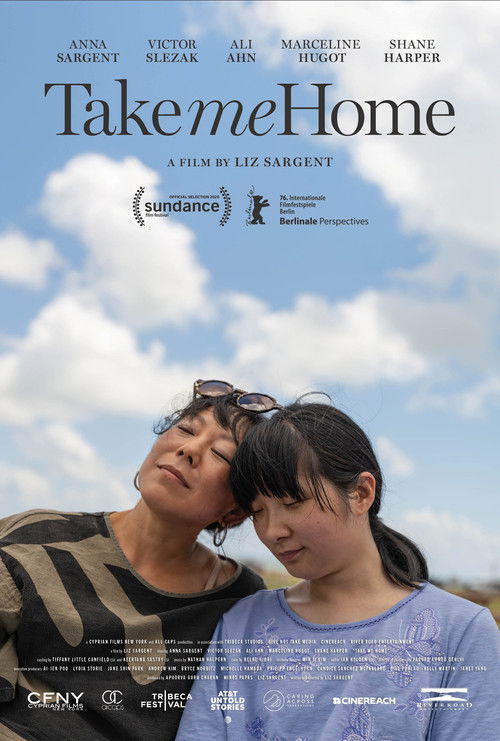
This movie hurts to watch, but for all the right reasons.In previous years I’ve tried to watch every film at Sundance, which turned out to be a very good way to bore myself to death. I’m quite sure the people choosing films for the festival have aesthetic preferences which leave them allergic to entertainment value, and positively priapic about anything emotionally devastating or excessively tedious. This year, rather than wading around in the shallow waters until my fingers pruned, I figured I’d dive right into the deep end, and then get right back out to dry off. I chose to watch only the two films that seemed to have the most meaty potential for discussion. The first was about school shootings, which is super fun. The second was Take Me Home, which I chose with the lofty goal of using it to work through real personal issues.I guess I was feeling emotionally brave when I chose Take Me Home, which engages with my three most emotionally triggering topics: cognitive disabilities, adopted Korean little sisters, and aging parents with dementia, all of which hits close to home. What I didn’t anticipate is that while writing about the film, I’d find out that my movie-mom-surrogate Catherine O’Hara died, and that my father had to put down the family dog after 15 years. So now this review is more in conversation with my current emotional state than the film itself. I apologize if this turns into a long personal journal and therapy session instead. So be it.The story follows Anna, a 38-year-old Korean adoptee with a cognitive disability, who is in a mutually caretaking relationship with her aging parents. You can tell that they are all in a precarious, untenable situation, at the end of their abilities, caught in a fragile balance of meeting one another’s needs. Dealing with aging relatives is tough enough, but those aging parents dealing with a child with cognitive impairments turns this into a two-headed issue. This is not an uncommon one, and these issues represent—especially in America where our social safety nets are income-dependent—some of the most difficult issues a family can face outside of terminal illness. And indeed, without intervention, these cognitive impairments are themselves potentially terminal ones—either parent or child might just burn the house down or wander into traffic at any moment. When a Florida heat wave shatters their family and Anna’s routine, her future is uncertain, and her older sister is tasked with the responsibility of caretaking, of which she is not capable.The issue of cognitive disability is an emotional trigger for me going all the way back to grade school. I was so advanced in math and reading by fourth grade that I misbehaved out of boredom. Being particularly aligned towards justice, I deliberately bombed a standardized test because I thought it would reflect poorly on my math teacher, who was bad at her job. Then despite being told my standardized tests would have no effect on my academics, I was accused by several of my teachers of being intellectually disabled for scoring so low on the math section (I had a perfect score on the verbal, mind you). Psychologists determined I was not disabled, and that I was actually gifted. At the time the Vermont DOE did not officially recognize the existence of the category of gifted, because they thought it was "elitist" to suggest that you could rank human beings--even though we always do that all the time. My teachers scoffed at the results, and said I must then be “lazy.” The exact quote was, “If he’s so smart he should just join the chess club.” The school administration felt that by giving me advanced subjects to study they would be rewarding my misbehavior, so I was instead placed in the special needs class as a "behavioral concern". I was having trouble just being around normal kids, and when I was placed in the special needs class, it felt like I had been fundamentally dehumanized and oppressed. I basically have no memories of the next several years, all of which have been lost to a state of constant dissociation.This is when I lost faith in public institutions. Rather than being taught patience and tolerance and the value of equity, I felt contemptuous, angry, and resentful towards what felt like a fundamental anti-intellectual allocation of resources. One member of my “classroom” was on a ventilator, fed through a tube, had no functioning brain activity outside her brainstem, had to be resuscitated when she briefly died one time, and yet our “grade level” was the same. Our social status was the same. Our implied value and personhood was the same. I came to the conclusion that this is a social myth we tell ourselves for ideological purposes—and I also learned that this is not something anyone ever wants to hear expressed out loud. I didn’t feel grace towards my fellow students; I felt anger at being lumped in with them. Four standard deviations to the left of average is so abnormal you need a caretaker to live. But four standard deviations to the right of average—which is just as deviant from the norm and demonstrably quite disruptive—and I was considered entirely responsible for any difficulties I would ever face. I have felt entirely on my own in society ever since. I became severely depressed, started having undiagnosed panic attacks, and most germane to this film, developed a lifelong impatience and discomfort around people with intellectual disability. I am ashamed of this. I am grateful to films like this, which allow me to process this pathology in a more rational and gracious manner, and afford me opportunities for empathy and growth. My sister was also adopted from Korea like Anna, and in fact is the exact same age. I’m not embarrassed to say this made me care more about her than I otherwise would; it’s just the nature of my upbringing. I have so much deep, unending love for my sister that it extends towards anyone who even remotely reminds me of her. My “mirror neurons” are attuned to faces like hers, and in her face I see familial resemblance. I needed literally no exposition or character development to feel emotionally invested or fraternally protective.In the film, in a moment of especially difficult emotion, Anna’s older sister asks their father: “Why would you adopt someone with a disability?” His answer is quite simply the correct one, the exact same one my parents had: “Why not? We had love to give and wanted a child.” My mother worked for the Korean consulate for a while, and through connections there, had been trying to adopt a child for a while. We almost adopted a deaf boy, and I even learned some sign language in preparation. But some logistical issues meant he went to another family, and instead, my parents adopted a little baby girl with a congenital heart defect. At the time, it was easier, less expensive, and a faster process if you were willing to adopt a disabled child. My parents loved this idea—(only gentiles pay retail)—but when we finally got my sister, whatever heart defect had already self-resolved. Equally likely is that, due to a combination of cultural sexism and poverty, there was an excess number of little girls available, and my sister was fast-tracked by someone clever in clerical matters. She turned out to be the healthiest person in the family by far, both physically and mentally. She looks like a K-pop star and is a fitness instructor, among other things, while I am a short, fat, wheezy, neurotic man who looks like the lovechild of Kieran Culkin and Kevin Pollack. (Whenever we go out to eat, people assume we're a couple, and that she's in it for the cash.)Lastly, in terms of personal salience, our mom died of Parkinson’s a year and a half ago, after a five-year battle with Lewy body dementia. To say it’s not easy is an understatement, and to this day my number one biggest fear is losing my intellectual capacity. After seeing what it’s like to go through that, I know for a fact that I’d take my own life rather than live through it. It was the humane thing for my dad’s 15-year-old beagle to be euthanized today, and by the exact same logic, profoundly inhumane that my mother was not given the same opportunity. This strikes me as a shocking failure of humanity and our institutions, who again I see as capitulating to a bereft ideological standard. My father had to take on full-time caretaking duties for my mother, which was crushing for him in every possible way I can imagine. The material realities of aging in this film are shown in a matter-of-fact truth that hits hard to home, and echoes the long list of things I associate with my mother’s decline: bags of prescription pills, kitchen tables covered in stacks of paper, the quiet after people die, morbid jokes, a constant air thick with unspoken worry, fridges full of old food that needed to be thrown out in the previous presidential administration, and being constantly dictated by the illogical demands and emotional vicissitudes of people suffering from cognitive deficit.With all this in mind, I went into the film with real trepidation. At first I thought I might engage with it like a hot pan on the stove, but the sheer familiarity of it all settled me into a rhythm that felt like the rhythms of my own family. This film is not melodramatic. It’s not saccharine. It is only slightly emotionally manipulative—there are no swelling of the strings on the soundtrack, and the actual moments of trauma are depicted gracefully with their absence, through elliptical editing. Instead, we are presented with something that feels non-judgmental, documentarian, and which engages with the traumatic realities as they actually feel to engage with in reality, in a matter-of-fact manner. The reason for this is that the director, Liz Sargent, filmed the movie to tell a true personal story: Anna Sargent, the star of the film, is played by her actual adopted sister, and she is shooting this film to engage with her own lived experience.Because of that, the film feels entirely realistic, a systemic, exhaustive discussion of issues, presented as the logistical, procedural problems they really are. We see the inherent emotional exhaustion and frustration of the situation, both from the compassion fatigue which it elicits, and the difficulty of being faced with a problem you can’t fix. You can’t make your parents not have dementia. You can’t make them not cognitively impaired. You can’t rationalize away their confused emotions. You can’t explain their logical errors to them. You cannot force them to behave the right way. You cannot explain why they are wrong. You want to respect their desires and agency, but they don’t actually have the ability to discern or choose the right things. The problems are daily, and constant. I still remember how difficult it was to get my mom to stop trying to do my dad’s business accounting, even though when I found her QuickBooks account it showed $100 million-dollar swings on a monthly basis, and I’m still to this day mad at my father for allowing it to continue for so long. The personality changes and mood swings are real. My mother became a rotten, mean, slug of a woman. Your loved ones can’t help that they behave like that, and they don’t even remember doing it, but you still feel anger and hatred for it anyway. Their problems are only relieved by eventual death, and when that comes you have to wrestle with the guilt you have for feeling, more than a sense of loss, a sense of relief.The 2023 short this film was based on was an Oscar-qualified darling, which was screened at the White House for the 25th anniversary of the Olmstead decision. Liz Sargent secured the 2025 Tribeca AT&T Untold Stories Award—a $1 million grant—and spent it on scaling the story into a feature film. The sensitivity and elegance this film has for its subjects was baked into the production of the film itself. It’s a family affair in the most literal sense: The star is her actual disabled sister, the set was the director’s actual childhood home, and the narrative was a structured improv experiment designed to blur the line between social realism and documentary. The home was lit from outside the windows, but the detritus and details inside were the real material decorations of a real lived reality. Anna’s performance elicits a real sense of her personhood, neither mythicized nor fictionalized. Anna’s performance is built on a foundation of simultaneity: she is both the most vulnerable person in the room and the most grounded. While Hollywood usually demands that these roles exist along simple polarities—either inspirational or tragic—Sargent is allowed to show the impatient, thorny, prickly, often dislikeable reality of her behavior. It’s a performance rooted in sovereignty rather than pathology.Anna’s disability isn’t a clear learning disability that we can recognize quickly, but a general disability. She was born with a brain defect, and has problems with memory, logic, and verbally expressing herself. She has difficulty problem solving, making decisions, and procedural logic, which means even basic things like operating a microwave are a source of potential danger. Sargent engineered the set around her sister in a way only someone who is so personally connected to the story ever could. It wasn’t just “accommodating”; it meant a radical restructuring of the hierarchy of a film set. She didn't try to force Anna into a traditional "memorize-and-hit-the-mark" workflow, because her sister doesn’t have the capacity to remember lines. Instead, she used a reverse-scaffolding method for dialogue, literally whispering lines or prompting Anna right before a short take.As the scene progressed and Anna began to internalize the emotional shape of the interaction, and the correct tone, Liz would slowly pull back the verbal cues. This allowed Anna to hit specific narrative beats without the anxiety of rote memorization. Because the film is shot mostly in medium shots, with a handheld steadicam, and the lighting was all set up to be external to the house, the cast were free to move around set and choose more natural blocking. Anna’s literal understanding became a weathervane—she would only respond when the other actors were believable, and when anyone “acted” or “faked it,” Anna wouldn’t respond, and the scene would die on the vine. So everyone was instead prepped before the scene, and given the rules of the scene, but the actual path taken was dictated by Anna. We are not grounded in her intellectual perspective, but rather one that foregrounds empathy towards her. The shooting schedule was frustrating, requiring every actor to commit to Anna’s needs, and therefore was entirely bespoke. If Anna hit a point of sensory or emotional exhaustion, the production stopped. There was no "pushing through" for the sake of the budget. Many of the best scenes in this film weren’t planned.It’s worth pointing out that while this sounds similar to how Spielberg directs children, for example, it’s pedagogically different: Spielberg often gives the children lines right before the camera rolls or uses off-camera stimuli (a scary mask, a bright light) to trigger a visceral, "movie-magic" response. Spielberg is essentially "playing" the child like an instrument to achieve a very specific, pre-visualized narrative beat. It’s about control disguised as spontaneity. Liz Sargent’s approach is so dripped in her philosophical approach to her sister, that she isn’t looking for a "reaction"; she’s looking for agency. While she prompted lines, she did so to clear the cognitive hurdle of short-term memory, not to dictate the emotional tenor. Once the line is delivered, the "control" is handed back to Anna. Sargent wants to show the truth of Anna as a three-dimensional, often quite difficult human being. Spielberg wants a kid to look at an alien and cry on cue, but Sargent wants us to know what it’s like when she’s fighting with Anna over where the goddamn soap dish went off to.The biggest moment of tonal friction, and the point in the film which may divide audiences, is that towards the end of the film, the documentary realism collapses into magical-surrealist montage. I don’t consider this a fault. I think the film built up its pressure like an Instant Pot, and had to release it somehow, and I don’t blame Sargent for glossing over the final death of her remaining parent, and the disruption and logistics of finding a group home for Anna. This film doesn’t lean into the simple hero narrative that her busy, hard-working sister found a way to take care of her and sacrifice her life. It doesn’t show respite from her parents' dementia. Instead, we cut to a hopeful future, a prologue where Anna is depicted as having a life with more freedom, agency, structure, and social support, living in an assisted care facility. I know many people want to push for inclusion above everything, and are against institutionalization in general, but I am not. If I logistically could have put my mom in a care home, I would have. If I could stick my dad in a fancy retirement home, I’d do that too. It would be one thing if we lived in close-knit communities, and my family was big. But it’s just me and my sister, and what’s asked of a caretaker is everything. I do not begrudge, judge, or even remotely disagree with any family’s decision to put family members in assisted living. I understand that in reality not all of these group living situations look as idyllic as the one in this film, and Medicaid/Medicare doesn’t just step in and cover this sort of thing automatically. But I do agree with the film’s perspective—that this represents the single best possible resolution and outcome practically possible at the moment.The film is small, and humble. It’s not formally audacious. It’s not groundbreaking. But it’s one of the most honest and realistic portrayals of what it’s like to provide this sort of caretaking. This is one of the single best films I’ve seen around the topics of aging with dementia, or the responsibility of caretaking for people with special needs. It’s honest, it’s truthful, it’s disciplined, and in absolutely no way is it sniffing its own farts, taking itself too seriously, and unlike the majority of Sundance films it doesn’t have its head up its ass or offer any self-important pretense. It’s not self-important; it’s just important, which makes all the difference in the world. My hat is off to Liz Sargent.2026 Films Ranked: boxd.it/RSjU4