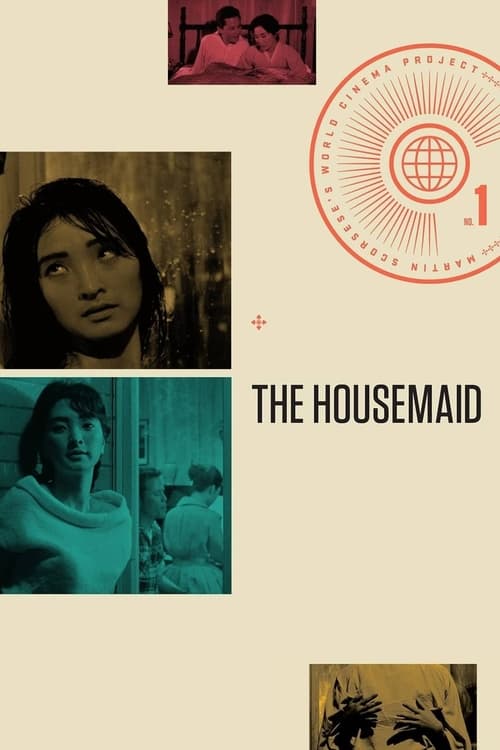
The Housemaid is basically only male anxiety. Male anxiety about what would happen if women treated men like how men treat women (systemically not individually). Our main male character is technically in the position of power as a patriarch and a teacher, and when his power goes unchecked, his world is safe and normal. But as soon as a student is inappropriate to him, his grip on male power (specifically sexual dominance) disappears. He is the one being desired inappropriately. He is the one being assaulted. He is the object that one woman can give to another. The Housemaid is terrified of the power being flipped, even ending with the intention to quell its male audience's fears about the film becoming reality by reasserting the myths of men's dominance and large sexual appetite.As a look into Freudian anxiety it's fascinating. As a piece of entertainment it's a mixed bag. The first 20 minutes of the film is effectively useless thematically and it actively muddles the tense main plot. It would have benefited the film significantly to cut straight to the housemaid's introduction into the home. This early 20 minutes really throws off the film's entire pacing, and while the climax of the film is freaky and shocking and well worth the wait, I can readily admit that it was a WAIT.(Also, American erotic thrillers from the 80s and 90s owe EVERYTHING to this movie)
please choose the synonym of the word given1. familya. unitb. lovec. statusd. pain2. moneya. bone tiredb. unattainablec. a caged. everything3. childrena. rude little buggersb. an investmentc. your future d. dead4. love lettersa. innocentb. a child's first lovec. a dark sparkd. she stands outside the window in the rain5. marriagea. necessaryb. repressionc. words that pierce like weaponsd. his hand is cold6. housemaida. choresb. rat poison above the sinkc. her dark hair piled above her pale faced. you brought this upon yourself
This entire review is about the last 90 seconds of the movie so, yes, there are spoilers.For nearly all of the running time of The Housemaid I was either angry or distracted; no matter my other emotions, I was always deeply resentful that I was being forced to spend time with this collection of complete fools. All of that changed, however, in the 90 seconds when the "it was all a dream!"-type ending recast everything in an urgently fascinating way. I still hate everyone, but the ending suggested I'm supposed to, and it opens the film up in ways that are both frustrating and thrilling.Let me explain. The main thing that so exasperated me about the story of the film is the helplessness and passivity of Kim Jin-kyu as the composer, Dong-sik Kim — he makes virtually no effort to regulate his life until it's way too late, and sees himself essentially as a simply piece of flotsam at the mercy of the desires of others. But, in that final minute or so the film gives us of the (presumably) real man, he's nothing like he was in the precious 105 minutes. Instead, he's confident and almost cocky, glorying in his own masculinity and delighting in the way his discussion of desire has shocked his wife. In those few seconds, Mr. Kim shows more backbone and personality that he does in the entirety of the rest of the film, which begs the question: through whose eyes has the imagined melodrama we've just watched taken place?Is it how Mrs. Kim (Ju Jeung-ryu), the composer's wife, envisions her husband would be in the face of even the slightest temptation to stray? Weak and pliant and unable to take responsibility? Or is it what the housemaid (Lee Eun-shim) envisions, a warped fantasy of romantic and sexual control that ensures her arrival in the privileged class through manipulation of a man and his family? Or is it Mr. Kim himself, indulging in his own fantasy of impossible desirability, a scenario in which younger women line up to adore him, so devoted they're willing to take lives (including their own) to secure him for themselves?On one hand, things feel somewhat incomplete without knowing the answer, particularly because of the fodder that would be available for analysis, could we be sure through whose eyes we've been looking. On the other, however, the uncertainly is morbidly delightful, potentially implicating everyone for the dark vision through which we've all just lived.⏩ ☃️ Winter of (foreign language) Noir 🗡️