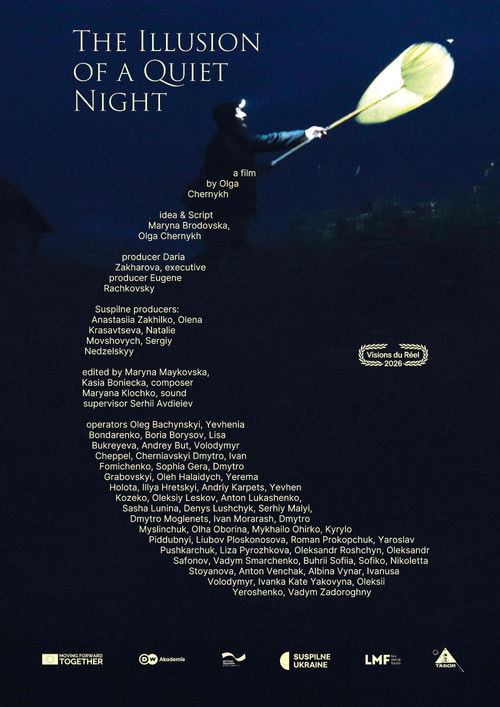
„I have something to say. A lot, even. But there‘s no one to talk to about it.“Love, loss, fun, fights, solitude, solidarity — life during war still remains life, yet it continues with a distinctly different quality to it. The rhythms may be the same, but the meaning imbued with these everyday activities — from cooking dinner to going to sleep — and broader cycles of humanity — from giving (birth to) life to giving (one‘s) life — echoes a mixture of anxiety, resilience, and hope.Compiling footage from a single night in July 2025, shot by dozens of professional cinematographers, ordinary citizens, and soldiers alike, this is a deeply personal experimental documentary that is as diverse as the people it represents. The resulting parallelism of this immersive insight into the realities of a nation is poignant in that the variety of what happens in one night is unified not just by the war, but the very people experiencing it. There is both beauty and sadness in all these small moments of life, but the most striking image is probably the juxtaposition of baking bread and the making of a rocket/mortar shell — both being indispensable staples nowadays for the ability to continue life in Ukraine.Collective memory as the accumulation of personal memories, documentation as a mechanism for survival, conservation, and protest. This is an emotionally and intellectually evocative look at the „humanity that is constantly being attacked and erased by a genocidal regime, but also of that humanity‘s perseverance“ — because what is a country if not the many individual names, faces, and stories that want to be heard and need to be listened to?P.S. Incredible pre-screening performance by Crimean Tatar artist Aziza Eskender, whose spoken word/musical act, complemented by projections of artworks, focused on the erasure of names, languages, and indigenous voices under the Russian occupation.
За 10 років цей фільм настоїться як гарне вино й стане таким собі «документом епохи». А поки це добрий інструмент, щоб пояснити європейцям, «а що тут у нас коїться і як ми тут так виживаємо».Передивлятися у випадку «все пропало», щоб згадати, «що життя триває».
Ukrainian Film Festival BerlinFilms about Russia’s war in Ukraine[Deutsch]Leuchtet in das Nachtdunkel der menschlichen Seele - Poesie in Kriegszeiten: Widerstand und Alltag, ein Film der Montage, schwankend zwischen Pessimismus und Lebensfreude. Filmemacherinnen und Amateure drehen in einer Julinacht 2025 in der Ukraine. Feiernde im Techno-Club, daneben Kriegsversehrte oder U-Bahnhöfe voll von Schlaflagern. Wildtiere untersuchen die Umgebung, ein Eisbär im Zoo schaut den Raketen nach. Eine Entbindung im Kreißsaal, Soldaten kochen Essen, Kinder tanzen. Die Gräber in der Stadt werden für die Jüngeren mittels eines düsteren Märchens erklärt. Das Unwetter mit Blitz und Donner wechselt sich mit herannahenden Bombardements ab. Die künstlerischen Bilder mit Schatten an der Wand wechseln sich mit Amateuraufnahmen ab. Eine durchgängige Narration fehlt, doch sind immer Themen montiert, die sich zu einer eigenen Kurzgeschichte formen und Kraft entwickeln. Im Kontrast stehen die Dunkelheit und Angst in der Nacht zur Energie, die am nächsten Morgen die Orte wieder zum Leben erweckt.Im Panel erzählt Regisseurin Olga Chernykh, dass 40 Kameraleute und 300 Amateure 300 Stunden Material beigetragen haben. Sie sieht es als ein Archiv zu diesem bestimmten Zeitpunkt mit spezifischen Themen. Durch die Parallelität, die Gleichzeitigkeit der Dinge, verbinden sich in der Montage durch Kunst, Motive und Gerüche. Auch in besetzten Gebieten wurde gefilmt, wie Krim und Donezk. Kommunikation und Übersendung des Materials waren schwierig. Laut Chernykh gibt es einen großen Drang nach Kultur bei der Bevölkerung vor Ort., z. B. durch Folklore, Techno-Clubs oder Buchmessen. Russland hat es nicht nur auf die Infrastruktur abgesehen, sondern auch auf die ukrainische Kultur. Auch das ist von der Bevölkerung eine Art Widerstand.Filmemacher Taras Spivak meint, dass sich mittlerweile viel verändert hat. Angriffe gibt es 24 h, selbst in Kyjiw, wo es kritische Infrastruktur gibt und eher wenig Schutzunterkünfte.___________[English]Shining into the darkness of the human soul—poetry in times of war: resistance and everyday life, a montage film that oscillates between pessimism and joy of life. Filmmakers and amateurs are shooting on a July night in 2025 in Ukraine. People partying in a techno club, alongside war veterans or subway stations filled with makeshift sleeping quarters. Wild animals explore their surroundings; a polar bear at the zoo watches the rockets fly by. A birth in the delivery room; soldiers cooking meals; children dancing. The graves in the city are explained to the younger ones through a dark fairy tale. A storm with lightning and thunder alternates with approaching bombardments. Artistic images with shadows on the wall alternate with amateur footage. There is no continuous narrative, yet themes are consistently woven together to form their own short stories and develop their own power. The darkness and fear of the night stand in contrast to the energy that brings these places back to life the next morning.During the panel discussion, director Olga Chernykh explained that 40 cinematographers and 300 amateurs contributed 300 hours of footage. She views it as an archive of this specific moment in time, focusing on specfic themes. Through the parallelism and simultaneity of events, art, motifs, and scents come together in the editing process. Filming also took place in occupied territories, such as Crimea and Donetsk. Communicating and transmitting the footage was difficult. According to Chernykh, there is a strong desire for culture among the local population—for example, through folklore, techno clubs, or book fairs. Russia is targeting not only the infrastructure but also Ukrainian culture. This, too, is a form of resistance on the part of the population.Filmmaker Taras Spivak says that a lot has changed in the meantime. Attacks occur 24 hours a day, even in Kyiv, where there is critical infrastructure and relatively few shelters.