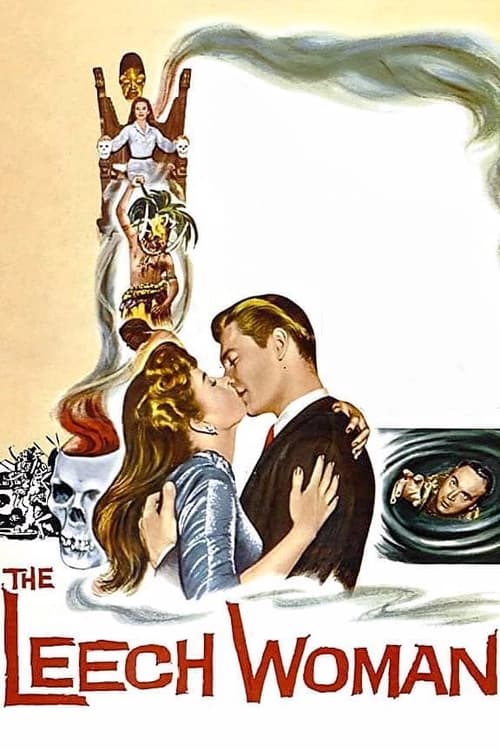
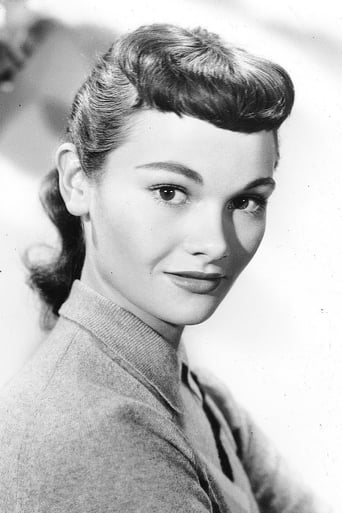
1st Edward DeinLook past the cheap sets and the colonialism (and they are hard to look past, I know) and The Leech Woman is a cut above the usual B horror film of the era. In no small part, it’s thanks to the character work it gives Coleen Gray as June, an alcoholic trophy wife to an experimental endocrinologist interested in rolling back the body clock. While her personality is entirely based around her lost beauty, something that she drinks to forget, that obsession provides a fascinating and really quite sympathetic hyperbolisation of the limited opportunities for women in the late 50s/early 60s. June feels as if she has no value without her looks and her willingness to kill to maintain them is, thanks to Gray’s performance, remarkably believable in the context of her fading femininity. Her ageing makeup may seem exaggerated in the sheer number of wrinkles her face displays, but considering the dramatic quality of her own anxieties, it makes a perverse emotional sense. Indeed, the whole film constantly yaws between outrageously dated and quietly progressive, especially in the presences of Estelle Helmsley and Kim Hamilton as Old and Young Malla. While they conform to the stereotype of an ethnic minority who possess special knowledge, they nevertheless have a more complicated role within the narrative than Stepin Fetchit would have in a horror of the 1940s. Instead of commenting on the action inanely, they are actively inspiring the events that lead to the tragic conclusion, possessing an understanding the arrogant white characters lack to their detriment. But that is balanced out by the terrible scenes of tribal rituals filmed on the soundstage and the cheap stock footage of jungle animals. I’m also pretty sure that the film gives the tribe members Zulu-style shields when they are not even close to South Africa, but someone with better knowledge of 19th century African history can inform me as to my mistake. Whatever the case, reckoning with this film is a strange and complicated experience.This was put on as background noise while I was working on my thesis, I currently have only two weeks left, so imagine my surprise when I found that an author I reference extensively in my thesis, Vivian Sobchack, has written an excellent article on the film and its gender politics. You can find it here!
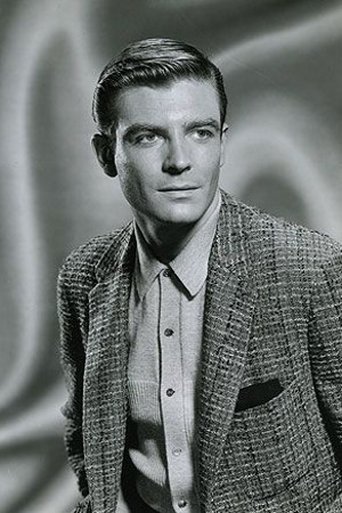
Director Edward Dein's enjoyably mean-spirited little 1960 horror flick is a lot of fun, especially the home stretch. Coleen Gray gives it her all, in a variation of one of those tragic 'youth potion' storylines."Old women always give me the creeps."So in this one, one prick of a Doctor (played viciously cold by Phillip Terry, probably best remembered for "The Lost Weekend") learns of a youth formula located in the deepest confines of Africa. He see's it as a solution to his lost interest in his aging wife June (Gray), who's turned to drinking heavily. Their acidic relationship seems doomed, with their patter nothing more than a series of not-so-subtle jabs at the other..."As a Doctor, I resent the word butchering...almost as much as I resent looking at you."Feel the love. But hey, June gives as good as she gets..."Here's to you, whiskey...the guardian of all frustrated wives."Yet for all her bitterness, June seemingly still loves the jerk...so she accepts his invite to tag along on the expedition, and off to Africa they go. There, they witness much stock footage, as well as one heck of a ritual creating the potion. It involves using a ceremonial ring (adorned with a small blade) that's then punched into the back of the neck of the sacrifice, in order to extract the person's pineal gland secretions! It's the needed ingredient in the potent elixir, and it's power is validated when one of the tribe's elder women takes it and regains her youthful beauty, embodied by the attractive Kim Hamilton. (Apparently the potion also applies makeup and does your hair while you transform.) However, the effects only last for a while. Theoretically, one would need to keep knocking off victims in order to sustain youth. Hmmmm...Once June realizes her husband asked for her company simply so he can test-drive the potion on her...the sadistic relationship takes a welcome, Karma-fueled turn. She then returns home (with the ingredients and ceremonial ring) and pretends to be her own niece. She ends up falling in love with a young but engaged lawyer, played by Grant Williams ("The Incredible Shrinking Man"). He's got a wandering eye...so easy pickings. Of course, she continues to kill to stay attractive, but now the cops are starting to zero in.With a story that's pretty nuts, a slew of despicable characters, a surprisingly decent kill count, and cruel fates for nearly all involved...this proved to be a diverting 77 minutes. For a low-budget effort aimed at filling the bottom half of a double feature, it's better than given credit for. Recommended.
Spoilers ahead.Much like Kurt Neumann's incredible She Devil from just a few years earlier, The Leech Woman is a horror movie about what happens when a woman gets control over the one thing that gives her power in society: her appearance. In both films, that control comes through the hands of men who see the women as nothing more than subjects upon which to experiment, something their subjects recognize and immediately articulate to the men — who, inevitably, are shocked and offended by the suggestion that they are interested in anything but what is best for the women.Whereas in She Devil, the woman is a stranger whose isolation and poverty make her the perfect subject/victim, in The Leech Woman the subject is married to the man who wants to experiment upon her — in other words, she, too, is isolated, and entirely at the mercy of the man who would use her. In many ways, the situation in the later film is far more intense and uncomfortable, because the wife (an excellent Coleen Gray as June Talbot) is acutely aware of the fact that she is a decade older than her husband, a reality for which she is constantly apologizing. Most of the time, the pair can hardly stand one another — the fault for which lies with June: her looks, her anger, her drinking — but June has been so conditioned by society to bind her value to her ability to attract men that even the slightest kindness from her scientist husband immediately turns her into a simpering acolyte who wants nothing more than to be forgiven for the sin of aging (to be loved again).June's husband Paul (Phillip Terry) is ferociously cynical, a nasty piece of work — true of literally every white man in the movie — who manipulates his wife without the slightest hint of regret, feigning renewed affection in order to take her along to Africa in search of a youth serum that he plans to test upon her. But Paul makes one, crucial mistake: he assumes that the possibility of renewed youth will render his wife the masculine ideal, without needs or ideas of her own. The reality, however, is that, at least in the movie's telling, women who are able to get younger at will instantly shake off the bounds of social convention and take their lives into their own hands, casting aside the men who are so used to controlling them.For June, the mere knowledge that youth is within her reach is enough: she abandons the submission that has ruled her life and, in an instant, chooses her husband as the male sacrifice that will secure her renewed beauty. And, tellingly, the African woman who acts as June's guide to her new future* shows not a hint of surprise at June's choice — indeed, she goes so far as to express her approval and understanding of the efficiency of the choice, remarking that June will have youth and revenge in a single action.Through one lens, June's youth turns her into a dangerous predator, a siren to younger men who are unable to resist her supernaturally secured good looks. Through another, however, she is simply following the rules society has laid out for her. If women can achieve security and happiness only through being desirable to men, having once again become desirable, it makes all the sense in the world that she wields that precious weapon for all it is worth. And, given how eagerly the men around June abandon any loyalty to her husband and their own significant others at the slightest glance from her, their status as victims is dubious to say the least — were June's looks not aided by magic(al science), we would see the men as the predators, not her.The final confirmation of the importance of male desire to feminine survival comes in the way the movie's only naturally youthful woman (Gloria Talbott as Sally Howards) responds to the threat of losing her fiancé (Grant Williams, nearly as pretty as Talbott) to June. Determined to defend her status, territory, and future, the entirely conventional Sally takes what to her is the only logical step and pulls a gun on her rival. She needs to drive the threat out of town long enough to get married; once that happens, her husband will be bound to her in the eyes of society and her security will be assured.It's a moment that is both shocking and grimly logical: physical beauty is relevant for women only for what it secures them, namely the love and attention from men. Without beauty, there is no man; without the man there is no (economic, social, physical) security. Without the man, woman is nothing — and Sally refuses to be nothing. NB: I've started a list of female rejuvenation movies — please let me know what else to add! I want it to be purely movies in which women control their own looks/youth, so I'm not including things like Eyes with a Face, in which men exclusively act upon women.*This movie is rooted in the othering of non-white people though, as others have pointed out, the only person in the movie with depth, and who is able to emotionally regulate herself, is Malla (played by Estelle Helmsley as an old woman, and Kim Hamilton as a young one), the formerly enslaved 'tribeswoman' from whom the youth formula comes.⏩ Female Rejuvenation: Youth and Beauty Through Blood, Goo, and Magic(al Science)