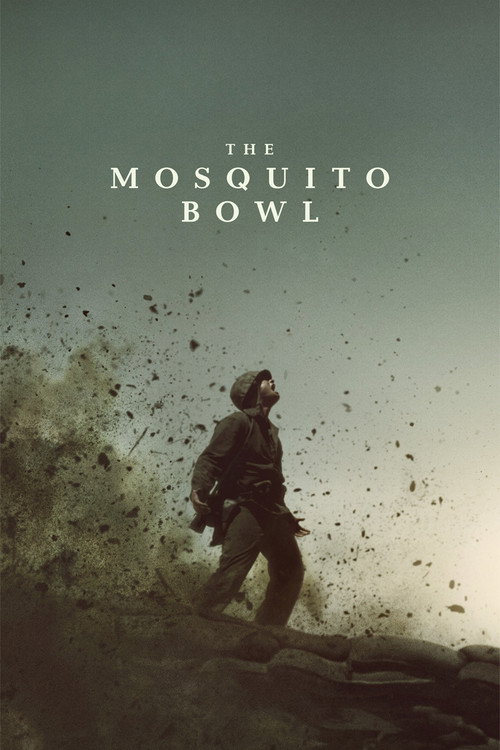





There have been any number of movies about the hell of fighting in World War II, the most visceral of which have been made in the years since “Saving Private Ryan” provided a very enduring template for how modern filmmakers could render that carnage with both the spectacle of a blockbuster and the horror of a memory. Peter Berg’s brutal and concussive “The Mosquito Bowl” is definitely one of them! No one could ever say that it’s not.What differentiates this unsparing epic from the scores of other stories about the Greatest Generation, however, is that some of its characters are good at football. Indeed, these All-American college boys are so good at football that, on Christmas Eve 1944, the soldiers are ordered to play a morale-boosting game of two-hand touch on the beach where their units are preparing for the Battle of Okinawa.And for the span of the eight-minute montage during which “The Mosquito Bowl” actually makes good on its title, it’s easy to picture how the famous scrimmage — fought between a roster of impossibly beautiful athletes in their primes — might have been used to backstop a story that accentuated the senseless waste of sending thousands of young men to their deaths. Alas, for the rest of this 126-minute film, that waste is better expressed through Berg’s failure to make anything more of their lives, as the “Spenser Confidential” auteur’s latest Netflix project does almost nothing else to distinguish itself from a genre so well-worn that it’s seemingly run out of ways to blow up a human body.Why “almost”? I was hoping you wouldn’t ask. For starters, there’s the decision to cast thin-skinned ESPN commentator Pat McAfee as an R. Lee Ermey-inspired drill sergeant. “The Mosquito Bowl” also stands out for how confusingly it conflates the thrill and teamwork of combat sport with the violence and camaraderie of armed conflict; war is presented as both a natural extension of what these boys have been trained to do on the gridiron (to the point that the soldiers briefly diagram their plan of attack as if it were a football play), and also the catastrophe that robbed them of a more innocent purpose. (Berg loves the troops as much as he hates the fact that generals and presidents so wantonly sacrifice their lives.) Someone declares that “The Marine Corps is the greatest offensive line in history,” and yet the film’s characters don’t seem to have any special advantages on the field of battle, as it would be glib to suggest that even the country’s best college running back might be able to slip free of a mortar blast. It’s one thing to argue that football is war, and another, much more asinine thing to argue that war is football.~this review continues on IndieWire~