
I love Parker, I love Q, I love a heist, and this cast is sick. Not a great movie but I’m sure it made for a fine night at the drive-in.
Während eines Football-Spiels erleichtern fünf Gangster die Kasse des Stadions von Los Angeles um den enormen Wettkampferlös, werden jedoch ihrer Beute nicht froh. Temporeicher und spannender Krimi.
The Split läuft in 1 Kino in Los Angeles - nächste Vorstellung Mittwoch, 18. November um 14:00 im Vista Theatre.
Nächste Vorstellungen: Mittwoch, 18. November.
Vollständiger Spielplan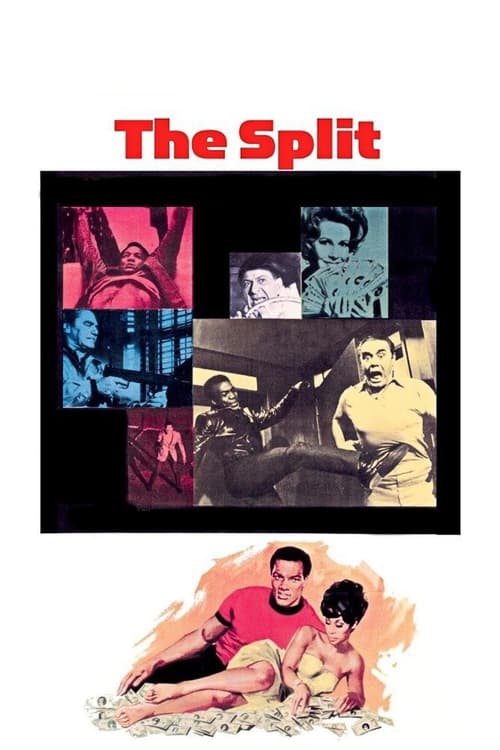
Spielzeiten zu The Split, jeden Morgen aktualisiert
Wähle dein Kino und bekomm einen Hinweis, bevor der Film aus dem Programm fällt.
I love Parker, I love Q, I love a heist, and this cast is sick. Not a great movie but I’m sure it made for a fine night at the drive-in.

The Split is a 1968 film adaptation of the Richard Stark (aka Donald E. Westlake) novel, The Seventh, featuring his anti-hero Parker. Its producers were Irvin Winkler and Robert Chartoff who had just a year earlier brought Parker to the big screen with Point Blank. Here however, the Parker role is taken by former NFL player Jim Brown after Marvin passed on the opportunity of making a franchise. To avoid any confusion, Parker is renamed McClain.Stylishly directed by Gordon Flemyng, the father of British actor Jason Flemyng who had previously helmed the two Doctor Who big-screen spin-offs, and with a score from Quincy Jones, this is a prime slice of fashionable '60s hardboiled heist movies. In some respects it occasionally reminded me of Kubrick's The Killing in the way that the actual heist itself (a $500,000+ robbery of a football stadium) plays a professional-looking second fiddle to the bitter recriminations that follow in its aftermath. I also liked the emphasis the film places on assembling the team to pull off the job. Much of the first half of the film is made up of Jim Brown picking fights, intimidating and taunting Ernest Borgnine, Jack Klugman, Warren Oates and Donald Sutherland. Why he does this is initially not clear; have they wronged him in the past on some other job? Is it somehow racially motivated? It only later turns out that Brown is merely testing each of them for the skillsets and attributes required for the heist. And what a cast! You're looking at three actors (Brown, Borgnine and Sutherland) who had starred opposite the original Parker, Lee Marvin, in The Dirty Dozen the previous year, as well as two actors (Borgnine and Oates) who would form part of The Wild Bunch a year later. Also starring are Julie Harris, Diahann Carroll and Gene Hackman. For me though, the standout is Brown; his easy charisma, intimidating frame and quiet menace makes it very hard to wrench your eyes away from him whenever he graces the screen. The Split may not be the greatest heist movie of all time, but it's short and compact and rattles along rather well.

I became aware of this when it was suggested for my 'American Films, Scottish Directors' list. It seems to be the only film Gordon Flemyng made in the US, probably because it didn't do well at the box-office.But why didn't it do well? It's a fast-paced heist action thriller with a stacked cast and it looks great. Could it be that the stacked cast was led by Jim Brown in his first leading role? The film was adapted from a Donald E. Westlake (as Richard Stark) 'Parker' novel with the character here called McLain. Perhaps the 1968 American audience didn't like a white character (who had previously been played by Lee Marvin in the highly successful 'Point Blank') being portrayed by a black actor?Although, strangely, in the first film appearance of the character, it was played by a woman, Anna Karina, in Jean Luc Goddard's 1966 film 'Made in the USA'.Anyway the film is great and highly enjoyable.
Eine Gruppe von Dieben versucht einen waghalsigen Raubüberfall auf ein Fußballstadion.
The Split wurde 1968 von Gordon Flemyng inszeniert, einem schottischen Filmemacher, der für seine Arbeit in Film und Fernsehen in den 1960er Jahren bekannt ist.
The Split ist in den USA mit R eingestuft.
The Split wurde am 4. November 1968 in den USA veröffentlicht.