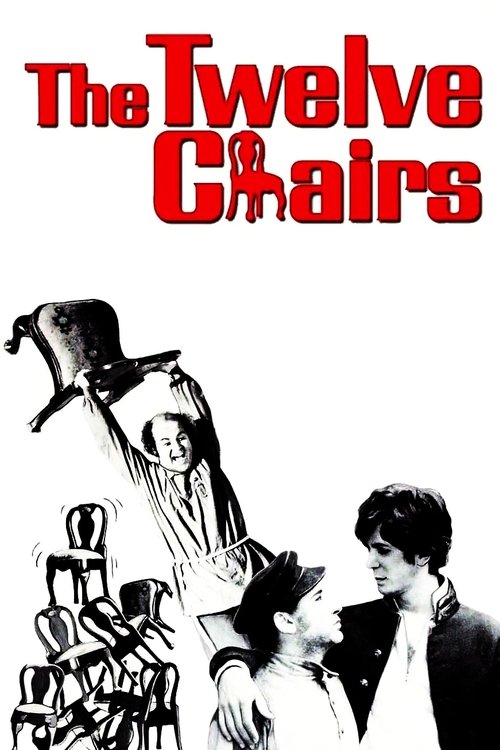
"Remember the famous Russian proverb: 'The hungrier you get, the tastier the meal.' On the other hand, the French have a proverb: 'MERDE!'"In 1927, in the Soviet Union, the mother-in-law of impoverished aristocrat Ippolit Matveyevich Vorobyaninov (Ron Moody) summons him to her deathbed, telling him about a fortune in jewels she hid in a chair years ago. Determined to find the jewels, Ippolit is manipulated by con-artist Ostap Bender (Frank Langella) into a partnership, while priest Father Fyodor (Dom DeLuise) is also after the chair ...The Twelve Chairs is a comedy film written and directed by Mel Brooks, based on the novel of the same name by Ilf and Petrov.Brooks' second movie is based on a classic satirical novel which has been filmed more than twenty times. Brooks also played a supporting role and composed the film's title song.The Twelve Chairs marked the film debut of Frank Langella, the movie's highlight, and he's perfect as the charming, manipulative and handsome Ostap. It was also the first of many collaborations between Brooks and DeLuise.Thanks to its great cast, Brooks' excellent writing and overall very good production values, the movie is fun to watch. Still, it's not exactly the funniest or sharpest among Brooks' films, and is occasionally too farcical or silly.In conclusion, The Twelve Chairs succeeds thanks to its excellent cast, biting satire and overall very good writing, but is too uneven to call it a truly great comedy.RankingsMel Brooks' films
Possibly the strangest film you will find in Brooks' filmography because this is his most politically charged facet, but only tangentially (as if that was little). Langella appears in his second theatrical run as a calculating con-artist with a double agenda. There is a special appearance by Brooks for the first time on a theatrical film, leaving clear that his characters will consist of the physical comedy of the 20s and 30s.People accustomed to Brooks social parodies, or his major productions of 1974 onwards, will find this strange to relate, but it is more human than anything. Humor is consistent instead of overflowing and non-stop; beneath hides, very subtly, the social commentary included in the original novel by Ilf and Petrov. In the end, this is the strangest anti-Communist comedy, again, tangentially, although it does make a statement on social strata and the separation between the middle class and the upper social strata. It tackles artists, noblemen, priests and aristocrats. No one is safe here, at least under the post-revolutionary USSR regime of 1927.The film is very smartly written and probably conforms Brooks' most elaborate screenplay, which works wonders for the film. Had Brooks followed this path, we would have a different director of comedy and equally intelligent, without a shadow of a doubt. I'd take this over a Spaceballs anyday.Oh, and that central theme of "Hope for the Best (Expect The Worst)" main theme by Brooks himself is pure gold.The truth is, this is the director at his most experimental when it comes down to combining genres with zany comedy. It is less loud than the rest of his productions, but it still makes enough noise to extract laughter; nevertheless, there are character arcs too. One defining point for me was when the unlikely duo pull of the idea of faking epilepsy. The preamble of that scene is very revealing and all done in one single shot.Speaking of which, Brooks' framing since his debut is intelligent, I reiterate. He has a clear sense of how he wants his shots to look and it shows. Close-ups with a malicious character on the front while the more passive one reacts in the background is a clear demonstration of knowing what contrast is. Art direction is great and how Yugoslavia and the Adriatic Sea are filmed leave nothing, if few, to be desired.Extremely underseen and undervalued comedy by a very popular director. People telling there is a "non-existing script" have zero idea of how films are done.Also, a very hard-hitting ending.84/100
In the years after the Russian Revolution, an impoverished aristocrat (Ron Moody) reluctantly teams up with a slick con artist (Frank Langella) to track down a fortune in jewels that were sewn into one of twelve antique chairs shipped off by the Soviets, encountering all sorts of problems along the way, in Mel Brooks’ comedy featuring Don DeLuise. This seems like a bit of a transitional project for Brooks; it was first set in the past, and contains traces of the spoof style his next few films would hone, but unlike those (better known) comedies this is actually direct adaption of another work (being based on a satirical novel by Ilf and Petrov), with a mellow streak underneath it all not really shared by anything else in his filmography. I haven’t read the book, though it does seem as if this source material isn’t always the best fit for Brooks and his more go-for-broke style. Because of that, the film is kind of all over the place tonally, with the main plot (taken from the book) of this odd couple on their quest side-by-side with the filmmaker’s frequent injections of manic slapstick in a way that makes it all feel a bit uneven.It starts off really funny while setting that premise up, especially whenever Brooks himself is onscreen as the drunken former servant of Moody’s character (his scenes feeling closer in their gleefully silly spirit of something like Blazing Saddles or High Anxiety), but once our leads eventually embark on their journey the runtime starts to feel more like a series of hit or miss extended skits, some of which last a bit too long to always flow entirely well (like the moments featuring the antics of DeLuise’s bumbling ex-priest, which eventually get old after a while). Having an episodic structure while Moody and (an incredibly young looking) Langella go on the hunt for those riches does allow for a lot of variety story-wise, though, thanks in large part to extensive location shooting; the production values are surprisingly high here, really doing a great job of recreating these eclectic locations in all sorts of ways, but I think Woody Allen did a similar sort of Russian setting with a better/more consistently funny approach in Love And Death a few years later, which by virtue of not being directly based on anything feels snappier in execution. I just wish Brooks had allowed himself to go even crazier and be more freewheeling with the material, unable to cut loose here in the way a Universal horror homage or a western send-up allow. This leaves the film in a bit of an odd middle ground, leaning too heavily into schtick for some of the smaller and more emotional character moments to breathe, yet at the same time a bit over-restrained by the nature of this subject matter to fully delve into some of the broader stuff. There’s really two different stories here; one a more bittersweet little tale about a man trying to reclaim his dignity through finding these riches and the other a comedy that’s more madcap in nature, so while both are fun it’s almost as if they’ve been squished together in the writing process, like Mel was trying to adapt the book but couldn’t help throwing in lots of his own sensibility as extra additions (which becomes a bit tiresome after a while when neither side entirely gels). This results in a sophomore outing from the filmmaker that’s never quite sure what it wants to be, a likeable but spotty trip to post-Revolution Russia that doesn’t ever quite hit the heights of his later outings-though the raw elements are all there.