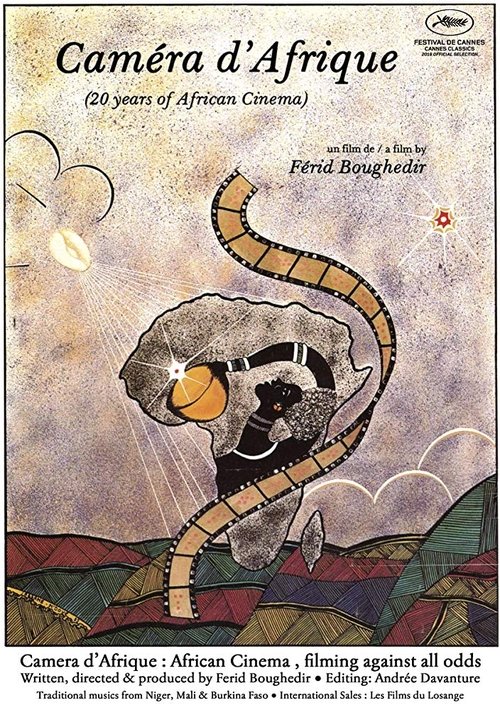


Streaming for free until April 10th through Institut Francais is the documentary Caméra d'Afrique/Twenty Years of African Cinema, which acts as a pretty good primer on the development of pan-African cinema from the 1960s through 1980s, and the challenges of censorship, lack of support from the government, no profit and lack of international distribution and also addressing local cinema's tastes for imported international films. It covers and interviews several films and filmmakers that have found a place in the collection, including Ousmane Sembène (Black Girl, Borom Sarret, Mandabi) and Med Hondo (Soleil Ô), and Touki Bouki.While much of the film is a clip show, most of the films featured have fallen out of distribution (I pray that none of them have been lost), like Adja Tio, Jom, Djéli, Ajani Ogun, L'éxilé, La chapelle, Amanie. Many of the films are new to me, like Wênd Kuuni, Finye, Baara, Kaddu Beykat, Muna Moto, and might not get a chance to see clips of otherwise.The website does have an unfortunate presentation, as subtitles are presented with a transparent black bar at the bottom of the screen that doesn't disappear when no spoken words are said, but I'm not sure if the documentary is available anywhere else. It's also a little amusing seeing English subtitles overlaid on top of French subtitles (although it also offers other languages and the option of no subtitles), although the English subtitles are only partial and do not subtitle when English is spoken in the film.Not sure if it's geoblocked but I'm sure some might use a VPN anyway.I will say that my exposure to African cinema is very limited (as much as you can describe the cinema of an entire continent). Besides a couple of Sembenes, Crazy World and a few South African films like District 9, Zulu and Joe Bullet, even a wonderful film like I Am Not a Witch is internationally coproduced with the UK, France and Germany, than being able to entirely stand on its own as a Zambian film.