This film could’ve been an email… that I probably wouldn’t have read

In a last-ditch mission to get recognition for her talent, Audrey Amiss (Monica Dolan) persuades her psychiatric nurse, Sandra Panza (Kelly Macdonald) to take her on a road trip back to where her story began – but with so many deviations along the way, will they ever make it?
Typist Artist Pirate King läuft in 1 Kino in London - nächste Vorstellung Samstag, 28. November um 15:30 im The Garden Cinema.
Nächste Vorstellungen: Samstag, 28. November.
Vollständiger Spielplan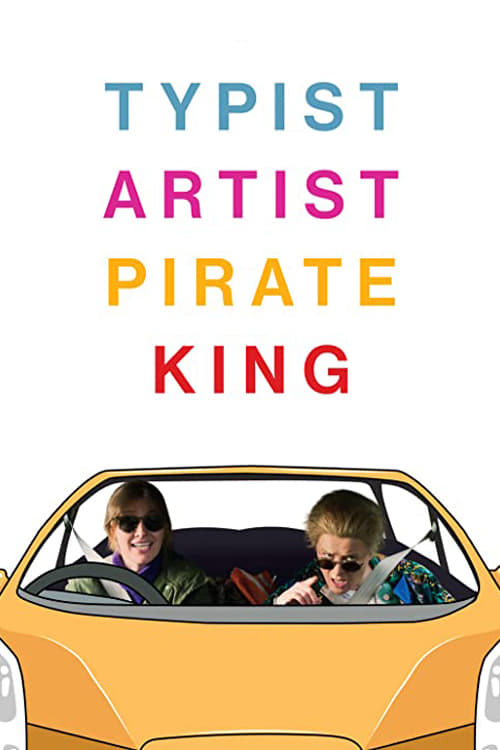
Spielzeiten zu Typist Artist Pirate King, jeden Morgen aktualisiert
Wähle dein Kino und bekomm einen Hinweis, bevor der Film aus dem Programm fällt.
This film could’ve been an email… that I probably wouldn’t have read

52 films by women 2023: 71/52."I used to be a kitchen sink realist painter", explains Audrey Amiss, the real-life artist at the centre of Carol Morley's irresistible road-trip comedy. "Now I'm avant-garde and misunderstood". You could say something similar about Morley, who began as a documentarian and has assembled one of the most impressive, restless bodies of work of any British director this century without really shaking off a reputation for making divisive, underrated features. She is uninterested in realism - at least, not the kind of straitened, didactic realism that is synonymous with the phrase over here - but also uninterested in genre, and British cinema only rarely allows such people to prosper. If she'd been making films in the 1990s, she might have caught the tail-end of that era's craze for Forteana and marginalia; but then, even directors who got through that door in time like Ben Hopkins and Andrew Kötting struggled through the decade that followed.My favourite of her films is The Falling, whose structure and visual style is as dense and kaleidoscopic as the research binge that her movies usually emerge from. Typist Artist Pirate King is the product of an eight-year investigation, but its style and tone is mostly clear and breezy. It's based on Amiss's personal archives, notebooks and paintings, which Morley will frequently show full-screen. Another director might have arranged them chronologically, so we can see how her work changed after her schizophrenia diagnosis: the early, delicate life studies, the move towards abstraction, the later scribbles, collages and splashes that clearly hold some incomprehensible personal significance. One of Morley's most humane gestures is that she refuses to do this, and I think I know why. It would make it too tempting to read Amiss's work as a decline, the early gift for realism giving way to pages and pages of scribbled notes around sweet wrappers. For all Audrey was frustrated about her lack of recognition, she never saw her schizophrenia as an obstacle or a failing. She saw it as an essential part of who she was.Morley reminds me so much of Werner Herzog, not just in her casual shifts between documentary and fiction but in their insistence that truth as it applies to art is not the same thing as truth as it would apply in a courtroom. The road trip that Monica Dolan's Audrey takes with her social worker did not happen, and I can imagine some viewers dismissing the film because of that. Yet it gets to a key truth about how Audrey saw herself that a realist film would struggle to express. Amiss compared herself to Don Quixote, constantly fighting enemies and celebrating triumphs that no-one else could see. If that sentiment was expressed in a more conventional social realist telling of Amiss's life, it would be heartbreaking; you picture the sad old mad woman in her filthy flat dreaming of fighting giants. That isn't what Morley delivers. She christens the fictional social worker "Sandra Panza" and films Amiss's life as the hallucinatory hero's journey she lived, rather than the life other people mistakenly assumed she was trapped in.It's a risk, and there have always been people who object to this commingling of reality and fiction that seems to be central to Morley's work. I once read a review of her breakthrough film Dreams of a Life which lambasted her "unethical" film-making because of a scene where Zawe Ashton, as Joyce Vincent, sings a song that we have no record of Vincent singing or even liking. The song exists in the film because Morley thought it expressed an emotion she found in Joyce's story, and the reviewer thought this was an abhorrent motivation. I'd say that motivation - the urge to tell an emotional truth through metaphor - is something that has quite a lot of artistic precedent: it's why "artifice" contains the word "art". It unnerves me a little to think that we are now so reality-crazed that people will just casually venture opinions like that without realising they're objecting to the whole concept of art. All of this slipperiness, though, is only there if you dig for it. And it is worth digging for it, if only to realise how faithfully Morley has followed the detail, if not the incident, of Amiss's life. (Many of her best lines, including the one at the top of this review, are verbatim) But if you just want to drift along with the film it's remarkably easy to do that. The film's visual style is much more straight-ahead than The Falling, albeit still framed and lit gorgeously by Agnes Godard. Rather than a reduction in complexity, this makes the film's delineations between Audrey's world and the world of the other characters even more fascinating. An encounter Audrey has without Sandra present appears plainly naturalistic until an actor's performance throws it into question, while the compositions become more, rather than less, poetic as Audrey gets closer to a kind of factual truth. And then, at the end, a clearly unreal event is witnessed by a crowd of real, fictional and probably fictional characters, and what does that mean?It's likely that you'll be enjoying it too much to think about such things until you're on your way home. Typist Artist Pirate King - its title derived from what Audrey writes in the "career" space on her passport - is a breezy comedy with a deep emotional undercurrent, a crowdpleaser that also dares to risk provoking and unsettling the crowd when necessary. Everyone is wonderful in it, and Kelly Macdonald has many stand-out moments as Sandra, but the film rightly belongs to Monica Dolan as Audrey. Dolan has been one of the best character actresses in the country for over a decade now, and this is exactly the kind of full-strength showcase she deserves; it would win her an Oscar in a more just world. She is a hurricane at the start; as the film goes on she settles down a little, as does the film itself. It may end in a more conventional way than I'd have liked, but that feels like part of Morley's deliberate ploy to bring these provocative ideas about mental health and reality to the masses. She won't be misunderstood this time.

it’s giving ITV Sunday night drama
Eine exzentrische Künstlerin mit schweren psychischen Erkrankungen überredet ihre Psychologin zu einer unerwarteten Reise zu ihren Wurzeln.
Carol Morley inszenierte das britische Comedy-Drama von 2023, das auf umfangreichen Recherchen zum Leben der Außenseiterkünstlerin Audrey Amiss basiert.
In Großbritannien ist er ab 12 Jahren freigegeben.
Er wurde am 27. Oktober 2023 in Großbritannien veröffentlicht.