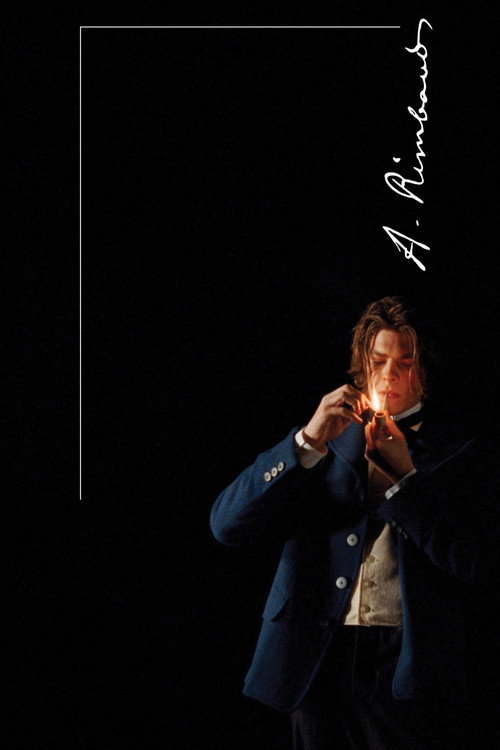




Wang goes Welles — really, Stanley Cortez, who had the experimental range to lens both Magnificent Ambersons and Shock Corridor ... and this careening, cumulatively engaging 3-hour study of the poet Rimbaud suggests a productive meeting point of both. More to the point, Wang's approach inspires the attentive viewer to find different ways to tell the history of a people, of a movement, of the intersection of colonialism and the emergence of the individual, of a strain of poetry, and of memory. It's doing something different with each scene; and like I've said before in relation to Altman's Quintet, it doesn't matter if it all "works" or not (by whose standards? Hollywood, implicitly), it matters that artists are trying to find fresh new ways to deal with the same problem, the same shit, and not just resign themselves, Matt Gasda-style, to useless, reactionary, and ponderous wah-wah-wah'ing.Wang and company respect not only the amorphous creation of the poetic individual, they place that individual in a social context that is both wildly innovative (music and sound are Rimbaud's sole interlocutors) and truthful (though we exist alongside others, we are fated to only know, really, our own bodies — life, then, is glimpsed as the Snowian, Christ Stopped at Eboli-ian back-and-forth between subjectivity that pleases the one and the state that feeds all). In his hands, in the dialogue of his instrumental ensemble, and in the spectacular hands and body of Blake Draper's (who is this Draper?!? discovery of the decade, for real), Rimbaud's "Je est un autre" is lent tactile form, is fully embodied, his poetry given its mysterious, solitudinous due.Rimbaud's second half of his life — giving up poetry for colonial administration — actually engaged me, on this first viewing, more than the familiar beats of his stormy first 20 years: the Verlaine love-affair, the shooting, the drunken boats and fugues of cities, the stuff of legend that inspired the bohemian yearnings of the Patti Smiths and the Robert Zimmermans and the Jim Morrisons. Those years where Rimbaud gives up poetry, in the hands of Wang, reminded me of the Ithaca chapter in Ulysses, in which the narrator catalogues, with frighteningly scientific intensity, every single angle, item, and possible path within Bloom's house as he makes hot cocoa for the drunken Stephen Dedalus while Molly Bloom overhears their conversation from bed. "Verse is taming reality," says Wang's Rimbaud and Joyce's narrator. Proposed thesis: Rimbaud found a purer, more effective, and powerful poetry than the one he left behind in Paris for the cultural enrichment of an empire in decline. "Verse is taming reality": commerce, each grain traded back and forth between the Ethiopians, the Greeks, the beginning of the plunder and the commencement of globalization. What is real poetry, as sung by the Greeks? He finds the people he subjugates "the most poetic people I know," truth dressed up with equal shades of condescension and rocksolidity, eternal youth and the dissolution of the bureaucratic adult. He finds poetry, as does Bloom, in inventory — is this not a more potent madness? And is this not the pre-culmination of the nothing, as Baudrillard would argue in the 80s w/r/t Warhol's "art"? Rimbaud accepts the cruel world order, and so he becomes a martyr to future poets like Wang who take up his example and wrestle with the contradictions of the world in order to create new harmonies. "Better a life of damnation than amputation": the cutesy, ruthless, sober conclusion.We must face that there was something earth-shatteringly conclusive about Warhol's genius — and that Warhol challenges us to think beyond art, beyond reality. Wang offers one such method of a post beyond the morass of postmodernity. Make it New! You've heard that song before, no?Though it may look like a perverse negation of his 4-hour epic of big-hearted ensemble life Bread Factory, Wang's A. Rimbaud is, in fact, the dialectical inversion that solidifies Wang's status as a beacon for filmmakers to reach for more with limited means. Welles and Caravaggio, Rimbaud and Ruiz, are available to all with the imagination, the companionship, the drive, and the will.