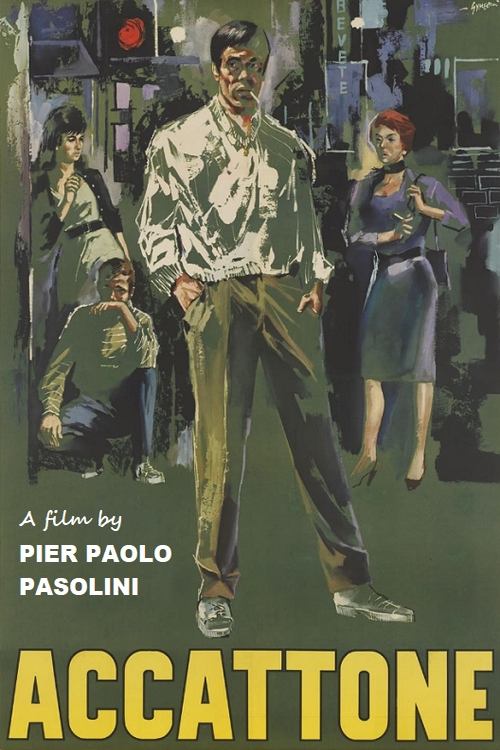
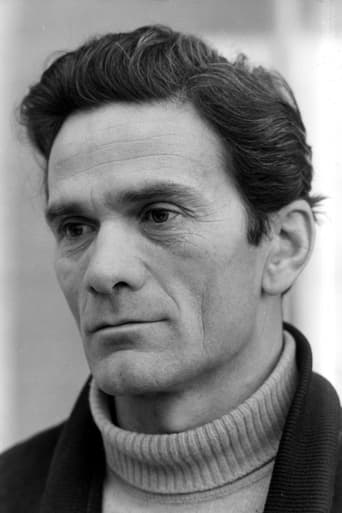
You can tell by the way Pasolini films people - full face, looking deeply at them - that he loves them. He's just often disappointed with them, is all. His debut would be an interesting double-bill with Salo, his last film; watch as the little, despairing allusions to fascism and forced labour in Accattone become all-consuming terrors.
An audacious, controversial auteur from the very beginning, providing Bertolucci his first film industry participation as an assistant director, I thought, with all the naivety in the world, that this being Pasolini's debut and an early 60s film, there would be more air to breath and more compassion. Naturally, I was proven wrong, as the auteur explored, since he ever grabbed a camera, the darkest corners of humanity. The film is endlessly depressing, partially derivative from the works and themes of the Italian fathers of Neorealism, but more exploitative from the viewpoint of a morally degraded Rome, relentless towards its characters, in a world where true friendships do not exist and where tragedies are expressed through Bach's music.Such pessimism is justified by the unusual advanced aesthetics of the film: horizontal panning shots that capture fully immersive scenes where it is clear that there is more than one character interacting with each other, impressive tracking shots (particularly the reverse continuous shot where Accattone is arguing with her wife holding their crying baby, a shot that is repeated afterwards under ironic and contradictory circumstances), and the dream sequence, which I would consider as one of the highlights of 1961.Unforgiving and uncompromising in the portrayal of a dark world where injustice prevails for the lowlifes, Accattone is the signature of an important voice being born, maybe, at the wrong time, although even today it is greatly banned and misunderstood.93/100
Although technically the first feature film directed by Pier Paolo Pasolini, Accattone set the foundation for everything that we have come to love most in his provocative and legendary body of work. We nonetheless still recognize it as the definitive blueprint for his cinematic identity. Being his directorial debut, adapted from his own literary explorations of the Roman underworld, Accattone not only has not aged a single day in time but, like all of the most vital works of Italian cinema, its message is one that still resonates with the way the disenfranchised are treated in our world today. Above all, the relentless honesty that Pasolini creates within such a desolate setting results in one of the most hauntingly beautiful films ever made.Based on his own deep understanding of the Roman "borgate," Accattone tells a story set within the dusty, impoverished outskirts of the city; where the post-war economic miracle has failed to reach the shadows of the sub-proletariat. What remains is a landscape of crumbling facades and sun-drenched wasteland, where the titular character, Vittorio "Accattone" Rubante, resides as a pimp and a thief. In this forgotten corner of humanity, Accattone seeks a means to survive in a world that has already predetermined his failure. With Pasolini having portrayed what remains of the human spirit when it is crushed by systemic injustice, there’s still something transcendent in his almost hellish vision of the slums because the most unlikely element one could ever call for during such a dark depiction of life is the presence of the sacred.Everything about Accattone is incredibly astounding. Whether it be the jarring yet perfect use of the sacred music of Johann Sebastian Bach, the stark details within the cinematography, or the raw, non-professional performances, there’s never a moment where it feels as if Pasolini is ever letting down on providing a vision that is both brutal and poetic from beginning to end. But even a vision of a morally degraded Rome could only be made to look so divine in the eyes of Pier Paolo Pasolini. He shows us a world that exists on the periphery, where poverty has become its own malevolent force, fighting a long war against the individual to the point it continually breaks them apart. Everything is so visceral to the eye, much to the point where the injustice we see is so distressing just by thought; for Pasolini ruminates upon everything that society had orchestrated to lead into the downfall of its most vulnerable.In Pasolini’s vision, the very idea that this cycle of misery could only be a byproduct of a system that views the poor as disposable makes for a more distressing picture. While the film is partially derivative of the themes established by the fathers of Italian Neorealism, Pasolini takes it further, creating something more exploitative and relentless towards its characters. To think about how a film like this plays with an angry political undercurrent only reaffirms the themes of Accattone so many years later; because even as society progresses, it also leaves behind something ugly for the "other" to inhabit. This is a world on the brink of spiritual collapse, where the visual grit emphasizes the devastating effects of a society where true friendships do not exist and where every tragedy is underscored by the high art of the heavens, creating a jarring contrast between the gutter and the divine.But as Pasolini continually insists that these characters are worthy of our gaze, it makes every moment all the more alluring. Even amidst a world where the protagonist is never meant to escape his station, Pasolini nonetheless provides a deeply complex figure in Accattone. He is a man who is a victim of his own environment, seeking a means to navigate a world of pimps and beggars, and even in his most morally questionable moments, he still draws you in for the fact that he is so profoundly human. He represents the tragedy that thrives throughout a world where redemption could almost never be found, his suffering going beyond his own individual choices to reflect a collective struggle.It still amazes me to think about the fact that this was only Pasolini’s first feature as a director. Pasolini’s immense ability to find the "holy" in the "profane" is beyond extraordinary, but looking at it purely on the count of how much he shows the extent to which the system eclipses the individual only makes the final moments land with greater power, because they also feel deeply inevitable. It leaves behind that afterthought that one’s end is often the only peace the sub-proletariat can find, yet we need to witness this truth in order to understand our own world. Seeing how all of this beautifully adds up, I’m only left to say that Accattone is one of the best directorial debuts ever made.