

“I’m the guy who almost fucked you at the beach today“
Σκηνοθεσία Brian De Palma
Body Double
Ένας ηθοποιός χάνει το ρόλο του σε μια ταινία τρόμου εξαιτίας της κλειστοφοβίας του. Στη συνέχεια, χάνει τη φίλη του, από κάποιον άλλο. Τότε εμφανίζεται στη ζωή του ένας περίεργος τύπος που του προτείνει ένα παράξενο παιχνίδι. Του παραχωρεί το σπίτι του και μ' ένα τηλεσκόπιο παρακολουθεί την όμορφη γειτόνισσα που κάνει στριπ-τίζ, ώσπου αυτή να δολοφονηθεί από κάποιον άγνωστο καθώς ο ηθοποιός παρακολουθεί το θέαμα.
Η «Διχασμένο κορμί» παίζεται σε 1 σινεμά στο Λος Άντζελες - επόμενη προβολή Δευτέρα 18 Ιανουαρίου στις 19:00 στο Los Feliz 3 Theatre.
Επόμενες προβολές: Δευτέρα 18 Ιανουαρίου.
Πλήρες πρόγραμμα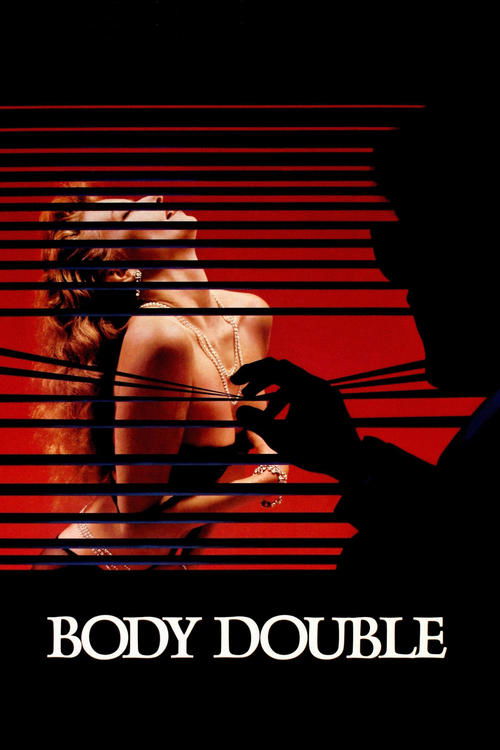
Προβολές για Διχασμένο κορμί, ενημερωμένες κάθε πρωί
Διάλεξε σινεμά και πάρε υπενθύμιση πριν κατέβει.
“I’m the guy who almost fucked you at the beach today“

"I should have known the moment you told me I had a terriffic smile! No real producer would have told me that in a million years!"Recently, Steven Bauer recalled running into Martin Scorsese after the premiere of Scarface in 1983, and remembered him saying: “They’re going to hate this film in Hollywood…because it’s about them.” It's hard not to think about this quote while watching this film as well. Also it's important to remember that De Palma made this as a direct response to criticism of Scarface: Blow Out and Scarface both point into this direction, but on revisiting this, it seems now the clear peak of De Palma's ability as Brechtian ironist, and is so flawless in it's execution and precise in it's concision (the film is almost satire, but it's ideas are so clear-headed that it's maybe something more) that it seems pretty obvious that this is De Palma's finest work. The narrative trajectory is as generic as can be: a young man loses position because of a deep fear, but goes on another personal trajectory, solves a crime and overcomes that same fear in the process. This is the perfect blueprint for De Palma to excise all the things he despises about Hollywood (virtually everything) - namely, this is really a work of film criticism as a film itself, breaking down traditional narrative codes and symbols to show you their more perverse connotations and implications. Two major points here: first - the Hollywood cinema is the intersection of sex and death, and secondly - the linkage between Hollywood cinema and pornography. Wasson can perhaps be deemed to stand in for both the viewer and the traditional Hollywood thriller leading man: there is the question of the voyeur as always, where to watch a woman undressing and being murdered is of no difference, but also Wasson's actions AS leading man. Wasson follows Deborah Shelton to the mall - seeming in his mind to help her. But in the way De Palma positions him - he seems like (and is) a stalker. This first set-piece at the mall is one of De Palma's highest moments: a suspense sequence only if you are identifying with Wasson. But it's self-reflexivity is easy to parse (for what reason does Wasson take Shelton's underwear other than his own perversion?) But also important is the figure of the Indigenous American - the original boogie-man of the first half of American cinema - who we don't need much to tell this is a figure in disguise. But in this sequence we can see that both Wasson and Henry's actions mirror each others: not only is Griffith literally the body double of Sheltons, but Henry is metaphorically the body double of Wassons. "What are you, some kind of method actor?" says a porn producer to Wasson later on in the film. But look at this mis-en-scene, the cigar chomping producer - it's innately more stylized (if not flat out exaggerated) than the rest of the film, as though parody of a studio heads office itself. Whether the office is in Hollywood or in porn, De Palma sees no difference. The second major moment is the "Relax" sequence, where Wasson repeats his "I like to watch" to Griffith, after saying it to Shelton through the telescope. Both methods of voyeurism are identical - the predominant way for the conventional Hollywood film to film a woman is for the males sexual gratification. The "Relax" sequence again amplifies this, continuing the exaggerated quality from the producer's office: an extended set-piece (does porn ever have set-pieces?) with a giant staircase, studio-lights in the camera-eye, women giving back massages by standing on a mans back, and a giant poster board that reads: "SLUTS". De Palma is stating something perverse and horrifying here: that the abuse and exploitation of women is fundamental to the making and sheer existence of Hollywood. In Chris Dumas's Un-american Psycho, he writes that De Palma is the greatest theorist of Hitchcock, because all he does is examine Psycho, Vertigo & Rear Window to display their most negative connotations: Shelton's murder is by a drill that is framed as though phallus. If the film appears to become conventional by the end (and this is how it played for me on first viewing!) it's actually the point to the film: these are the fundamental ideas which drive cheap genre thrills - after Scarface, this is De Palma responding to the studios saying: "OK - here is the movie you want to see." The moments of Wasson reliving his claustrophobia is unbelievably corny, if it was not informed by the sequences beforehand. The last shot: a mans arm, a womans breasts, and blood: this is De Palma's understanding of the kind of vision the figures in power want. Now it seems clear to me as De Palma's highest achievement, one of the most astonishing and important breakdowns of form in the mediums history. Connotations and implications of nearly a century of moving images.

I believe scientists have confirmed that the Frankie Goes to Hollywood scene is the peak of 1980s cinema.
Ένας ηθοποιός που παλεύει για την καριέρα του, μένει σε ένα πολυτελές σπίτι στο Χόλιγουντ, εμμονικά παρακολουθεί μια γυναίκα μέσα από τηλεσκόπιο και γίνεται μάρτυρας της δολοφονίας της.
Το Body Double σκηνοθετήθηκε από τον Brian De Palma το 1984, γνωστό για τα στυλιζαρισμένα θρίλερ και τις αναφορές του στον Χίτσκοκ.
Το Body Double έχει βαθμολογία R στις Ηνωμένες Πολιτείες.
Το Body Double κυκλοφόρησε στη Γερμανία στις 25 Οκτωβρίου 1984.