

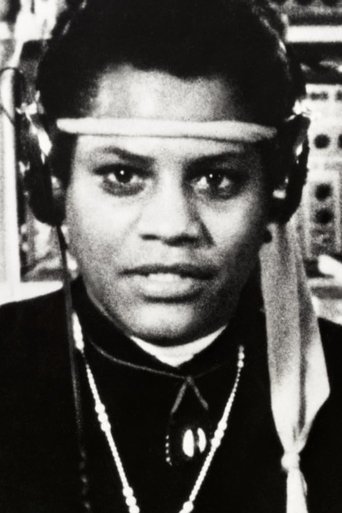



Democratic socialism will not save us.Inspired by Marxist writings on women's issues (Borden is not specific about which ones), this film posits a democratic socialist United States and explores the idea of an incomplete revolution. It's interesting to note that director Lizzie Borden identifies as an anarcha-feminist; aspects of the film feel critical of the state to some extent, but other aspects reflect a Marxist Leninist understanding of the need for fighting chauvinism. A critique of social democracy as being unfit to address sexism, racism, and homophobia makes sense; any political approach which insufficiently addresses imperialism is doomed to uphold all of those and more. In the film, it never addresses this aspect of social democracy, instead taking an approach in keeping with an intersectional point of view, and one that views as insufficient mere welfare-based reforms. It's a call for revolution that centers women, black and indigenous women, and queer women. What's interesting is that it makes room for the idea that it's not merely identity that provides these women their perspectives. Simply being black, queer, indigenous, Chicana, a woman does not bestow insight; they disagree with each other. It suggests that these identities fuel their need for revolution; it does not fuel their abilities. Their abilities, their capabilities, come from study, experience, and training. What's interesting is that it builds a narrative out of fragments and distortions. It shows a flawed, hesitating, broken approach that slowly coalesces through intentional actions. It does not rely on spontaneity. It does not show revolution magically occurring. It does not show revolution as the product of reaction, but of proactive planning. And it shows it as necessary. Fundamental to any critique of social democracy is the attack on the idea of reform over revolution. (Which is why it's odd that a socialist democracy is formed in the U.S. in the film after a revolution, but this is dystopian science fiction, so there's always a few off-the-wall ideas.)The film's criticisms of the state, then, seem both well pointed (when directed at the idea of social democracy) and misguided (when they seem to be directed at the idea of a state in general). Better writers than I have addressed the need for a state post-revolution; the film's critiques are layered into moments that hardly make it the main thrust of the film. Instead, the film attacks chauvinism and examines the power of media. Aspects like the decentralized nature of the Women's Army or anti-state chanting from protestors are subtle endorsements, but they are also contradicted by both the understanding of chauvinism's ongoing role in a social democratic state. Borden says elsewhere that she is attracted to anarchism because it constantly challenges ideas and brings change, and while that may or may not be an aspect of anarchism (depends on the form of anarchism, I suppose), it is absolutely foundational to the scientific socialism of Marxism Leninism--the point is to take a practical perspective on fighting the legacies of patriarchy, capitalism, and white supremacy and address them based on the conditions we exist in. The point is to find ways to fix problems. The film shows a social democracy in stagnation and a call from the people for change; the film shows a budding Marxist Leninist revolution even if the filmmaker did not see it that way.Borden's film is a call to arms. It's a collage of moments, a puzzle of images put together with montage and a certain raw approach. There are moments where the actors perfect the art of speaking over each other, that back-and-forth that overlaps and makes things seem real; there are moments where it feels stiff and practiced. The latter is as important as the former in setting the tone of a collage, of something pieced together. The film pulls together (simulated) news media, radio broadcasts, documentary footage, educational films, and narrative filmmaking into a screed, a lattice of styles that tells the story of rising up, of challenging the status quo. It feeds that feeling by eradicating standards of its form; it experiments and finds a story that expresses a proletarian rage, frustration, and hope in revolutionary imagery. Whether it's communist or not, it serves as a powerful visual critique of misogyny and racism, of half-measures and entitled sentiments, of opportunists and hegemony. Its a call to arms worth listening to.52 project: 116/52