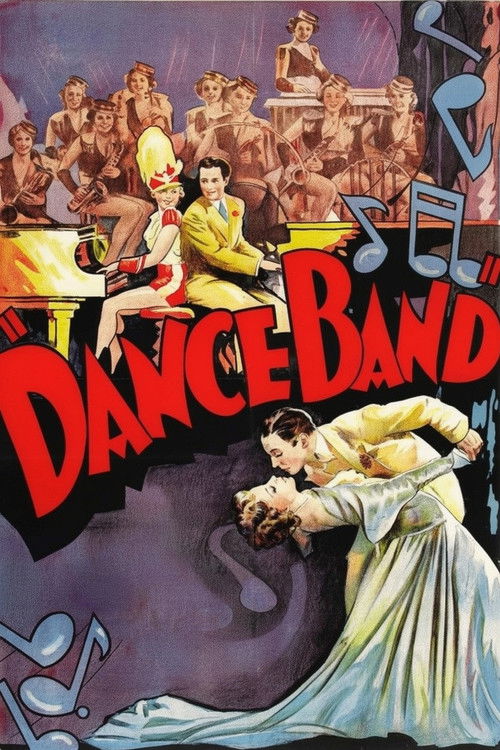
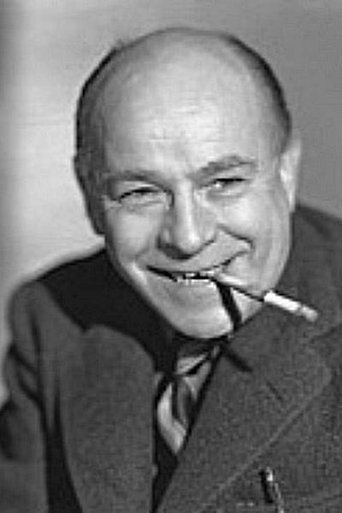
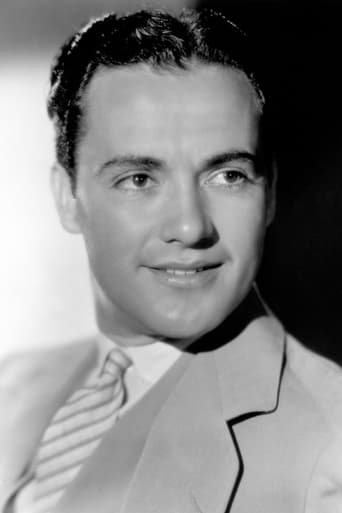
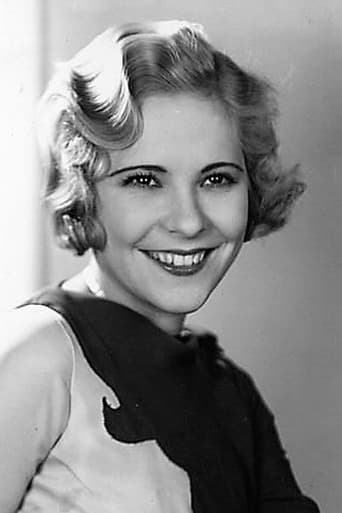
A 30s British musical with a plot that's about as imaginative as its title. American imports Buddy Rogers and June Clyde play rival bandleaders competing in the same competition. Buddy flashes his winning smile at her, June resists his charms, and then ... but gosh, you wouldn't want to spoil it for you, would you? Marcel Varnel's production is stuffed with gorgeous art deco and the numbers are quintessential thirties big band, corralling in rhythms from Mexico, Hungary and the Far East. Rogers, on the downward trajectory from his Hollywood peak, is a dashing lead and Steven Geray is amusing back-up but the makers could've expended just a tad more effort on the script.
Buddy Rogers masterfully plays numerous instruments and his band swings the shit out of some tuneful melodies in this British musical that stepped up when his cinematic stardom had started to dim back home. Paired with a luminous and multi-talented June Clyde, with whom he has bountiful chemistry, he makes a trope-filled plot of dueling bands feel fresh, even if his character's relentless pursuit of a disinterested woman starts to irk. I did notice that his physical charms were not as plentiful as they were only a few years earlier in his films with Nancy Carroll. I don't know if that was natural ageing, too much partying, or what, but it could have contributed to his downfall as a movie idol. Whatever, though, it's interesting to finally understand that the Buddy Rogers Music Store that I used to frequent for sheet music was not named in vain. The man knew his way around musical instruments.• RANKED! — 1935• Size Matters! — My Movie Collection (or, I’ll Show You Mine If You Show Me Yours…)
Dance Band is a fun but unremarkable British musical, with an international flavour. Many British musical and comedy producers of the thirties seemed to feel the need for casting (usually second rate) American stars to support the otherwise decidedly British leads, this isn't the case here, they're not supporting, both of the leads are (second rate) American stars. After this film though leading lady June Clyde did actually settle, and continue to make films, in England. The film stars Charles “Buddy” Rogers a fading American matinee idol, whose one great film, the first best picture Oscar winner, Wings must have seemed a world away by the time he'd reached the level of this movie. In the early thirties well after the glory days of Wings Rogers had started a new career as a dance band leader, fronting a band not due to any real musical talent but on the back of his cinematic fame (Bob Crosby did similar on the back of the notoriety of brother Bing.) Although he continued to make a few more films in America his career quickly all but petered out, and anyway he didn't need to work, after married the erstwhile queen of Hollywood Mary Pickford, who he remained with until her death in 1979. To complete the international, or should I say lack of British, flavour, the big number The Valparaiso was written by American songwriter Mabel (In A Little Spanish Town) Wayne and the film was directed by Frenchman Marcel Varnel. We gave something back to Hollywood. While Buddy's band are on the train the coach is invaded by an allegedly adorable, eight year old gawd-help-us Sybil Jason who sings a cringe-making song to her teddy bear, in a pretty obvious attempt to replicate the success of Shirley Temple. As it turned out she must have been fairly successful as Warners signed her up and she appeared with Al Jolson in The (and as the) Singing Kid. To end her film career she actually appeared with Temple (well down the cast list) in The Little Princess and The Blue Bird. Most notable amongst the (British) supporting players is Richard Hearne as the acrobatic, scene stealing, drunk. Hearne would find some fame in fifties as early children's TV favourite Mr. Pastry. The film, if you like British dance band music of the thirties, is pretty enjoyable, some of the comedy doesn't work and the plot is pretty non-existent, but the music makes up for it.