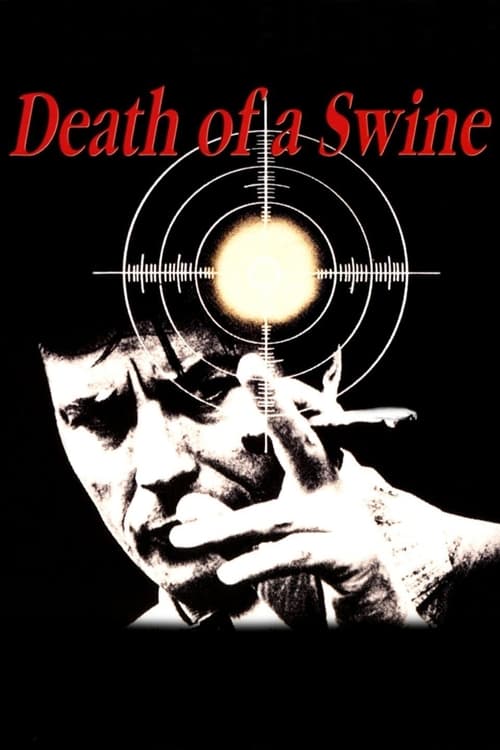
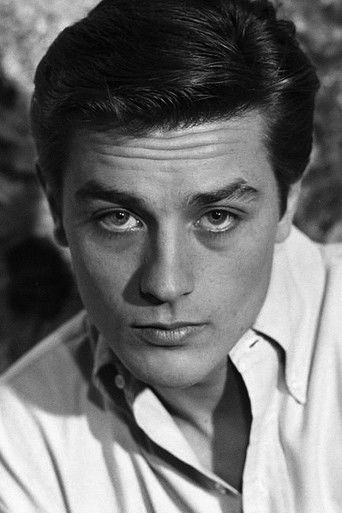
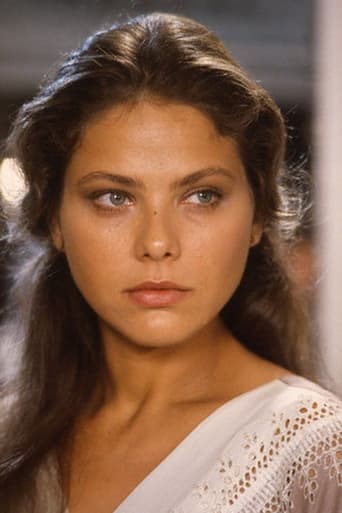
Watched a 35mm screening of this slightly reddish-tinted Euro Crime, a politically charged French film, at BUTplugged in Breda—democratically chosen from a selection by Ryan.Political thrillers usually aren't my cup of tea—especially when the story leans heavily on exposition and dialogue, with few action-packed set pieces. Sure, there's enough intrigue, betrayal, and twists to keep you engaged, and the occasional assassination or chase sequence adds a layer of suspense to its heavy whodunit elements. But for the most part, it's Alain Delon trying to gain the upper hand by carefully playing his cards in a battle of wit and power, as he seeks to uncover the murderer of his dear friend.The McGuffin of choice: a stack of documents—described in the odd Dutch translation as "de cahier"—in which prominent political figures are implicated in various bribes and embezzlements. Everyone, including their grandmother, is after it. It's definitely a strong premise for building an intriguing thriller.At 120 minutes, though, it’s a long film, with many dialogue-heavy scenes that could’ve been trimmed for tighter pacing. When people are run off the road, or—at one point—a semi-truck filled with cars dumps its entire load on the vehicle behind it, or when characters are gunned down in drive-by shootings, the film clearly ups its game. But for me, it was a wave of rising tension followed by long stretches of exposition, repeating until the end.I loved Jean Bouise’s portrayal of a Hercule Poirot-style detective—always a step ahead, poking holes in alibis, making suspects nervous with dry humor, and never losing his temper. Alain Delon is charismatic in the lead, delivering a few witty lines in what seemed like well-written dialogue (as far as we could tell through the lazy subtitles). Italian actress Ornella Muti is stunning, and Klaus Kinski appears in a small role that never quite lets him go unhinged.At one point, the film almost veers into giallo territory, with killer POV shots and black gloves. A victim screams in terror upon recognizing the killer, but strangely doesn’t react to her own pleas for mercy. She's thrown out of a window (off-screen) and lands on a car below—a moment that, as I learned from Kloki one half of the Cinemaatjes, is staged to resemble the real-life suicide of Evelyn McHale, who jumped from the Empire State Building. It’s this kind of detail that shows director Georges Lautner is a thoughtful and skilled filmmaker.There’s quite a bit of messaging in the film about the futility of exposing political corruption—how, in the end, nothing really changes. The final line, "Paris goes back to sleep," is telling. Watching this in 2025, it still rings true: nothing ever really changes.Definitely not a bad film, and I’m glad I saw it. But it’s a one-off for me—I definitely felt its length. It fits the 70s mood and serves as a neat time capsule, emphasized by its saxophone-heavy jazz score. But as a procedural mystery, it felt like an extended episode of a German Krimi.Still, judging by the enthusiastic reactions from others leaving the theater, your mileage may vary. Watch it for yourself!Next month's BUTplugged, on August 6th, will feature a 16mm screening of the original "Gone in 60 Seconds (1974)" as voted from the selection of Parachutist.
A man knocks on Xavier's door in the middle of the night. It is his friend, Philippe. A terrible accident has occurred. Philippe has just put a bullet through the head of a nasty corrupt asshole when the man threatened to expose Philippes own unfortunate dabblings in illicit mutual favours. Oops! Dont you hate it when that happens? After Philippe also winds up dead the next morning, Xavier ends up on a quest through a maze of conspiracy to find the minotaur responsible for his friends untimely end.In the mean time, Xavier has scooped up a diary that Philippe stole from the man he murdered. It is essentially a ledger of every dirty transaction that every politician, businessman and lobbyist piece of scum has benefited from. If these details are made public, a lot of very self-important people will be ruined. He is hoping to use it as leverage to find out who killed his friend but in the mean time, every dirty rat and his dog in the city is trying to bully Xavier into revealing the location of the diary in an effort to save the skin on their arses.I haven't seen much in the way of the 1970s Eurocrime thriller genre before. Perhaps this is a mighty fine example of what it has to offer because this was certainly Euro-cool. Alain Delon + mod decor + Stan Getz saxophone makes for one slick production. At the same time as being mesmerized by Delon's performance as Xavier, with his effortless charisma, assured confidence, slightly aloof demeanor and piercing eyes, I was also drinking up every element of the mise-en-scene with an intoxicated relish.When Xavier connects with Philippe's improbably smoking hot mistress, Valérie, I once again fell under the spell of a character, this time portrayed by an actress I have not encountered before, Ornella Muti. The moment she appeared on the screen I was struck by her stunning beauty. With flawless exotic skin, full round cheeks and searching cerulean eyes, she certainly has a striking presence that would stop most men in their tracks. Unfortunately, she is a little child-like and vulnerable, reducing her pretty face to a handy plot device to further motivate Xavier's behaviour.Despite their being a fair bit of expository dialogue to explain each next twist in the plot, it still manages to move along at a rapid pace despite its two hour running time. It is also interspersed with a few short and sharp car chase sequences, which are always welcome. There are enough twists and turns to keep things interesting but they are well grounded and don't come across as random events to try and keep things interesting. Some of the supporting characters are instrumental in this sense. Speaking of supporting characters, there is a police inspector with an obese moustache, spectacles and a large nose that looks like a refugee from a Guess Who tile. And does Klaus Kinski look like a creepy child molesting vampire in every film he is in?As the film progresses, a conspiracy of epic proportions unfolds. Despite its myriad of complexities it somehow manages to maintain a coherent thread without collapsing into a convoluted quagmire of non-sensical rubbish. This helps provide a platform for a bit of commentary on the evils of corruption, the selfishness and greed of the elite and the weaknesses inherent in democracy and capitalism. After all, at the end of the day, there is no single king that creates the maze or the monster at the centre of it. Instead, it is a amorphous collective of a certain type of person that is more than willing to hide behind our legitimate social structures and use their inherent flaws to leech off the masses.With the leak of the Panama Papers to the media a few years ago, which exposed millions of potentially shady transactions held and routed through offshore financial institutions, the relevance of this film today feels even greater. As the Panama Papers revealed, there is no one crooked mastermind and sometimes there is nothing actually illegal going on. But there is a relatively small subset of people who are able to use their existing wealth, knowledge and connections to grow that wealth exponentially compared to the rest of us. And with that growing disparity in wealth comes a dangerous imbalance of power. The question is what can we do about it? What are we willing to do about it? Two years later, how many people even remember the term Panama Papers let alone what it was about? A few rich people get a slap on the wrist, a few politicians are sacrificed, but otherwise the circus continues behind a slightly modified facade like "an old hooker who gets a butt-lift".In the end, this film captures the personal story of one man's dissilusionment as he descends into the snake pit, while trying to single-mindedly honour his friend. Xavier goes from being a clean shaven pretty boy at the beginning of this film to a dishevelled looking dude in a green M-65 jacket by the end as the extent of corruption reveals itself and weighs him down with disgust. If only he shaved his head into a low profile mohawk he could be the French cousin of Travis Bickle. Whatever the case, this film is a thrilling ride with a message. Definitely worth checking out.
In 1977, Delon’s career was already in a transitional phase between good crime thrillers and a period of repetition and increasingly poor films, where either the director lacked a vision, or Delon was a co-producer and his contribution was evident – his acting remained up to standard, but the ideas were incredibly repetitive – an ageing cop, a woman on the side, being framed for some crime. The Death of a Corrupt Man is probably one of those last good films, which has also been recommended to me many times as it combines a good script with the classic themes of the 1970s and, I suppose, Delon’s favourite ensemble of actors, with whom he has always worked so well on screen over the years. I’m not just talking about his beautiful co-star Mireille Darc, but above all about Maurice Ronet; these two gentlemen appeared together in their biggest hits (with the exception of Ronet, who didn’t star in any of Melville’s films), whilst they navigated both salty and fresh waters together, befriending and murdering one another on screen, and even sharing women. In director Lutner’s film, they met on set for the last time; Ronet died about five years later, which is perhaps why it holds a special place for me. My only regret is that they shared so little screen time given the film’s length, but this is understandable given the movie plot itself.The entire scenario is based on a novell by Raf Vallet; the film tackles the themes of corruption and the cynical abuse of power within police and political circles – a subject that has been explored many times, but is handled well here. I must admit I’m not a fan of complex thrillers, especially political ones; if I do read them, it’s usually in the form of a book I get lost in at night rather than a film. This is because when watching films, I’m usually on the treadmill and at some point lose my bearings and get lost in the complicated plot. Here, the plot and the grime of corruption have layers like an onion; yet, for some reason, I got drawn in – perhaps it was the aforementioned cast and their compelling performances, or the 1970s atmosphere that I love, or maybe the brilliant jazz soundtrack by Philippe Sarde that kept my mind from wandering away from the film. I won’t go into the plot twist and spoil the whole film for you; I’ll simply recommend it if you’ve got a quiet evening to spare and are looking for something along the lines of *Murder on the Orient Express*, but set against a backdrop of corruption. And if the brilliant French cast isn’t enough for you, I’ll add that this is the film where, near the end, alongside Delon in an M65-style jacket, the legendary Nosferatu, Klaus Kinski, appears wearing a massive tartan tie – I don’t know if anything could be cooler than that.