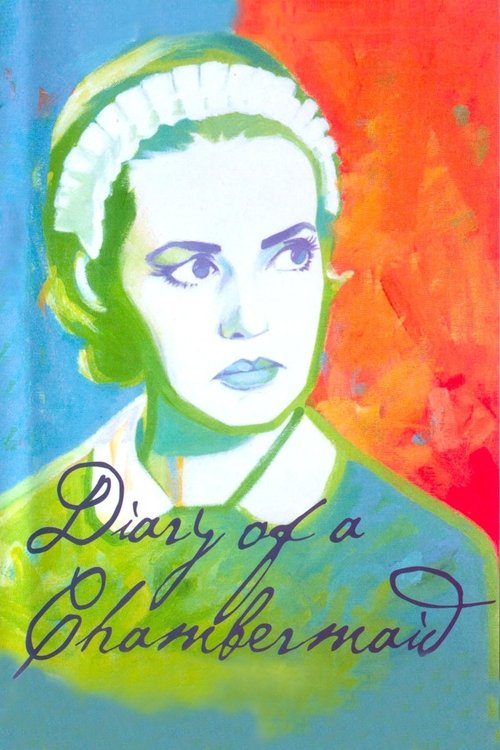
Μια καμαριέρα πηγαίνει να δουλέψει σε μια αστική οικογένεια στην επαρχιακή Γαλλία του 1930 και γνωρίζει όλα τα βίτσια των αφεντικών της, αλλά και του υπηρετικού προσωπικού.
RESEÑA EN ESPAÑOL AQUIACTION! - LUIS BUNUEL: BETWEEN SOCIAL REALISM AND SURREALISMBuñuel follows up one of his landmark films with a French tale told through two parallel threads: one an absurd comedy, the other a murder mystery, with the two occasionally intertwining—mostly to effective results.For the most part, the story is engaging enough, even if it never quite reaches the level of fascination of some of his stronger work. As expected in a Buñuel film centered on the bourgeoisie, many of the characters are portrayed as ridiculous, morally bankrupt, or outright perverted. That approach actually works in the film’s favor, making the mystery more entertaining. While Buñuel more or less signals who the culprit might be early on, the film cleverly spreads the sense of guilt across the entire cast, suggesting that culpability isn’t limited to a single individual.Jeanne Moreau stands out as the chambermaid, delivering a performance that balances sex appeal with restraint, a contrast that plays nicely against the film’s often dry and ironic tone.All in all, this is a relatively “conventional” Buñuel film, but still a solid and worthwhile watch, anchored by a strong script and dependable performances.ACTION! - LUIS BUNUEL: BETWEEN SOCIAL REALISM AND SURREALISMTODAY SCHEDULEThe Exterminating AngelDiary of a ChambermaidSimon of the Desert
Richard Chandler4.0
"No matter how sturdy a man is he doesn't need twice a week."In the politically turbulent interwar '30s, modish Parisian beauty Celestine (Jeanne Moreau) relocates to the French countryside to work as a chambermaid for a provincial family. The various people she discovers in and around the household form a microcosmic rogues' gallery of moral turpitude. The least threatening member of the clan is the paterfamilias Monsieur Rabour (Jean Ozenne), a doddering foot-fetishist. His shiftless heir Monsieur Monteil (Michel Piccoli) contents himself with compulsive skirt-chasing and hunting to compensate for the frigidity of Madame Monteil (Françoise Lugagne)—who has much stronger feelings about the cost of replacement bulbs than she does about sex, which she avoids by reporting chronic vaginal pain. As unpleasant as Celestine's employers may be, their odiousness pales in comparison to her virulently pro-fascist fellow servant Joseph (Georges Géret). When old man Rabour kicks the bucket getting his rocks off to Celestine's footwear, she sensibly decides to make tracks for Paris but ultimately chooses to stay in an effort to prove Joseph's guilt when an angelic little girl is raped and murdered in an area he is known to frequent daily. Celestine's determination to coax a confession out of Joseph brings the pair so close that they nearly marry, at least until she gives up the game by planting evidence to have him arrested. Joseph is eventually released for lack of evidence with the implication being that he has been spared by his nativist political views, though the diegesis gives every indication that he is likely guilty of the heinous crimes in question. A somewhat dejected Celestine anticlimactically agrees to marry her portly war-hero neighbor Captain Mauger (Daniel Ivernal), who is composed of a similarly authoritarian bent but proves more biddable than Joseph. A chilling coda sees Joseph realize his lifelong dream (with an anonymous non-Celestine wife) of managing a cafe that caters to fellow xenophobes.I haven't seen the earlier 1946 Jean Renoir adaptation of Octave Mirbeau's 1900 novel of same name, but a quick Wikipedia plot summary informs me that it has very little to do with Luis Buñuel's 1964 Diary of a Chambermaid (Le journal dune femme de chambre). The film was the first of five collaborations with eminent screenwriter Jean-Claude Carrière, but like most of Buñuel's films, it functions primarily as an excoriating broadside against bourgeois propriety. Since this was my first viewing, I'll take my turn as the millionth observer to note that Diary of a Chambermaid is remarkably straightforward by Buñuelian standards—the only bit of trademark surreality I recall is a throwaway scene in which Rabour shoots at a butterfly with a rifle. The other component that really stands out to me relative to Buñuel's earlier output is the abandonment of pictorial rudimentariness in favor of highly dynamic, striking deep-focus cinematography from Roger Fellous. It's hard to cozy up to a film this cold, but it's pretty easy to admire it. Some stray notes:-THE COUNTRYSIDE ALWAYS LOOKS GRIM-THE SERVANTS SHE DOESN'T FIRE, HE GETS THEM PREGNANT-THEY'RE BETTER IF THEY SUFFER, AND I ENJOY IT!-LET ME SEE THOSE TINY BOOTS MOVE!-SHE'S TOO POOR FOR 'EM TO FIND HER KILLER
ScreeningNotes4.0
Catching Up with Buñuel"France for the French"Nationalists are a bunch of criminals, racists, pedophiles, rapists, and murderers. Hey, don't look at me! It's all Buñuel! That's just what the movie's about!Hard to call the way the aristocracy treats its servants "micro"-aggressions when the old man basically wants to masturbate at you while you walk around in his old-ass leather boots.God, I love how unapologetically dogmatic this movie is. Joseph is hilarious:Marianne: "Why do you talk about killing Jews?"Joseph: "Aren't you a patriot?"Patriotism involves killing Jews, apparently. Not much has changed in 50 years. And again:Célestine: "I think you're a crook."Joseph: "A crook, me? Are you serious? Look around! I love the army! Religion! Law and order! My country, above all!"Joseph, you raped and murdered a child, get off your fuckin high horse you worthless pile of red flags. If you're the best L'Œuvre Française has to offer then it's no wonder the movement died.Jeanne Moreau putting these bourgeois pricks in their place gives me life. It seems like this one is considered one of Buñuel's more minor films, but I really loved it.Luis Buñuel | France | Italy | Criterion Channel
More like this
Συχνές ερωτήσεις
What is Diary of a Chambermaid about?+
A Parisian chambermaid moves to a provincial estate to serve a wealthy family, only to find herself embroiled in the dark secrets and twisted moral failings of her employers and the staff during the rise of fascism.
Who directed Diary of a Chambermaid?+
It was directed by Luis Buñuel, the Spanish-Mexican filmmaker known for his surrealist masterpieces and sharp social critiques, and released in 1964.
Has Diary of a Chambermaid won any awards?+
While it did not win a major festival prize at Cannes, it remains a celebrated work in Buñuel's filmography and a cornerstone of classic French cinema.