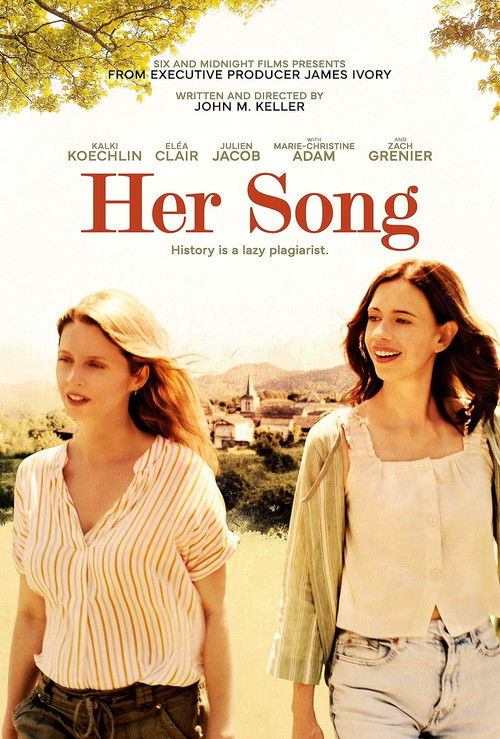
"Her Song" makes a valiant effort in trying to be a unique story. The idea of tying WW2 to the Coronavirus epidemic is certainly something that has not been explored yet. But the parallels come up short for many of the connections. In addition it does have some quirky energy which also inhibits it from reaching a more emotional level at some crucial points. The scenery was pleasant.
John M. Keller's "Her Song" evokes a simpler era, when everything seemed much more peaceful and manageable. It operates in a peculiar zone of indie dramas from a decade ago by maintaining a sense of coziness through its characters and the setting. You can basically call it a film about people walking and talking in a quaint French village, given its minimalist and conversational style. That's why it feels almost like a crossover between Nicole Holofcener's work and Olivier Assayas's low-key dramas like "Summer Hours." There's a similar emphasis on conversations related to love, desire, and motherhood, parsed through the lens of its female characters.What we get is a breezy ride through a writer's anxieties that becomes a mode to explore its more delicate themes of perseverance and survival. Set in the early 2020s, the film follows a New York-based Franco-American writer, Olivia (Kalki Koechlin), who moves to a French village while working on her new novel. That's when she tries to learn more about her grandmother, hoping to write that story in her words.Her grandmother had survived the Nazi occupation during the Second World War, an era that feels strikingly different than their present lives in this bucolic setting. Now, everything feels carefully designed (or maintained) to put them at ease. So, the only reason for their frustration might be a church bell that refuses to stop ringing every hour. Nothing more, at least nothing out of the ordinary.That's where Olivia meets Madeline (Eléa Clair), who seems to be one of the few young people who stay in that village. A multi-skilled artisan, she can do everything from fixing cars and refurbishing old items to crafting her own art. Part of her is drawn to habits against the tide of her time. She barter food when needed and doesn't like supermarkets. Yet, that investment in older ways isn't tainted by regression. It reflects her self-sufficient nature and agency, a theme central to Keller's film. In its first few moments, Madeline recalls a folk tale in which a woman seeks couplehood after realizing 'her song.'Continue Reading this on High on Films