Klaus Kinski vs. 5,000 annoyed hippies.What could possibly go wrong?Full review: klaus.kinski.us/jesus-christus-erloser-2008/
Σκηνοθεσία Peter Geyer
Jesus Christ Saviour
Σκληρό, ρεαλιστικό ντοκιμαντέρ
Το νokιμαντέρ καταγράφει μια επεισοδιακή θεατρική παράσταση του 1971, όπου ο εκρηκτικός ηθοποιός προσπαθεί να δώσει έναν επικό μονόλογο για τη ζωή του Χριστού, ενώ βρίσκεται αντιμέτωπος με ένα εχθρικό και προκλητικό κοινό.
Η «Ιησούς Χριστός Σωτήρ» παίζεται σε 1 σινεμά στο Βερολίνο - επόμενη προβολή Κυριακή 18 Οκτωβρίου στις 13:00 στο Hackesche Höfe Kino.
Επόμενες προβολές: Κυριακή 18 Οκτωβρίου.
Πλήρες πρόγραμμα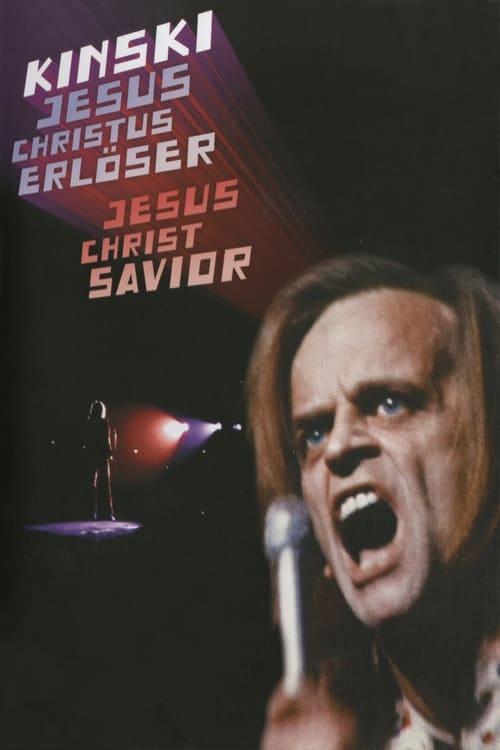
Προβολές για Ιησούς Χριστός Σωτήρ, ενημερωμένες κάθε πρωί
Διάλεξε σινεμά και πάρε υπενθύμιση πριν κατέβει.
Klaus Kinski vs. 5,000 annoyed hippies.What could possibly go wrong?Full review: klaus.kinski.us/jesus-christus-erloser-2008/

Peter Geyer put together every imaginable snippet of Klaus Kinski's legendary performance on November 20, 1971 in the Deutschlandhalle, creating a completely independent, unique experience. Because Kinski does not - as we know it - fill a television screen with an appearance on a talk show or a narrative construct in one of his many film roles, but he completely occupies a cinema hall for 75 minutes. Full concentration on Kinski. He has to start his lines over and over again because he gets interrupted. It seems a little sensationalistic when one revels in the conflict between Klaus Kinski's cholerics and German ignorance, but there is always that strange moment when one is drawn back into the Deutschlandhalle on November 20, 1971. A spectacle. "One man in the middle of the darkness". You almost want to shout or applaud. A real "movie".Geyer assembled countless images - Kinski himself had commissioned 7 (!) cameras to film his performance, the image material was of such high quality (and expensive; Kinski paid out of his own pocket) that it is still excellent to work with today - so important especially the image-sound coherence. The act of production took several years, and so Geyer is considered somewhat sarcastically as a "Kinski known by heart". Even when you were there, you really couldn't help but get the impression that the good man had become a very restless, excited person because of the Sisyphean task. When a spectator in the audience remarks that he can imagine why people reacted so furiously to Kinski at the time, Geyer asks him to come forward with the words: "Now come over here and explain to me why!" This was by no means ironic and referential to the film - in the middle of which there was this legendary 1:1 sequence between Kinski and an angry viewer - but came from deep within Geyer.

"Komm, halt deine Schnauze, damit du hörst, was ich jetzt sage!"Eine Parabel dessen, dass die unmittelbare Zeit nach der 68er-Bewegung von verwilderter und wirrer Politisierung sowie die Ablehnung jeglicher Autoritäten lebte, die die Disziplin für das Erhören einer aus linker Sicht gerade sehr fruchtvollen Rede verweigerte, junge Leute zum Ergötzen ihrer selbst provozierten, um die Stimme eines gestandenen Schauspielers, der aufgrund seiner exzentrischen und teils manisch-menschenverletzenden Art, in der er alles Erdenkliche tat nicht geliebt zu werden, immer wieder, ohne ihn zu erhören, niederschmetternd abzuweisen, wodurch auch sein Bedürfnis, in Zeiten des Vietnamkriegs, trotz seiner berüchtigten Reputation, eine überraschend friedliche Botschaft, entlehnt aus dem Neuen Testament über die Identität und das Leben Jesu mit seinen Mitmenschen, zu säen, verworfen wird, die genau das widerspiegelt, was die damals junge Generation wollte. Progressivität im Staate Deutschlands, 1971.Amen.
Καταγράφει μια χαοτική θεατρική παράσταση του 1971 στο Βερολίνο, όπου ο ασταθής ηθοποιός επιχειρεί να δώσει έναν παθιασμένο μονόλογο για τη ζωή του Χριστού, συγκρουόμενος με ένα εχθρικό και αποδοκιμαστικό κοινό.
Ο Peter Geyer σκηνοθέτησε αυτό το ντοκιμαντέρ του 2008, συγκεντρώνοντας χαμένα επί χρόνια πλάνα από εκείνο το διαβόητο θεατρικό γεγονός.
Πλήρες πρόγραμμα στο Mood.