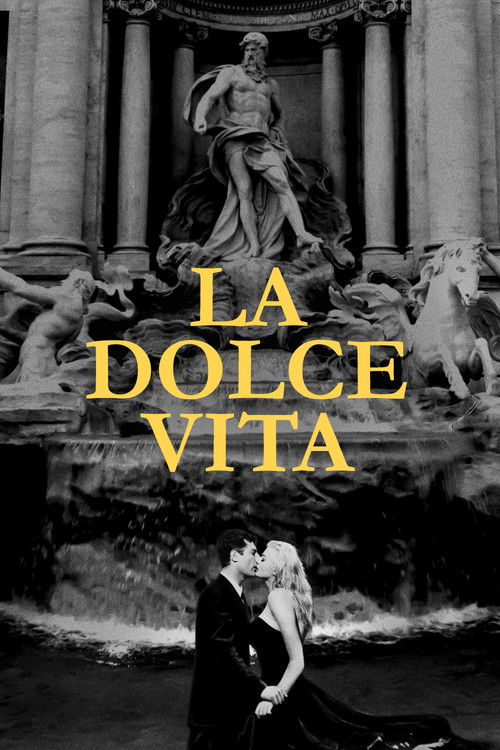
Περιπλανώμενος σε έναν προνομιακό θύλακο της Ρώμης, ο Μαρτσέλο, δημοσιογράφος του κουτσομπολιού, συναντάει κομψές αριστοκράτισσες, πεινασμένους καλλιτέχνες, χυδαίους νεόπλουτους, γόησσες και "ταχυδακτυλουργούς" της κοσμικής νύχτας. Ανακαλύπτει ότι κάτω από την επιδερμίδα της απατηλής χάρης τους, ελλοχεύουν κενότητα, απόγνωση και μοναξιά, όλα όσα οδηγούν έναν αδιάλλακτο στοχαστή φίλο του σε τραγικό τέλος.
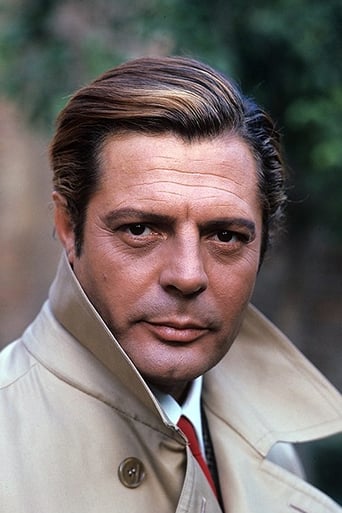
Slight spoilers in the last paragraph.Our modern malaise is all-encompassing self-pity. I went through it last year: what was the point of wanting things if you were never going to get them anyway? In the throes of my self-absorbed sorrow, I didn’t notice that I had no ambition to begin with. Finding something to care about got me out of that horrible dark place, but every day, I come across more people my age – kids who haven’t even hit twenty yet – diagnosed with depression, although nothing monumental has happened to them, to us. Why are you so unhappy? I don’t know.Watching La Dolce Vita was like coming across yet another one of those depressed kids, or thinking about my own life a year ago – it fills me with both pity and anger, because it's only in retrospect that you can see that life is ugly only if you allow yourself to grow indifferent. And our protagonist Marcello has been indifferent for a very long time. Marcello hasn't got any ambition, but he thinks he does. He’s a journalist with vague literary aspirations. Several times he’s asked how his book is coming along, and he always waves away the question, somewhat irritated to be reminded of his higher aspirations. He grows increasingly disgusted with the people he’s surrounded by, but it’s not like he’s very different from any of them. Everyone is impeccably dressed, everyone is drinking and laughing and talking, and nobody is happy.Marcello has a girlfriend, Emma, who proclaims that Marcello has the most important thing in the world – love – but her clinging, suffocating form of dependence is the farthest thing from love. It’s helpless selfishness, though evidently it used to be something different back when Marcello himself was different. He probably used to be one of those wide-eyed writers with bad haircuts, burning with ambition and the desire to prove himself. He’s quite different now – suave, handsome, perfect hair – and he isn’t exactly insecure, but he’s hungry for something else now, something he can’t define. None of us can define it. If we could, we probably wouldn’t be this way.But why are we like this? We chase after famous people, we make idols out of vapid celebrities, and always, always apologize for things that aren’t our fault. We want to accept everybody, to make everyone feel welcome, and in the process, we lose sight of ourselves. The world of La Dolce Vita is one of extreme decadence, which we don’t often come across ourselves, but we all engage in empty intellectualism and shallow talk and casual approaches to relationships. Marcello’s world glitters a lot more than ours does, that’s all.La Dolce Vita is episodic in nature, a string of loosely connected vignettes that build upon the inner emptiness and alienation of Marcello's world, though some of the moments that make up these vignettes are often funny and unexpectedly touching. Mostly, though, they get increasingly bleak. And the final portion of La Dolce Vita, the one in which Marcello Mastroianni sits on the beach in front of the enormous carcass of a shark, is full of deep-seated disgust. Over the course of the last week, Marcello has kept company with people from every walk of life: with a celebrity and her posse; with Steiner, a married man with a beautiful home who keeps company with the brightest intellectuals; with Paparazzo and the hyenas; with his father; with the old rich; and finally, with people like himself: selfish, shallow wannabes who have no idea what they want out of life. It’s no wonder that Marcello finally goes a little crazy; he doesn’t like anybody he keeps company with. But far before all that happens, it was already obvious that nothing makes Marcello happy.When you don’t know what you want, life becomes frighteningly empty. All of La Dolce Vita consists of Marcello coming slowly to terms with the aimlessness of his existence. But when he waves goodbye to the young girl at the beach, he doesn’t leave the party; he trails after them until one of the partygoers comes and takes his hand. He’s not going to extricate himself from this life anytime soon. He knows that his life and his future are horribly uncertain, but right now he’d rather just forget about it all and continue to pretend that he’s better than the people he keeps company with. And we understand. Oh, how we understand.
Darren Carver-Balsiger5.0
Jesus flies above a Rome that is elegant but decadent. There is no strict character development in La Dolce Vita, just a slither of a story about a hedonistic reporter getting lost amidst an amoral landscape. The film embraces the shallowest of lifestyles to reveal the emptiness of it all. Fellini's Italy is an enchanting place where the nights are alive, but everything in La Dolce Vita is fake. News and reality is all constructed, as characters seek new adventures in a city deemed tranquil and bland. La Dolce Vita contains so many characters, essentially it is cavalcade of the people who wander through a certain social class. These people are disconnected from the world. Their lives are shallow and everything is fleeting. The mundane is to be violently avoided, though perhaps quietly accepted. This is a stinging look at post-war Italy, with modern Italy, a land of aeroplanes, paparazzi, and record players, shown as a bloated corpse without value. Cynicism runs this world, but it takes imagination to enjoy it. La Dolce Vita is a magical movie, one which transports you to a glamorous world, while repulsing you with its inhumane void. It's an orgy of civilised rot, providing pleasure even as you know it's unclean.Palme d'Or Winners RankedMy Top Films of the 1960s
ScreeningNotes5.0
"Don't be like me. Salvation doesn't lie within four walls. I'm too serious to be a dilettante and too much a dabbler to be a professional. Even the most miserable life is better than a sheltered existence in an organized society where everything is calculated and perfected."It's always intimidating to try and write about something considered to be one of the best films ever made. Regardless of how great it might be, sometimes it can be hard to have fun without a personal access point. It's like staring at the Mona Lisa: sure it's a nice painting and it's easy to appreciate on that level, but what does it have to say about my own subjective reality?So it was with some trepidation that, having found a sufficiently long time slot, I finally got around to watching Fellini's masterpiece, La Dolce Vita. And I was pleased to discover not the inert historical mile marker I feared but something that spoke directly to me. You see, this isn't just one of the most influential films to ever come out of Italy, it also explores the same themes as my one of all-time favorite works of American literary fiction.La Dolce Vita is The Great Gatsby.Not in a reductive way, of course — none of the characters are quite the same, and the plot is entirely different — but rather in the sense that they both explore the lonely and unfulfilling nature of a certain kind of superficial success. Where Gatsby explored the emptiness of the American Dream, La Dolce Vita shows us how "the good life" in Italy might not be so good after all. If you thought Baz Luhrmann's Gatsby was a gaudy monstrosity, then La Dolce Vita may just be the adaptation you've been waiting for.Marcello spends most of his time attending parties that could have been thrown by Jay Gatsby. Everybody's drunk on expensive champagne and talking a lot about nothing important. Everybody's sleeping with everybody else. Everybody's doing something or someone and none of it means anything, and we can feel the weight(lessness) of this existential emptiness on Marcello's mind. Over the course of the film, he puts increasing amounts of distance between himself and the moral and intellectual vacuum of high society. He tries to make real connections with people like his father and his endless series of girlfriends, but the closer he gets the more he realizes that everyone he knows is just as vapid as he is.The film shows us this not only through the story and Mastroianni's performance but also visually through the way it frames its images. Early on when Marcello is still enamored with the sweet life, the film focuses on its artificial, constructed nature, opening scenes on shots of cameras and stage lights. His life is manufactured, unnatural — and for now that's okay, that's the way he likes it. But as Marcello begins to grasp at his vanishing ties to humanity, this element of the film falls out and we get more focus on natural social situations. He finally talks to his estranged father. He argues with his girlfriend about the nature of love. He tries to rediscover himself and connect with something real.La Dolce Vita may be intimidating because of its privileged position in film history, but it is by no means a difficult or inaccessible film. It plays on classic themes everyone can relate to in some respect, and Mastroianni's effortless performance makes it a thoroughly enjoyable experience. I could watch him do anything for three hours; it just so happens that what he does here is truly unforgettable.Decades Project: 2/6 of the 60's
More like this
Συχνές ερωτήσεις
What is La Dolce Vita about?+
A gossip columnist drifts through the superficial and hedonistic social life of Rome while searching for a deeper sense of personal meaning.
Who directed La Dolce Vita?+
Federico Fellini directed this 1960 film, a foundational work of Italian cinema that explores the emptiness of fame and glamour.
Has La Dolce Vita won any awards?+
The film won the Palme d'Or at the 1960 Cannes Film Festival and an Academy Award for Best Costume Design.