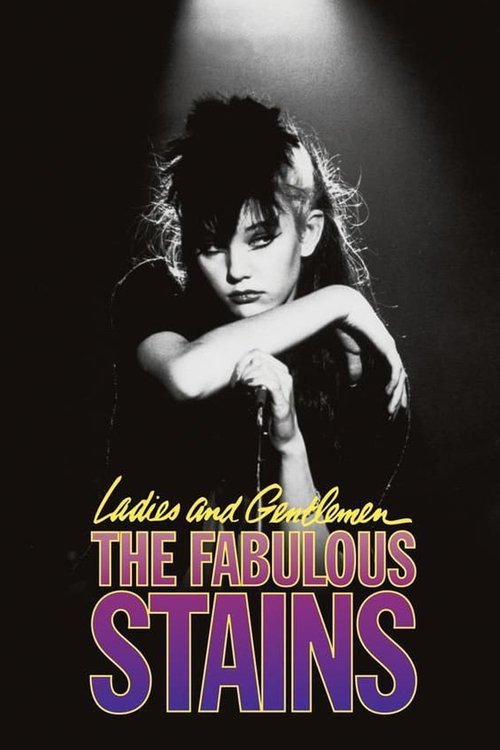
The moment of the movie, for me, is the girl at the Stains' first (disastrous) performance who looks up at Corinne Burns with a mixture of awe, wonder, and worship as Corinne unleashes her anger and contempt. This is the power and appeal of punk rock. The girl sees in Corinne her own anger, her own feelings, and her own desire to be heard and to not be contained within what people deem appropriate. The Stains' image or more specifically Corinne's image is, in that moment, genuine, vital, unvarnished, unpracticed (other than three long rehearsals), and completely sincere. Whether Corinne maintains that sincerity in the face of petty feuding and sexist rock promoters trying to take advantage of a young girl is the thrust of the plot, but it makes a great point about the many varied forces arrayed against girls who don't fit the tiny boxes in which we are supposed to live and the lengths people will go to in order to destroy that vitality.
“Ladies and Gentlemen, the Fabulous Stains” might not be the most revolutionary of band films, but it is one of the best ever made about the most essential aspect of revolution there is:The revolution of self-creation. Specifically, that of three teen girls from a dying mining town, as played by Diane Lane, Laura Dern, and Marin Kanter. As actual and self-declared orphans of the patriarchy, the trio create a punk group that inspires the ‘anarchy’ of power and personal determinism in their young women fans. “Stains” creation makes it both a work of strident rebellion, but also of eerie portending for what was to come for women in the music industry. The aggressive individuality heralded in the movie’s plot no doubt came from “Stains’” screenwriter; Nancy Dowd, who previously penned the foul-mouthed Paul Newman sports classic “Slap Shot.” The graceful unwillingness to compromise for any man made Lane’s lead singer of Corinne Burns a childhood icon for riot grrls of the 90s including Bratmobile’s Allison Wolfe, and the members of Bikini Kill. Then…there was the film’s director, legendary music producer Lou Adler - notably, of Carol King’s “Tapestry.” Adler’s insistence that “Stains” have a happy ending; bequeathed on its heroines by a male figure (Adler himself), so disgusted Dowd, that she removed her name from the movie’s credits. It’s a pull-pull of creation manifested by rejection of ownership that would later play out in the trajectory of girl power groups like “Spice Girls.” But, it’s unfair to drag “Stains” through the necessity of being historically significant. It’s just here to shred the guitar and scream with all the earned anger of teenage girldom. Its screams are so loud - they echoed all the way to actress-musician Kate Nash (lately of GLOW); who, growing up, dyed her hair in Corinne’s distinct ‘skunk’ style. As someone who, as a teenager, more than once brought a picture of Rachel Leigh Cook from “Josie and the Pussycats” to her own exasperated hairdresser…We are still living in the young girl’s world of The Stains. Sweaty Dudes Cinema: Teaching teen girls everywhere that there is mighty power in their sweat (and tears)
Corinne Burns: You are so jealous of me. I'm everything you ever wanted to be.Billy: A cunt?Corinne Burns: Exactly.Not a very even film (and featuring way too many close-up shots of underaged girls' underpant-clad crotches to be comfortable), but a film to love nonetheless. While I think Times Square has more soul and captures confused teenagedom better, Diane Lane is iconic in this film. The Fabulous Stains' lack of soul probably comes from its anger and divided message. Now, it's nothing new that the Stains are formed to escape their small town, out of anger at their surroundings. Diane Lane as Corinne Burns has some fantastic lines about the disillusionment she feels as a teenage girl, but she's almost too angry to be creative. She's angry at her town, angry about not being taken seriously, angry about being made an accessory. Corinne's transformation with her two-tone hair is a miraculous moment and deserves to be a cinematic icon - it establishes her sense of agency, originality, ownership. She refuses to take life lying down. It's a powerful moment, but sadly the only truly original moment the Stains offer as a band. Their songs are terrible, and I don't know if it's the feeling of anger, or badly-acted anger, that brings the film down - all I know is that the scene where the Skunkettes flip off the Looters on stage is a lot less powerful than the chant in Times Square to "go for it."I think you can argue that it's a positive film for teenage girls, but there's a very cynical viewpoint, represented by the media presence in the film. IMDb's synopsis says it all: "the media and disaffected teens mistake the acerbic rants of an obnoxious teenage punk rocker as a rallying cry for the women of America, launching her and her talentless group to national stardom." While the Stains don't possess much talent, I think this cynicism that's so heavily present in the film is its downfall. Although Billy (Ray Winstone being absolutely ridiculous and over the top) has a point about the Skunkettes being adverts for the band, it's overly cynical for the film's/the Stains' demographic, and ignores the fact that being part of a group like that, looking the part, is incredibly important when you're that age. You can argue about who keeps your money after buying band-merchandise-hair dye, but that experience of dyeing your hair is a powerful moment as you become who you want to be for the first time. Considering there had been so very few films about girl rock groups, about teenage girls' sense of self, this negative viewpoint is just a big downer. In a very small, 1-minute scene, Christine Lahti gives a very poignant insight into growing up as a small-town girl, saying her parents never figured she'd amount to much, and therefore she didn't think her daughter would either. It's the film's confusion about whether or not to take teenage girls seriously that brings it down. PS: Paul Simonon should have gotten more screen time, he was so gorgeous back then.